
Let’s be honest starting an export or import business feels like navigating a maze. You have a great product, a buyer waiting on the other side of the world, and then you hit the wall of government paperwork.
The first wall you will hit? The Import Export Code (IEC).
Most people think of the import export code as just another registration certificate to hang on the wall. It’s not. It is the passport for your business. Without it, your goods stop at the border, your foreign payments get stuck in bank, and your business essentially doesn’t exist in the eyes of customs.
But here is where it gets tricky. The rules aren’t the same for everyone. A freelancer selling software needs to treat the IEC differently than a manufacturer shipping textiles.
In this guide, we are going to skip the textbook definitions and look at how the DGFT IEC code or DGFT license actually works in the real world, how to get one without getting rejected, and what to do when things go wrong.
Table of Contents
What is an Import Export Code (IEC)?
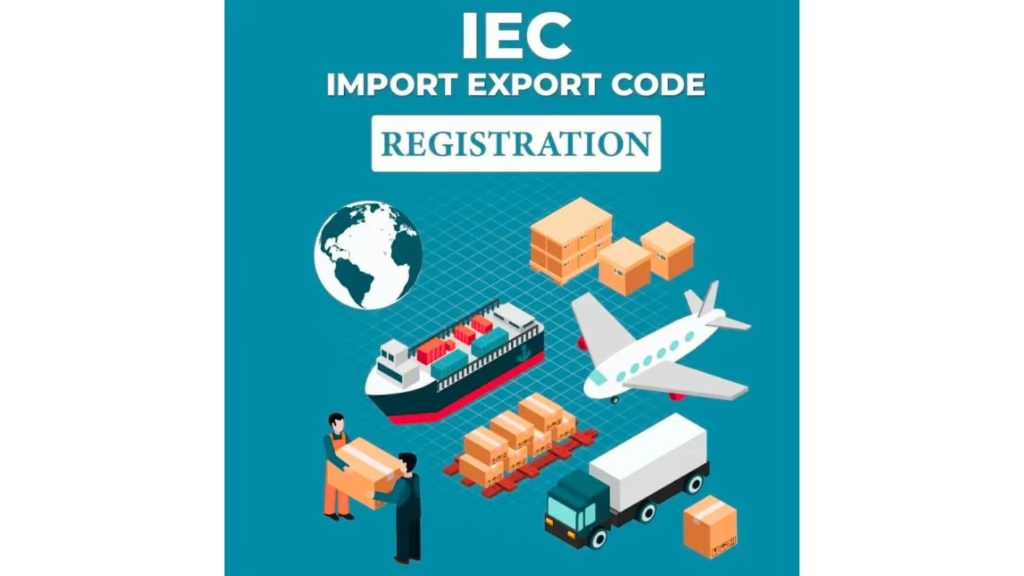
An Import Export Code is a unique 10-digit identification number issued by the Directorate General of Foreign Trade (DGFT), which falls under the Ministry of Commerce.
Think of it like a PAN card, but specifically for international trade. In fact, for most businesses today, the IEC number is actually the same as the firm’s PAN number but it must be separately registered on the DGFT portal to be active.
Why IEC is essential?
If you are moving goods across Indian borders, customs authorities need to know who you are. If you are receiving money from abroad (or sending it out), banks need to report it to the RBI. The IEC connects these dots. It tracks foreign trade and ensures national security and financial compliance.
What happens if you don’t have Import Export Code?
- Importers: You cannot clear your goods from the port. You will pay heavy demurrage (storage) charges while you scramble to get the license.
- Exporters: You cannot ship your products. Even if you manage to ship via courier, you cannot claim government benefits or tax refunds.
- Service Providers: Your bank may refuse to credit foreign currency into your account.
Why IEC Applications Get Rejected or Suspended (With Fixes)
You might think applying is as simple as filling out a form. Usually, it is. But when it fails, it feels hard. Here are two common scenarios where applications get stuck or approved but become useless later.
Scenario 1: The Name Mismatch Nightmare
The Problem: Your PAN card says Example “Shiva Kumar Sharma,” but your bank account is registered under “Shiva K. Sharma.” You apply for the IEC using the PAN name.
The Impact: The DGFT system might approve your import export license registration, but when you try to link it to your bank for foreign remittances, the bank’s system rejects it because the names don’t match exactly 100%.
The Fix: Before you apply for import export code, ensure your PAN name and Bank Account name are identical. If they aren’t, fix the bank records first.
Scenario 2: Address Proof Discrepancies
The Problem: You are operating from a rented apartment. You upload a rent agreement, but it’s expired, or the electricity bill is in the landlord’s name without a No Objection Certificate (NOC).
The Impact: Your application sits pending. You keep checking the DGFT login page hoping for a “Success” message, but it stays pending or gets rejected.
The Fix: Always provide an address proof that is current and in the name of the applicant. If using a rented space, a valid NOC from the owner is non negotiable.
IEC, GST, and PAN: What Actually Breaks If You Skip One
Many new entrepreneurs ask, “I have a PAN and GST, do I really need an IEC?” Or “I have an IEC, do I need GST?”
These three documents form a trio. If one is missing or mismatched, specific parts of your business break.
1. IEC exists, but GST is missing
The Impact: Your export invoice might be accepted by the foreign buyer, but your GST refund request will be rejected by the Indian government.
Why: To claim a refund on the taxes you paid to make your product (Input Tax Credit), your export data must flow from the Customs system (Icegate) to the GST system. Without a GST number linked to your IEC, this data bridge is broken. You lose money that legally belongs to you.
2. GST exists, but IEC is missing
The Impact: Your shipment is stopped at the customs gate.
Why: GST is a domestic tax registration. It has no authority at the border. Customs officers do not care about your GST number if you don’t have an IEC. You cannot file a Shipping Bill (for exports) or a Bill of Entry (for imports) without it.
IEC Requirements Based on Your Business Type
One size does not fit all. The requirements change based on your legal structure and what you are selling.
Sole Proprietor Exporting Services
- Scenario: You are a graphic designer with clients in the US.
- Requirement: You need an IEC to receive payments smoothly into your bank account.
- GST: You might not need GST if your turnover is below 20 lakhs (check current limits), but having an IEC is still crucial for the bank.
Private Limited Company Importing Goods
- Scenario: You are importing electronic components to assemble in Pune.
- Requirement: You need the full package: IEC + GST + Authorized Dealer (AD) Code letter from your bank.
- Why: You are sending money out of India. The RBI monitors this strictly to prevent money laundering. Without an IEC and an AD Code registered at the port of import, your bank cannot process the outward remittance to your supplier.
Do Service Exporters Really Need IEC?
This is the most debated topic in online forums. If you are selling software or consulting, you aren’t physically moving anything across a border. So, do you need a license?

The Freelancer Receiving USD via SWIFT
Situation: You did a project for $5,000. The client wires the money to your HDFC or SBI account.
Reality: The bank will likely put the funds on hold and ask you for a “Purpose Code” and your IEC.
Reason: Banks are required to report all foreign inflows to the government. While you can sometimes get by with just a purpose code for small amounts, having an IEC makes you a verified exporter.
It allows you to get an e FIRC (Foreign Inward Remittance Certificate), which is your only proof that the money was export income (which is not taxable under GST) rather than domestic income.
The SaaS Company Using Stripe/PayPal
Situation: You sell a subscription tool. Users pay via credit card on Stripe. Stripe settles the money in INR to your Indian bank.
Reality: You generally do not need an IEC to receive the money because the payment aggregator handles the foreign exchange. However, if you ever need to send money back (refunds) or if you cross a certain turnover threshold, getting an IEC is safer to prove your status as a niryat (exporter) bandhu.
How IEC Affects Foreign Payments and Bank Credits
You have done the work, but the money isn’t in your account. Often, the IEC is the invisible blocker.
The “Suspense” Account Problem
When foreign currency hits an Indian bank, it doesn’t go straight to your savings or current account. It goes into a “Nostro” or suspense account. The bank then looks for your details.
If your IEC is not linked to your customer ID in the bank’s system, the relationship manager has to manually verify you. This can delay your payment by 2-5 days. If you link your IEC, the process can often be automated.
The Missing FIRC
If you don’t have an IEC, banks may classify your incoming money as “Consultancy Charges” rather than “Export Proceeds.”
Why this hurts: When the taxman knocks, “Consultancy Charges” might look like domestic income liable for GST. “Export Proceeds” are zero rated (tax free regarding GST). You need the IEC to ensure the bank categorizes the money correctly so you get the right certificate.
How to Apply for an IEC (Step by Step)
Applying for an IEC is fully online. You do not need to visit a DGFC (a common typo for DGFT) office.
Step 1: Visit the DGFT Website
Go to the official DGFT portal. Look for the DGFT login page. If you are new, you will need to register as an “Importer/Exporter.”
Step 2: Prepare Your Documents
You don’t need much, but it must be accurate:
- PAN Card: Of the individual or company.
- Bank Proof: A cancelled cheque or a bank certificate. The name here must match the PAN exactly.
- Address Proof: Electricity bill, rent agreement, or sale deed.
- Digital Signature (DSC): Required for companies; proprietors can often use Aadhaar validation.
Step 3: Fill the Application (ANF 2A)
Log in and select “Apply for Import Export Code”. Fill in the details. It is a straightforward form.
Step 4: Pay the Fee
The iec code fees are currently ₹500. You can pay this online via credit card, debit card, or net banking.
Step 5: IEC Download and Print
Once approved (which is automated and often happens instantly or within a few hours), you can generate your certificate. Use the iec download or iec print options on the dashboard. You will receive an e IEC. The government no longer issues physical paper certificates.
What You Must Do After Getting IEC
Congratulations, you have the code. But you aren’t done.
The Annual Update Trap
This is where most businesses fail. According to recent rules, you must update your IEC details on the DGFT login iec portal every year between April and June.
- “But nothing changed in my business!” It doesn’t matter. You still have to log in and click a button to confirm that details are the same.
- The Penalty: If you don’t do this, your IEC will be deactivated. You will find out the hard way when your next shipment gets stuck at the port. Reactivating it is a struggle you don’t want.
Updating Address Changes
If you move your office, you must update the IEC immediately. If customs officials send a notice to your old address and it returns undelivered, they can suspend your license for being “non existent” at the registered address.
IEC for Amazon, Etsy, and Global Marketplaces
E commerce has changed the game, but the rules for IEC remain strict regarding physical goods.

Amazon Global Selling
If you plan to use Amazon FBA (Fulfillment by Amazon) to store goods in US warehouses, you are exporting bulk stock from India.
Verdict: IEC is mandatory before your first shipment leaves. Amazon will not let you generate shipping labels without it.
Etsy and Digital Products
If you sell digital planners or art prints on Etsy:
Verdict: You don’t need an IEC to list the items. However, refer back to the “Foreign Payments” section—you might need it eventually to manage your banking and tax proofs correctly.
Common IEC Myths That Cost Exporters Money
Myth 1: “My IEC expired.”
Reality: An IEC is valid for the lifetime of the entity. It does not expire. However, as mentioned above, it does get deactivated if you fail the annual April June update. It’s a subtle but expensive difference.
Myth 2: “I need a different IEC for each product.”
Reality: No. You have one IEC for your business entity. Whether you export leather shoes today and import computer chips tomorrow, you use the same 10-digit code. You do, however, need to update your RCMC (Registration Cum Membership Certificate) with different export councils, but the IEC remains the one constant.
Myth 3: “I can use my friend’s IEC.”
Reality: Absolutely not. This is illegal. The IEC is linked to a PAN. Using someone else’s IEC means they are legally responsible for your shipment and they will be liable for the taxes and any illegal items found in it. Never share your IEC.
Conclusion
The Import Export Code or import export licence is more than just a regulatory barrier it is the foundation of your international business identity. While the import export license process has become much easier with the online system, the maintenance of that license is where the real work lies.
Remember the golden rules:
- Match your PAN and Bank details perfectly.
- Update your IEC every year between April and June.
- Link your IEC to your GST and Bank Account.
Get these right, and your goods (and money) will move freely. Get them wrong, and you will be spending your time fighting with bureaucracy instead of growing your business.
FAQs
Q1. Why did my bank ask for an IEC after the payment already arrived?
A: The bank is holding your money in a suspense account. They cannot release foreign currency into your INR account without reporting the purpose to the RBI. The IEC is the standard identifier for this reporting.
Q2. Can I view my IEC details online if I lost the certificate?
A: Yes. You can use the view iec feature on the DGFT portal. You will need to log in with your credentials. You can also use the iec code check on various third party sites, but the DGFT portal is the only official source.
Q3. Is IEC required for PayPal or Wise transfers?
A: Technically, PayPal and Wise act as intermediaries. While they might not ask for the IEC to create an account, the Indian bank where the money eventually lands might ask for it to process the FIRC (Foreign Inward Remittance Certificate).
Q4. Can I apply for an IEC if I don’t have a current account?
A: Yes, you can apply using a savings account if you are a sole proprietor. However, for companies and partnerships, a current account in the name of the firm is usually required to match the PAN details.
Q5. How do I check if my IEC is active?
A: Go to the DGFT website and use the “Verify IEC” tool. Input your PAN or IEC number. If the status shows “Deactivated,” you need to log in and perform the annual update immediately.
About the Author
Hi, I’m Sriharsha, founder of shxhub.in.
I focus on explaining import export business topics in a practical, beginner friendly way, based on how exports actually work on the real ground especially documentation, quality control, and buyer expectations.

27 thoughts on “Import Export Code (IEC): 9 Critical Rules For Every Beginner”