
When One Missing Stamp Stops a Container Cold
A container sits at a port in Rotterdam. The goods inside are fine. The invoice matches. The packing list is clean. But customs won’t release it, because one document is missing a signature the certificate of origin. Now the importer is paying storage fees by the day, the buyer is calling twice a morning, and nobody on the exporter’s side can explain why a single piece of paper is holding up a shipment worth six figures.
This happens more often than most exporters expect, and it’s almost always avoidable. A certificate of origin isn’t a formality tacked onto the end of a shipping checklist it’s the document customs authorities rely on to decide how much duty a shipment owes, whether it qualifies for a trade agreement discount, and whether it’s even allowed to cross the border at all.
Get it right, and it’s invisible. Get it wrong, and it can freeze a shipment for weeks.
This guide walks through what a certificate of origin actually is, the different types you’ll run into, how to get one issued without delays, the mistakes that cause hold ups like the one above, and a real trade agreement example showing how it all plays out in practice.
Table of Contents
What Is a Certificate of Origin, Really?
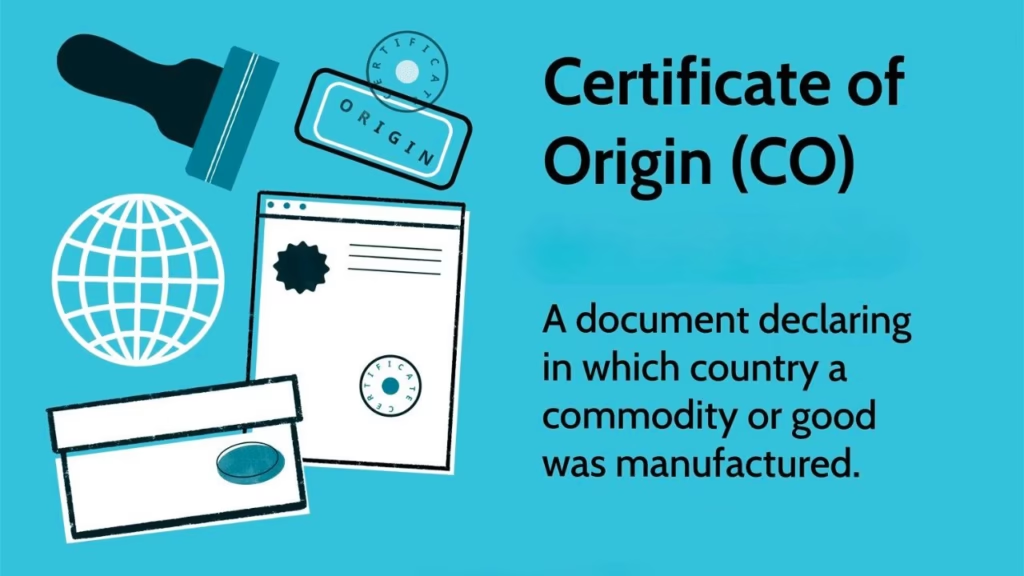
Most explanations stop at “a document that shows where your goods were made.” That’s technically true, but it skips the part that actually matters, origin is a legal determination with real money attached to it, not a geographic footnote.
Customs authorities don’t ask where something was made out of curiosity they ask because the answer changes the tariff, changes whether a trade agreement applies, and changes whether the shipment is even permitted in.
Here’s where it gets less intuitive origin isn’t the same as “where it was shipped from,” and it isn’t always where it was assembled either. Take a jacket that’s cut from fabric in Bangladesh, sewn together in Vietnam, and shipped to the EU from a Vietnamese port. It’s tempting to call this “Made in Vietnam” simply because that’s the last stop before export.
But customs doesn’t work off the shipping label it works off rules of origin, which ask where the substantial transformation happened. If the cutting and sewing in Vietnam count as a substantial transformation under the applicable rule (often measured by a shift in the product’s HS classification or a minimum percentage of value added there), then Vietnam is the legal country of origin regardless of where the raw fabric came from.
Change one variable say, the fabric was already cut into a finished shape before it left Bangladesh, and Vietnam only stitched panels together and the origin determination could flip entirely, because the “substantial” work happened earlier in the chain.
This is the part a certificate of origin is actually certifying. It’s not a statement of geography. It’s a formal claim, backed by an authorized body, that a specific legal test has been met and that claim is what customs uses to decide what the importer owes and whether preferential treatment applies.
Why It Exists — The Four Jobs One Document Does
It’s easy to assume a certificate of origin is just box checking. In reality, customs authorities are asking it to do four distinct jobs at once and most of the confusion around this document comes from not realizing all four are happening simultaneously.
Job one: setting the tariff. Duty rates aren’t universal they vary by where goods come from. A steel import from one country might carry a 5% duty, the identical product from another country might carry 25%. Without a verified origin, customs has no basis for picking a rate, so the default is usually the least favorable one.
Job two: unlocking trade agreement discounts. Free trade agreements exist precisely to lower or eliminate duties between member countries but only for goods that actually qualify as “originating” under that agreement’s rules. A certificate of origin is the proof that unlocks the discount. No certificate, no preferential rate, even if the goods would have technically qualified.
Job three: enforcing trade defense measures. Anti-dumping duties, safeguard tariffs, quotas, and trade bans are all origin specific. A country might restrict imports of a product from one supplier nation while allowing the same product freely from another. Customs needs to know precisely where goods came from to apply or correctly not apply these measures.
Job four: feeding trade statistics and policy. Every certified origin claim becomes a data point governments use to track trade flows, negotiate future agreements, and monitor whether existing ones are being used as intended.
One document, four jobs tariff, eligibility, enforcement, and data all resting on the same signature and stamp. That’s why a missing or invalid certificate doesn’t just cause a paperwork headache, it removes the one artifact customs relies on to make four separate decisions at once.
How “Origin” Is Actually Decided (Rules of Origin, Demystified)
Rules of origin sound abstract until you realize they boil down to answering one question: how much of this product’s story happened in the country claiming it? There are two ways customs answers that.
Wholly obtained
Goods are the easy case nothing about their origin is up for debate because nothing was imported into the process at all:
- A copper ore extracted and processed entirely within one country (mined)
- Wheat grown, harvested, and milled in a single country (farmed)
- Cattle born, raised, and slaughtered in one country (born/raised)
In each case, there’s no second country to argue about. Origin is simply where the thing came into existence.
Substantial transformation
It is where things get genuinely tricky, because it applies to products assembled from parts sourced in multiple countries which describes most manufactured goods today. Customs uses two common tests here, and they don’t always agree with each other:
- HS code tariff shift: if the finished product falls under a different Harmonized System classification than the imported parts that went into it, that shift signals a “substantial” change occurred in the country doing the assembly.
- Value-added threshold: a minimum percentage of the product’s total value must have been added in the claimed country of origin commonly somewhere in the 30–50% range, depending on the agreement.
Here’s a worked example. Say a bicycle is assembled in Country C using a frame from Country A (valued at $40), gears from Country B (valued at $25), and final assembly plus a $55 markup added in Country C. Total value: $120. Value added in Country C: $55, or roughly 46% of the total likely enough to clear a 40% value-added threshold and qualify Country C as the origin.
Drop that final assembly value to $20 instead of $55, though, and Country C’s share falls to about 17% nowhere near the threshold, meaning the bicycle would likely have to claim origin from wherever the frame or gears contributed the most value instead.
This is exactly where exporters get caught out. It’s tempting to assume “we assembled it here, so it’s ours” but assembly alone doesn’t guarantee substantial transformation. If the value added math doesn’t clear the threshold, or the HS code doesn’t actually shift, the claimed origin can be challenged, the preferential rate denied, and the shipment reassessed at full duty after the fact.
Types of Certificate of Origin
Ask most guides to explain the types of certificate of origin and you’ll get two words “preferential” and “non-preferential” followed by a one line definition of each. That’s the surface. The real distinction is what each one is trying to prove, and getting that wrong is one of the more common reasons exporters submit the wrong form entirely.
Non-preferential certificate of origin
This is the default, general purpose version. It exists to answer a simple factual question where were these goods made without claiming any tariff benefit. It’s used for standard trade where no free trade agreement is in play, and its main jobs are supporting customs statistics, applying normal (non-discounted) duty rates, and enforcing trade defense measures like quotas or anti-dumping tariffs.
Example scenario: a furniture exporter in Vietnam ships office chairs to a buyer in a country with no active trade agreement with Vietnam. The importer still needs to prove origin partly because the destination country tracks import statistics by source country, and partly because certain furniture categories are subject to anti-dumping checks.
A non-preferential CO satisfies that requirement. No tariff discount is being claimed, the document simply confirms fact of origin.
Preferential certificate of origin
This version exists for one purpose, to unlock a lower or zero duty rate under a specific free trade agreement or preferential scheme. It’s not enough for the goods to have been made in a member country they have to meet that agreement’s specific rules of origin (the wholly obtained or substantial-transformation tests covered earlier), and the certificate is the formal proof that they do.
Example: a Canadian auto parts manufacturer exporting to the United States under CUSMA/USMCA (United States-Mexico-Canada Agreement) needs a preferential certificate of origin showing the parts meet the agreement’s origin criteria. Without it, the shipment still crosses the border but at the standard duty rate, not the CUSMA preferential one. The certificate is the only thing standing between “full tariff” and “reduced or zero tariff.”
Regional and scheme specific certificates — where it gets more specific
Beyond the general preferential/non-preferential split, several regions and programs have their own dedicated CO formats, each with its own paperwork quirks:
- GSP (Generalized System of Preferences) Certificate — used by developing country exporters shipping to countries that grant them reduced duty access unilaterally, without a full reciprocal trade agreement.
- ASEAN Form D / Form E — Form D applies to trade within ASEAN under the ASEAN Trade in Goods Agreement. Form E applies specifically to ASEAN–China trade. They look similar but are not interchangeable submitting Form D for a China-bound shipment will get it rejected.
- SAFTA Certificate of Origin — used for South Asian Free Trade Area trade among SAARC member countries, with its own value content threshold rules.
- EUR.1 Movement Certificate — used for EU trade agreements with partner countries outside the bloc, verifying originating status for preferential access into or out of the EU.
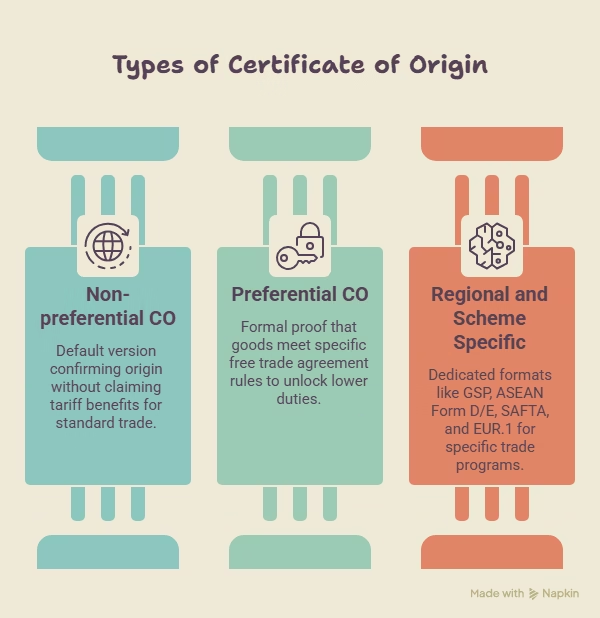
The pattern across all of them: the underlying logic (prove origin, claim a discount) stays the same, but the form, issuing body, and documentation differ by agreement. Using the wrong scheme specific form is a common, entirely preventable cause of shipment delays.
| Non-Preferential CO | Preferential CO | |
| Purpose | Confirms country of origin for general trade, statistics, trade defense | Proves eligibility for a tariff discount under a specific FTA/scheme |
| Tariff effect | No duty reduction Standard rate applies | Reduced or zero duty, if rules of origin are met |
| Proof required | Basic evidence of manufacture/production in the claimed country | Detailed proof against that agreement’s specific rules of origin (value added %, HS shift, etc.) |
Who Issues It and Who’s Involved
A certificate of origin isn’t self certified in most cases it goes through an authorized third party, and knowing who that is (and isn’t) prevents a lot of wasted applications.
In most countries, chambers of commerce are the primary issuing bodies for non-preferential certificates of origin. Exporters register with their local or national chamber, submit the required documentation, and receive certification once the chamber verifies the claim.
In India specifically, this role is shared between recognized chambers of commerce and export promotion councils, which handle certification for specific industry sectors (textiles, engineering goods, pharmaceuticals, and so on) so the right issuing body often depends on what’s being exported, not just where the exporter is based.
For preferential certificates tied to a specific trade agreement, government trade departments or designated customs authorities are typically the certifying body instead, since they’re the ones responsible for enforcing that agreement’s rules.
Here’s the distinction that trips people up the exporter declares, the authority certifies. The exporter is the one asserting under their own responsibility that the goods meet the origin criteria, based on their production records, supplier documentation, and cost breakdown.
The chamber, trade department, or export council doesn’t independently investigate the factory floor each time, it reviews the exporter’s submission against the relevant rules and, if satisfied, applies its official stamp or signature. That stamp is what converts a private claim into a document customs will accept but the underlying accuracy of the claim is still the exporter’s responsibility, which is exactly why false or careless declarations can come back on the exporter later, even after certification.
What’s Actually On the Document
Look at any certificate of origin format or sample and it can seem like a dense grid of boxes. But every field on it exists to answer a specific question customs will ask walk through it that way and the layout stops feeling arbitrary.
Exporter’s name and address — This identifies who’s making the origin claim and who’s legally responsible for its accuracy. If the claim turns out to be false, this is the party customs comes back to.
Consignee/importer’s name and address — Confirms who the goods are legally destined for. This matters because origin claims and preferential treatment are often tied to a specific transaction, not a generic shipment customs is verifying that this particular buyer, in this particular country, is entitled to whatever tariff treatment is being claimed.
Description of goods — A plain language description of what’s actually in the shipment. This exists so a customs officer can sanity check it against the physical goods and the commercial invoice, a vague or mismatched description is one of the fastest ways to trigger a manual inspection.
HS code — This is arguably the most consequential field on the form. The Harmonized System code is what customs uses to match the product to its correct tariff rate and to check whether a “substantial transformation” tariff shift actually occurred, as covered earlier. Get the HS code wrong, and everything downstream duty calculation, FTA eligibility gets checked against the wrong category.
Quantity, weight, and packaging details — These let customs cross verify the shipment against the packing list and transport documents. Mismatches here are a common, avoidable red flag.
Country of origin — The actual claim the entire document exists to support the specific country where the goods were wholly obtained or substantially transformed.
Transport details (mode of shipment) — Confirms the logistics route matches what’s declared elsewhere in the shipping paperwork, helping customs rule out origin laundering through a third country.
Exporter’s declaration — A signed statement, under the exporter’s own responsibility, that the information provided is accurate. This is the “exporter declares” half of the process described earlier.
Certification stamp/signature — The chamber of commerce, trade department, or export council’s official mark, converting the exporter’s private declaration into a document customs will legally accept. Without this, the form is just a filled out template not a valid certificate.
When You Actually Need One (and When You Don’t)
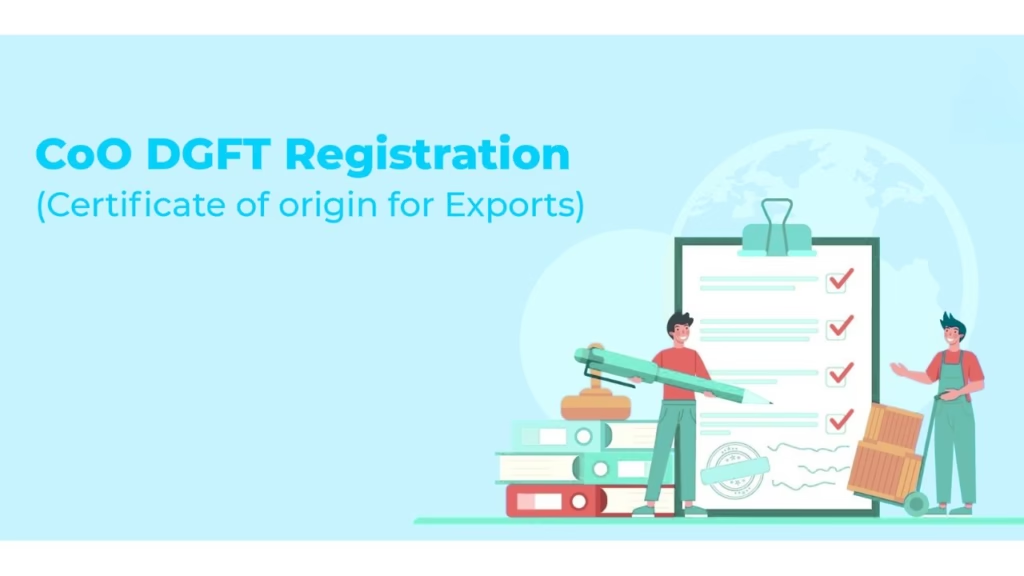
The honest answer to “is a certificate of origin mandatory for export” is, it depends on where you’re shipping and what you’re claiming not a blanket yes or no.
You need one when:
- The destination country’s customs regulations explicitly require it for import clearance, regardless of any trade agreement.
- You want to claim a discounted or zero tariff under a free trade agreement, and need to prove the goods meet that agreement’s rules of origin.
- The importing country needs to verify the goods aren’t coming from a banned, sanctioned, or restricted origin common with products under embargo or quota controls.
It’s often skipped when:
- The shipment is low value, falling under a threshold where the destination country waives formal origin documentation.
- There’s no special origin requirement between the two countries involved no FTA claim, no restricted origin concern, and the destination doesn’t mandate it by default.
Quick self check before assuming you need one:
- Does my buyer’s country require a CO for this product category?
- Am I trying to claim a reduced duty under any trade agreement?
- Is this product or origin subject to any restriction, quota, or anti dumping measure?
If the answer to any of these is yes, get the certificate. If all three are no, it’s worth confirming with your customs broker or the importer directly rather than assuming the requirement is set by the destination country’s rules, not a global standard.
Step by Step: How to Get a Certificate of Origin
The exact portal and forms differ by country, but the underlying process for how to get a certificate of origin follows the same four stages almost everywhere.
Step 1: Register with the issuing authority
Before an exporter can request a certificate for any specific shipment, they typically need to be registered with the relevant issuing body a chamber of commerce, export promotion council, or government trade department, depending on the country and product category.
This registration usually involves providing background information about the business like company details, the factories or facilities used, and the general categories of goods produced. This step exists so the issuing authority has a baseline understanding of the exporter before it starts certifying individual shipments it’s not something done fresh for every export.
Step 2: Prepare the documentation
Once registered, the actual application for a specific shipment requires supporting paperwork that proves the origin claim. This is the stage most delays trace back to, because incomplete or inconsistent documents get sent back for correction. A typical documents required for certificate of origin looks like:
- Commercial invoice
- Packing list
- Production or manufacturing records (showing where processing/assembly occurred)
- Bill of materials or supplier invoices for imported components, if claiming substantial transformation
- Completed CO application form for the relevant scheme (non-preferential, or the specific FTA form if claiming preference)
Step 3: Review and certification
The issuing authority checks the application and supporting documents against the applicable rules of origin wholly obtained, HS tariff shift, or value added threshold, depending on the claim being made. If everything checks out, the authority applies its official stamp or signature, which is what makes the document legally valid for customs purposes.
If something doesn’t match say, the declared HS code doesn’t align with the goods description this is typically where the application gets sent back for correction, rather than at the border later.
Step 4: E-CO / digital issuance — the part most guides skip
Increasingly, this entire process happens online rather than over a physical counter, and it’s worth understanding in its own right because it changes both the speed and the paper trail. Many chambers and trade departments now run e-Certificate of Origin (e-CO) portals where exporters submit shipment and product data digitally, upload supporting documents as scanned files, and receive a digitally signed or digitally verifiable certificate sometimes within hours instead of days.
A few things are genuinely different with e-CO versus the paper process the certificate often carries a QR code or unique reference number that the destination customs authority can verify online in real time, reducing disputes over authenticity. Some countries have also linked their e-CO systems directly to trade agreement partners, meaning the importing country’s customs can pull up the certificate electronically rather than relying on the importer to physically present it.
For exporters, this also means fewer lost document situations and faster reissuance if a certificate needs correcting a paper certificate that’s damaged or misplaced in transit used to mean starting the certification process over a digital one can typically be reprinted or re-verified from the portal directly.
The trade off is that e-CO systems are still not universal some countries and product categories still require the traditional stamped paper version, particularly for certain scheme specific certificates like EUR.1. It’s worth confirming with the issuing authority whether e-CO is accepted for the specific trade lane and agreement in question before assuming it’s available.
Certificate of Origin in Customs Clearance — What Happens on the Ground
Once a shipment arrives, the certificate of origin doesn’t just get filed it gets actively cross checked. Customs officers compare the CO’s details against the commercial invoice and transport documents does the goods description match, does the HS code align with what’s declared for duty purposes, do the quantities and weights line up, does the consignee match the actual importer of record. Any inconsistency here is treated as a flag, not a formality.
The consequences of a mismatch scale with how serious it is. A minor typo might mean the shipment gets held for clarification a few days of delay while the discrepancy is resolved. A more substantial mismatch, like a goods description that doesn’t match the physical cargo, can trigger a full inspection, adding significant time and, often, inspection fees.
If the certificate is claiming a preferential tariff rate and the details don’t hold up, customs can simply deny the preference outright the shipment still clears, but at the full standard duty rate instead of the discounted one. In more serious cases involving deliberate misdeclaration, penalties and future scrutiny of that exporter’s shipments can follow.
Here’s how this plays out in practice. An exporter ships a batch of cotton garments under a preferential certificate of origin, claiming the reduced FTA rate. The invoice lists the HS code for cotton trousers. The certificate of origin, filled out by an admin assistant working from an older template, lists the HS code for a broader “textile articles” category instead close enough that nobody catches it internally before the shipment leaves.
At the destination port, the customs officer cross references the CO’s HS code against the invoice and finds they don’t match the tariff category the FTA preference was actually claimed under. The shipment doesn’t get rejected outright, but it does get pulled for manual review, held for four extra days while the exporter’s broker submits a corrected certificate, and the importer ends up paying demurrage charges for the delay all traceable to one field that was copied from the wrong template rather than checked against the actual invoice.
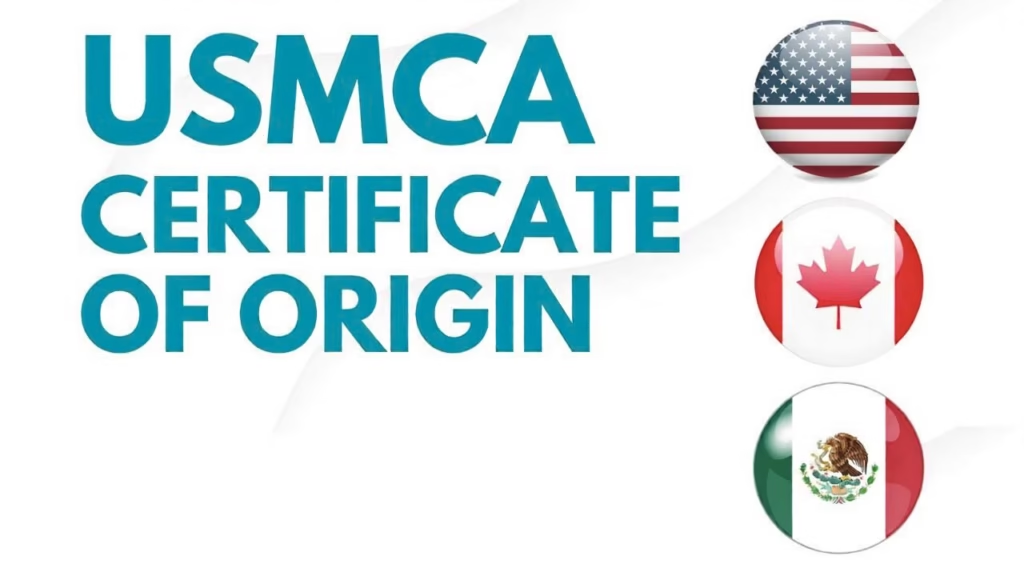
Worked Example: CUSMA/USMCA Certificate of Origin
Consider a Canadian auto parts manufacturer that supplies brake components to an assembly plant in Michigan. Under CUSMA (the successor to NAFTA), these parts can enter the US duty free but only if they qualify as “originating” under CUSMA’s specific rules of origin for automotive parts, and only if the exporter can prove it with a valid certificate of origin.
Here’s where the CUSMA framework differs from a lot of other trade agreements in a way that matters operationally it doesn’t require a separate certificate for every single shipment. Instead, an exporter who ships the same qualifying product repeatedly to the same importer can issue a blanket certificate of origin covering up to a 12 month period.
So instead of the Canadian manufacturer filling out a fresh certificate every time a truckload of brake components crosses the border potentially dozens of times a year one certificate, correctly filled out and covering the full range of parts being shipped under that agreement, can support every shipment to that same buyer for up to a year.
This matters for two reasons. First, it drastically cuts the administrative burden for high frequency, repeat trade relationships exactly the kind of relationship a lot of auto parts supply chains actually run on. Second, it shifts where the risk sits since one certificate now backs many shipments, an error on it doesn’t just affect one truckload it potentially exposes every shipment made under that blanket period to the same challenge if customs later finds the origin claim doesn’t hold up.
In practice, the manufacturer still needs to keep the underlying proof bill of materials, supplier origin declarations, and cost breakdowns showing the CUSMA regional value content threshold was met on file for the full period the blanket certificate covers, in case of a post clearance verification request.
The certificate itself is what crosses the border with the paperwork the supporting records are what justify it if customs asks questions later, sometimes well after the shipment has already cleared.
Certificate of Origin vs. Other Trade Documents
A certificate of origin often gets bundled mentally with the rest of the export paperwork stack, but each document is answering a different question and mixing them up is a common source of confusion for anyone new to export documentation.
CO vs. Commercial Invoice:
The commercial invoice is a transactional record it states what was sold, to whom, at what price, and under what payment terms. It’s the financial backbone of the sale. The certificate of origin, by contrast, makes no claim about price or payment it exists purely to certify where the goods legally originated. Customs uses the invoice to assess value and the CO to assess origin two separate determinations that happen to travel together.
CO vs. Packing List:
The packing list is a logistics document it details how the shipment is physically packed number of cartons, weights, dimensions, and what’s in each package. It helps with handling and verification at the physical level. The CO doesn’t describe packaging at all beyond a general reference its job is legal origin, not logistics.
CO vs. Bill of Lading:
The bill of lading is issued by the carrier and serves as both a receipt for the goods and a contract of carriage it’s proof that the goods were shipped and under what transport terms, and in some forms, it’s a title document controlling who can claim the goods on arrival. The CO has no role in transport or ownership transfer it says nothing about who owns the goods, only where they came from.
| Document | Core Purpose | Answers the Question |
| Certificate of Origin | Certifies legal country of origin | “Where did this originate?” |
| Commercial Invoice | Records the sale transaction | “What was sold, and for how much?” |
| Packing List | Details physical packaging | “How is this shipment packed?” |
| Bill of Lading | Carrier’s receipt/contract of carriage | “Who shipped this, and who can claim it?” |
Common Mistakes That Get Shipments Held Up
Most certificate of origin delays trace back to a small handful of preventable errors the same ones, shipment after shipment, across industries. Rather than another generic list, think of these as red flags a customs officer is trained to notice on sight:
🚩 A goods description that’s too vague to verify. “Machine parts” or “textile goods” doesn’t give an officer enough to cross check against the actual cargo. If the description can’t be matched to a specific HS code at a glance, it invites a manual inspection by default.
🚩 Numbers that don’t match across documents. If the quantity, weight, or value on the certificate doesn’t line up with the commercial invoice or packing list even by a small margin it reads as inconsistency, not innocent rounding. This is one of the fastest ways to get flagged, precisely because it’s so easy to avoid.
🚩 A missing or incomplete signature/stamp. A certificate without the certifying authority’s official mark isn’t a certificate it’s a filled out template. Officers check for this first, before even reading the content, because an uncertified document has no legal standing regardless of how accurate it is.
🚩 The wrong scheme specific form. Submitting ASEAN Form D for a shipment that actually needs Form E, or a generic non-preferential CO when a specific FTA form was required, doesn’t just cause confusion it typically means the preferential claim gets rejected outright, since the wrong form doesn’t certify against the correct agreement’s rules.
🚩 An HS code that doesn’t match the invoice. As covered earlier, this single mismatch can unravel an entire preferential claim, because the tariff shift and duty calculation both depend on it being right.
Any one of these red flags is usually enough to trigger a hold, a request for correction, or a lost preferential rate and all five are avoidable with a five minute cross check before the shipment leaves.
Best Practices for Exporters
The exporters who rarely run into certificate of origin problems tend to share a few habits, none of which are complicated they’re just consistent.
Keep production records organized and current. Bills of materials, supplier origin declarations, and cost breakdowns should be maintained on an ongoing basis, not reconstructed under pressure when a certificate application or a post clearance audit comes up. This is especially important under blanket certificates, where records need to justify months of shipments, not just one.
Build a real relationship with a customs broker. A broker who’s familiar with your specific products and trade lanes will catch scheme form mismatches and HS code issues before they become a customs officer’s problem instead of yours.
Keep digital backups of every certificate issued. A lost paper certificate used to mean starting the certification process over digital backups (and increasingly, e-CO records) eliminate that risk entirely.
Stay current on rules of origin changes. Value added thresholds, qualifying criteria, and scheme specific forms do get revised as trade agreements are updated or renegotiated. What qualified as originating last year isn’t guaranteed to qualify under the same math this year.
Key Takeaways
That container sitting in Rotterdam, held up over one missing stamp? By now it’s clear that wasn’t bad luck it was a predictable outcome of treating a certificate of origin as an afterthought instead of what it actually is a legal claim, backed by an authorized body, that determines tariffs, unlocks trade agreement discounts, and satisfies enforcement checks all at once.
Get the fundamentals right the correct scheme specific form, matching HS codes, consistent numbers across every document, and a properly certified signature and this document does its job invisibly, exactly as it’s supposed to. Skip any one of those, and it becomes the reason a shipment sits at a port instead of moving through it.
Next in this series how to fill out a commercial invoice correctly the document that travels alongside every certificate of origin, and one just as easy to get subtly wrong.
Frequently Asked Questions
Is a certificate of origin the same as a country of origin label?
No. A country of origin label (like a “Made in Vietnam” tag on a product) is a consumer facing marking requirement, often governed by separate labeling regulations. A certificate of origin is a formal trade document certified by an authorized body specifically for customs purposes. A product can carry one without the other being relevant to a given shipment.
How long is a certificate of origin valid?
This varies by issuing authority and destination country, but most non blanket certificates are tied to a specific shipment and don’t have a separate “expiry” beyond that shipment’s clearance. Blanket certificates, like those used under CUSMA, can cover repeat shipments to the same importer for up to 12 months, after which a new one is needed.
Can a certificate of origin be issued after shipment?
In many cases, yes some issuing authorities allow retroactive certification if the shipment has already left but documentation wasn’t finalized in time. However, this isn’t guaranteed everywhere, and retroactive certificates can face more scrutiny at the destination. It’s always safer to have the certificate finalized before the goods depart.
Does e-commerce/low value cargo need a CO?
Often not many countries set a value threshold below which formal certificate of origin requirements are waived for simplicity. But this threshold and its rules vary significantly by destination country and product type, so it’s worth confirming with importer rather than assuming a low value shipment is automatically exempt.
Can one CO cover multiple shipments?
Yes, under certain schemes. Blanket certificates, most notably under CUSMA/USMCA, allow one certificate to cover multiple identical shipments to the same importer over a defined period, rather than requiring a fresh certificate every time.
About the Author
Hi, I’m SriHarsha, founder of shxhub.in.
I focus on explaining import export business topics in a practical, beginner friendly way, based on how exports actually work on the real ground especially documentation, quality control, and buyer expectations.

telegram_line
ltrtmfzf http://www.ga7z6h44977w6etmpgv1a7g5y106l15zs.org/
[url=http://www.ga7z6h44977w6etmpgv1a7g5y106l15zs.org/]ultrtmfzf[/url]
altrtmfzf