
What Is Export Documentation?
Most people hear “export documentation” and picture a folder of forms nobody wants to read. That’s the wrong way to think about it.
Export documentation is really the legal and financial paper trail that allows goods to leave one country, enter another, and get paid for along the way. Every document in the process exists to answer one of four questions: Can these goods legally leave and enter? Can they physically move from point A to point B? Will the bank release payment? And if something goes wrong, whose fault is it?
That breaks down into four real functions:
- Customs clearance — proving to both the exporting and importing country that the shipment is legitimate, correctly valued, and correctly classified.
- Logistics movement — giving carriers, ports, and freight forwarders what they need to actually load, ship, and deliver the cargo.
- Bank payment processing — giving banks the paperwork they need to release funds, especially under letters of credit or documentary collections.
- Buyer confirmation and dispute prevention — creating a paper trail so that if the buyer claims the goods weren’t what was ordered, or customs questions the value, there’s a record that protects the exporter.
Here’s the reframe that most beginners miss, export documentation is not paperwork, it’s risk management. A shipment can be perfectly packed, fully funded by the buyer, and still get stuck at a port or held by a bank because one document doesn’t match another.
The goods being ready has nothing to do with the documents being ready they’re two separate risks, and documentation is the one that trips up first time exporters most often.
Understood this way, the export documentation meaning goes beyond “what forms do I need.” It’s really asking: what proof do I need at each stage so that customs lets the goods go, the ship or plane carries them, the bank releases the money, and the buyer has no grounds to dispute what arrived. Every document on the checklist exists to close one of those four gaps.
Table of Contents
The Export Documentation Process (Step by Step Flow)
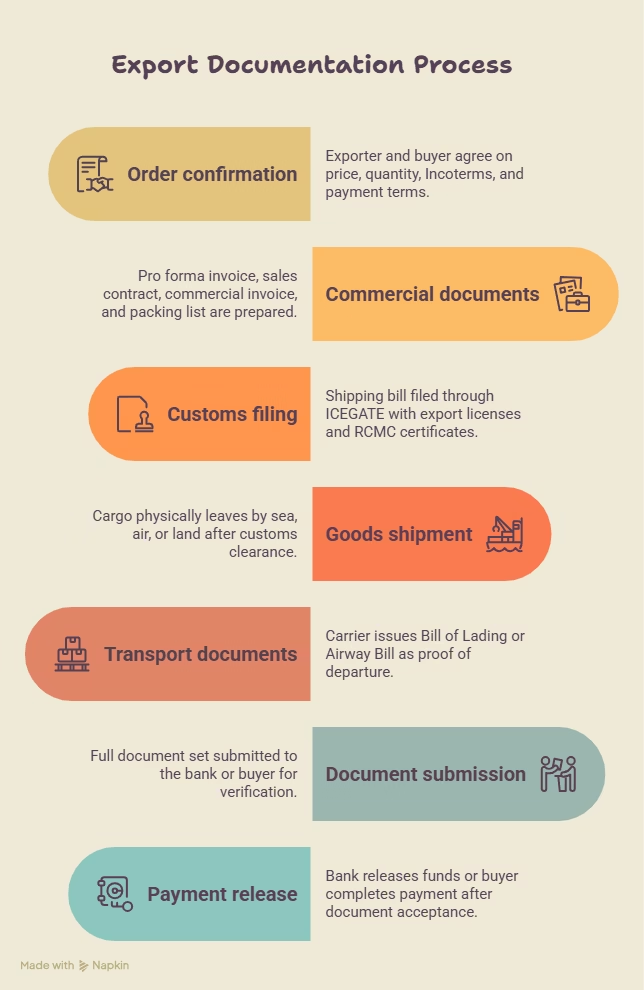
Most guides list export documents alphabetically or by category, which makes them easy to skim but hard to actually use. In a real shipment, documents don’t appear in alphabetical order they appear in a sequence, and each one depends on the one before it. Understanding that sequence is what actually prevents delays.
Here’s how it works on the ground:
- Order and payment terms are confirmed. Before anything is written down formally, the exporter and buyer agree on price, quantity, Incoterms, and how payment will happen advance, letter of credit, or documents against payment/acceptance.
- Commercial documents are prepared. The pro forma invoice, sales contract, and eventually the commercial invoice and packing list are drawn up based on those agreed terms.
- Customs export documents are filed. In India, this means filing the shipping bill through ICEGATE, along with any export license or product specific certificates(RCMC) the shipment needs.
- Goods are shipped. The cargo physically leaves by sea, air, or land once customs has cleared it.
- Transport documents are issued. The carrier issues the Bill of Lading or Airway Bill, which becomes proof that the goods have actually left and is often the single most important document for payment release.
- Documents are submitted to the bank or buyer. The full document set invoice, packing list, BL/AWB, certificate of origin, insurance certificate, and any LC specific paperwork is submitted for verification.
- Payment is released. Once documents are checked and accepted, the bank releases funds or the buyer completes payment as agreed.
The reason this sequence matters is simple: each step depends on accurate information from the step before it. If the commercial invoice has the wrong HS code, that error carries into the shipping bill. If the shipping bill doesn’t match the Bill of Lading, the bank can reject the document set even if the goods arrived perfectly fine.
Break the sequence file customs documents before payment terms are locked, or ship before the right certificates are ready and the entire chain stalls somewhere downstream, usually at the exact moment payment is due.
This is why understanding the export documentation process as a flow, not a checklist, is the difference between documentation that moves smoothly and documentation that causes a shipment to sit at port while everyone tries to figure out which paper is wrong.
Export Documentation Checklist: Quick Overview
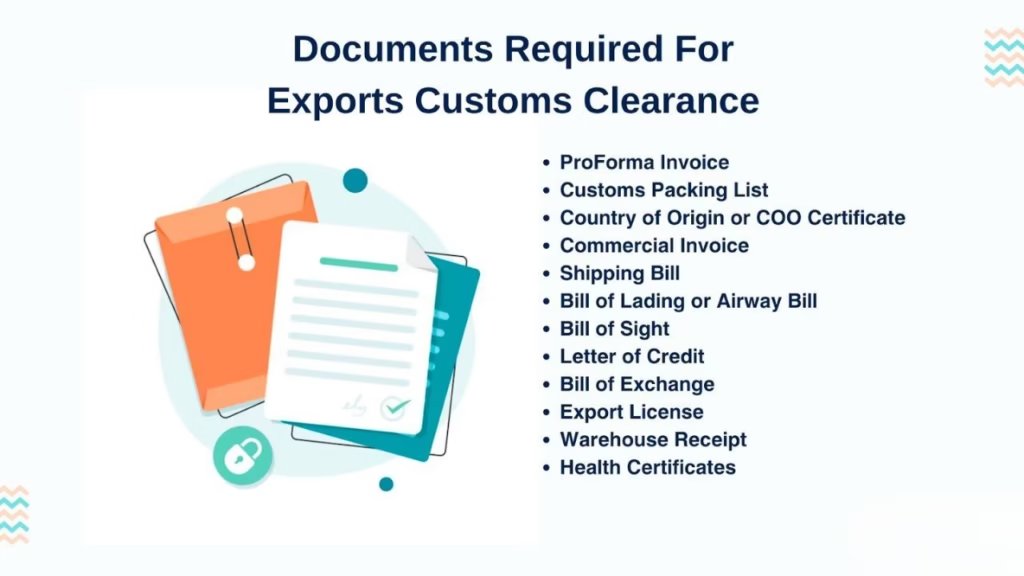
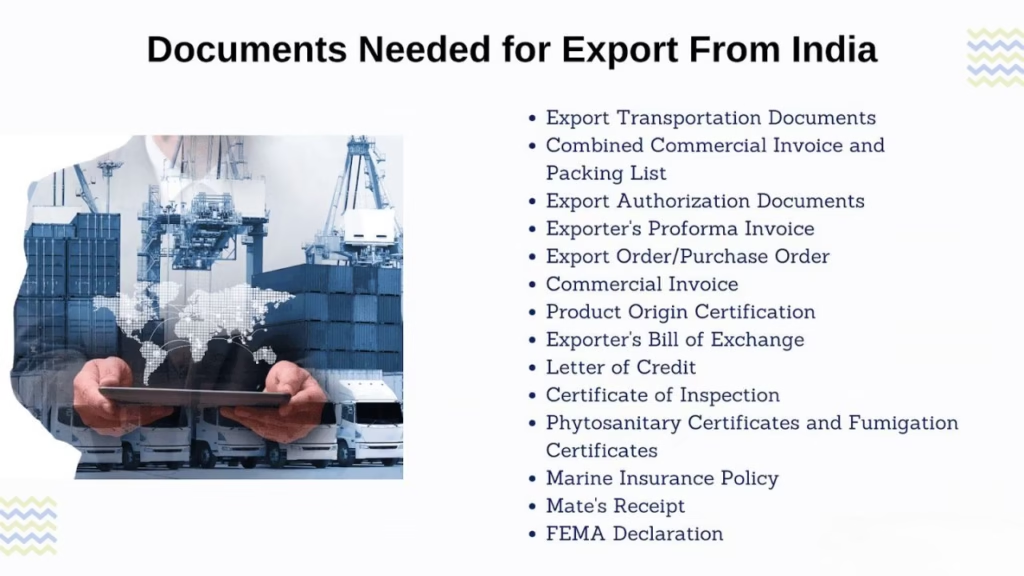
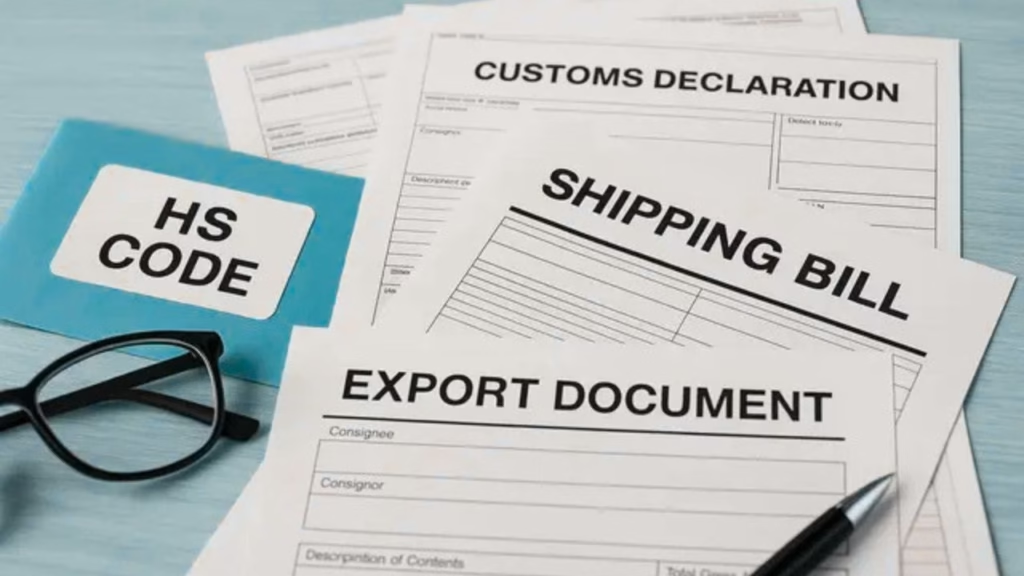
If you just want the fast answer before going deeper, here’s the master list. Most export shipments will need a combination of these, grouped by what stage of the process they belong to setup, commercial, customs and shipping, banking, compliance, and insurance. Each one is explained in depth in the sections below, including what it’s for and where beginners commonly go wrong.
- IEC (Import Export Code)
- GST registration and PAN details
- Pro forma invoice
- Sales contract / purchase order
- Commercial invoice
- Packing list
- Shipping bill
- Bill of lading or airway bill
- Certificate of origin
- Bill of exchange
- Letter of credit documents (if applicable)
- Insurance certificate
- Inspection certificate / test report (if required)
- Phytosanitary or fumigation certificate (if applicable)
- Bank Realization Certificate / eBRC
Not every shipment needs all fifteen. A first time exporter shipping a small B2B order on advance payment will use far fewer documents than an agri exporter shipping under a letter of credit to a country with specific import regulations.
What stays constant is the five core shipment documents commercial invoice, packing list, shipping bill, bill of lading or airway bill, and certificate of origin which show up in almost every export, regardless of product or destination. Those five are worth understanding properly before anything else, so that’s where we go next.
Core Shipment Documents (The Non-Negotiables)
Commercial Invoice
The commercial invoice is the foundation document of the entire shipment. Every other document the shipping bill, the bill of lading, the bank documents refers back to the details on this one. It isn’t just a bill for the buyer it’s a legal declaration of who is exporting, who is importing, what exactly is being shipped, at what value, and under what payment and delivery terms.
A correctly prepared commercial invoice needs to include: exporter and importer name and address, invoice number and date, an exact (not vague) product description, the HS code, quantity and unit, the FOB/CIF/CFR value, currency, Incoterms, and country of origin.
The most common mistake here is a mismatch the HS code on the invoice doesn’t match the shipping bill, the declared value differs across documents, or the Incoterms are stated incorrectly. Since every downstream document is built off the invoice, an error here doesn’t stay contained it multiplies. Invoice mismatches are consistently one of the top reasons banks delay releasing export payments.
Packing List
Beginners sometimes assume the packing list is optional or a formality. It isn’t. Where the commercial invoice tells customs and the buyer what was sold and at what value, the packing list tells them how it was packed and customs and logistics teams rely on it to physically verify the cargo.
A proper packing list includes the number of cartons, net and gross weight, the type of packing (bags, boxes, pallets), marks and numbers on each package, and dimensions.
The most frequent mistake is simply copying invoice data into the packing list without actually recording real weights, or letting the packing list drift out of sync with what’s physically loaded. Even a small mismatch here can trigger a physical inspection at the port, which slows the shipment down considerably.
Shipping Bill
In India, the shipping bill is arguably the single most important document in the entire process without it, an export legally does not exist. It’s a formal declaration filed electronically with Indian Customs through ICEGATE, stating that specific goods are leaving the country.
There are different types of shipping bills depending on what benefits the exporter is claiming a Free Shipping Bill, a Drawback Shipping Bill, or a RoDTEP Shipping Bill. Choosing the wrong type doesn’t just create paperwork confusion it can block government incentives the exporter would otherwise be entitled to.
Many new exporters leave this entirely to their Customs House Agent (CHA) without reviewing it themselves which is risky, since the exporter remains responsible even if someone else filed it. It’s worth checking the HS code, FOB value, and IEC details on the shipping bill before it’s filed, not after.
Bill of Lading / Airway Bill
This document is the physical proof that goods have actually left the country. For sea shipments, it’s a Bill of Lading, issued by the shipping line for air shipments, it’s an Airway Bill, issued by the airline.
The Bill of Lading does more than confirm shipment it acts as a receipt of goods, a contract of carriage, and in many cases, a document of title, meaning whoever holds it has a legal claim to the cargo. An Airway Bill is mandatory too, but it is not a document of title in the same way.
The common mistakes here are a wrong consignee name, details that don’t match the commercial invoice, or freight terms that weren’t checked before shipment. Banks are strict about this if the Bill of Lading details don’t line up exactly with the invoice, they can reject the entire document set, even though the goods have already shipped.
Certificate of Origin
The Certificate of Origin (COO) confirms where the goods were actually manufactured or produced. Buyers don’t request it just to keep records it directly affects how much duty they pay on import, particularly under Free Trade Agreements(FTA).
Buyers in ASEAN(Brunei, Cambodia, Indonesia, Laos, Malaysia, Myanmar, the Philippines, Singapore, Thailand, Vietnam, and Timor-Leste) countries, SAFTA(Afghanistan, Bangladesh, Bhutan, India, Maldives, Nepal, Pakistan, and Sri Lanka) countries, or parts of the Middle East, for example, often only get a lower duty rate if a valid COO accompanies the shipment.
In India, this generally comes in two forms one is Non-Preferential COO, and Preferential COO issued under an applicable FTA, typically through a Chamber of Commerce or the relevant Export Promotion Council (EPC).
Common mistakes include issuing the COO with the wrong HS code, a mismatch with the invoice’s stated origin, or simply assuming it’s optional when the buyer’s country requires it. A missing or incorrect COO can raise the buyer’s landed cost unexpectedly which often turns into a dispute or a renegotiation the exporter didn’t see coming.
Business & Exporter Setup Documents
Before any product ships, an exporter needs a set of documents that establish them as a legally valid exporter in the first place. These aren’t shipment documents they’re the foundation that makes every future shipment possible, and getting them wrong at this stage causes problems that follow the business for years.
The most important of these is the IEC, or Import Export Code. DGFT (Directorate General of Foreign Trade) states plainly that an IEC is mandatory for anyone exporting or importing goods from India without it, none of the customs or banking processes further down the line can even begin.
Alongside the IEC, exporters need GST registration, since export transactions still need to be reported correctly for tax purposes even when they’re zero rated. PAN details and standard business registration (proprietorship, partnership, LLP, or company, depending on structure) round out the basic legal identity of the business.
For certain product categories, an RCMC Registration-Cum-Membership Certificate is also required. This applies when the product falls under the purview of a specific export promotion council, such as APEDA for agricultural and processed food products. Without an RCMC, exporters in these categories may not be eligible for certain benefits or may face additional scrutiny.
Finally, AD Code registration with the exporter’s bank links that bank to customs processing at each port the exporter ships from. This step is often overlooked by beginners, who assume having a bank account is enough, it isn’t the AD code specifically has to be registered against each port used.
The distinction worth remembering here one that a lot of blogs blur is that these are one time setup documents, not something prepared for every shipment. Get them right once, and they sit quietly in the background enabling every export transaction that follows. Get them wrong or skip one, and it surfaces later as a blocked shipment or a bank query that has nothing to do with the goods themselves.
Pre-Sale and Commercial Documents
Before a single shipment document is prepared, the commercial terms of the deal need to be locked down in writing. This stage is easy to rush past, especially for exporters eager to close a sale but it’s also where most later disputes actually originate.
It typically starts with a pro forma invoice, which functions less like a bill and more like a negotiating tool. It lays out proposed pricing, quantities, and terms before the buyer formally commits, giving both sides something concrete to negotiate around rather than relying on verbal agreements or email threads.
Once terms are agreed, a sales contract or purchase order formalizes them. This is followed by a clear payment terms document spelling out whether the deal runs on a letter of credit, advance payment, or documents against payment/acceptance credit terms.
Ambiguity here is exactly what causes bank documentation to fall apart later, since every subsequent document (invoice, LC paperwork, bill of exchange) has to align with whatever was agreed at this stage.
Buyer specifications and sample approval also belong here confirming exactly what the buyer expects in terms of quality, labeling, and any product specific compliance requirements before production or packing begins.
The reason this stage matters more than it gets credit for a large share of export disputes don’t come from bad products or late shipments they come from a mismatch between what was informally agreed and what was actually documented.
When the pro forma invoice, contract, and payment terms are precise and mutually confirmed upfront, most of the friction that shows up later over quantities, prices, or payment timing simply doesn’t happen. Getting this stage right is what prevents the majority of disputes before they can even start.
Customs and Shipping Documents Deep Dive
The shipping bill was introduced earlier as the document that legally makes an export exist but its mechanics deserve a closer look, because this is where a surprising number of shipments get held up at port.
Every shipping bill is built on three linked pieces of data: the HS code, the FOB value, and the exporter’s IEC. The HS code determines how the product is classified for customs and often decides whether the exporter is eligible for benefits like duty drawback or RoDTEP.
The FOB value determines the declared worth of the shipment for customs and incentive calculations. The IEC ties the whole filing back to a specific, verified exporter. If any of these three doesn’t align with what’s on the commercial invoice, customs can flag the shipment for review before it’s allowed to move.
Some products also require an export license this applies when the goods fall under a controlled or restricted category, whether for strategic, safety, or regulatory reasons. Shipping without one when it’s required doesn’t just delay the shipment, it can result in penalties or seizure.
Most exporters, especially first timers, rely on a CHA (Customs House Agent) to actually file the shipping bill and manage port side formalities. That’s normal and often necessary but it’s worth being clear eyed about what it does and doesn’t cover.
A CHA handles the mechanics of filing, the legal responsibility for accuracy still sits with the exporter. If the HS code or value is wrong, “my CHA filed it” isn’t a defense customs or the bank will accept.
The most common triggers for a port hold are predictable once you know to look for them a mismatched HS code between invoice and shipping bill, the wrong shipping bill type chosen for the incentive being claimed, or a declared FOB value that doesn’t match supporting documents.
Checking these three things before filing not after a hold notice arrives is the single highest leverage habit an exporter can build.
Banking & Payment Documents
This is the category where most of the money risk in exporting actually lives. Getting the goods shipped is only half the job getting paid depends on a separate set of documents that banks scrutinize closely, and often more strictly than customs does.
The Bill of Exchange is essentially a formal payment demand, the exporter instructing the buyer to pay the agreed amount. It’s used in DP (Documents against Payment) and DA (Documents against Acceptance) arrangements, where the bank releases shipping documents to the buyer only once payment is made or a formal acceptance to pay is given.
Get this document wrong or skip it under these payment terms, and the bank has no basis to release documents to the buyer at all.
Where a Letter of Credit is involved, documentation accuracy becomes non-negotiable. It’s worth understanding how banks actually evaluate LC documents they aren’t assessing product quality they’re comparing every word across every document against the LC terms.
A spelling difference, a date mismatch on the Bill of Lading, or an incorrect Incoterm can trigger what’s called an LC discrepancy, which can delay or even block payment regardless of whether the goods themselves are exactly what was ordered.
A document that surprises many beginners is GR / AD Bank Compliance sometimes called the “hidden” document because it isn’t discussed as often as invoices or bills of lading. This is how the RBI tracks foreign currency inflow tied to Indian exports. Every shipment has to be linked to an Authorized Dealer (AD) bank, and the foreign payment received against it has to be formally realized and reported.
That connects directly to the Bank Realization Certificate (BRC), or its electronic form, the eBRC the document that confirms payment for a specific shipment has actually been received and reconciled. This isn’t just an internal banking formality it’s frequently required to claim export incentives.
The consequences of getting this wrong are more serious than a delayed shipment. If payment isn’t realized within the RBI permitted timeframe, exporters can receive formal RBI notices, have pending incentive claims blocked, and in more serious cases, have their bank account flagged for non-compliance.
Unlike a customs hold, which affects one shipment, banking compliance issues can follow an exporter across their entire export business which is exactly why this category deserves as much attention as the shipping documents themselves.
Compliance & Product Specific Documents
Everything covered so far applies to almost every export, regardless of what’s being shipped. This section is different these documents depend entirely on what you’re exporting and where it’s going. Skip the wrong one, and the shipment doesn’t get held up by customs at home, it gets rejected or delayed at the destination port instead, which is often a far more expensive problem to fix.
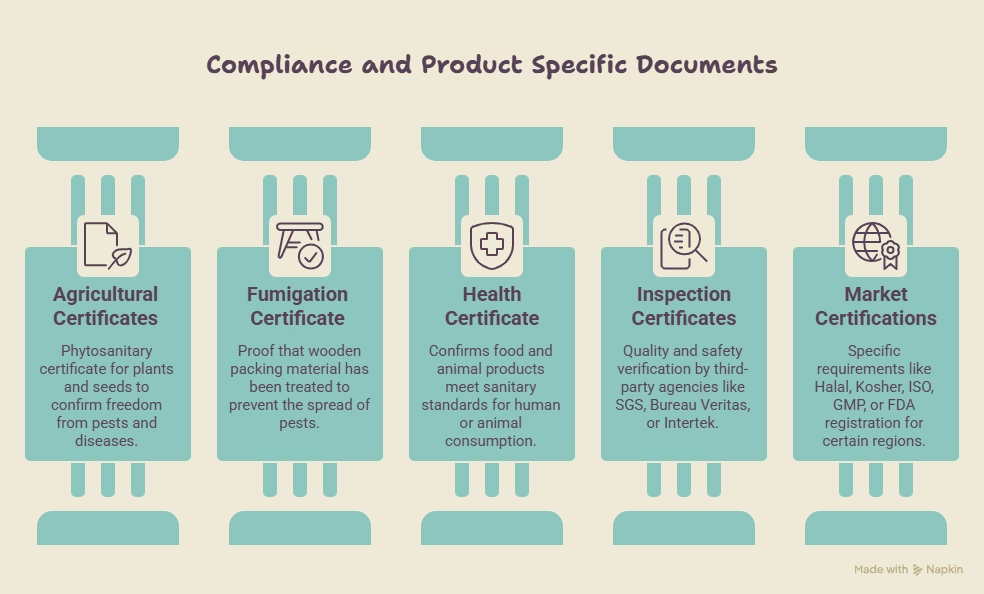
For agricultural products, plants, and seeds, a phytosanitary certificate is typically required, confirming the shipment is free of pests and plant diseases that could affect the importing country’s agriculture. Closely related is the fumigation certificate, which applies whenever wooden packing material is used many countries require proof that the wood has been treated to prevent the spread of pests through packaging alone, separate from the product itself.
Food and animal products often need a health certificate, confirming the goods meet sanitary standards for human or animal consumption in the destination market. Beyond that, many buyers and destination markets require an inspection certificate or lab test report issued by recognized third party agencies such as SGS, Bureau Veritas, or Intertek verifying quality, safety, or specification compliance before the goods are accepted.
Then there’s a layer of market specific certifications that only apply to certain buyers or regions. Halal or Kosher certification for religious dietary markets, ISO or GMP certification for manufacturing and quality standards, and FDA registration or clearance for shipments entering the US market, particularly food, cosmetics, or pharmaceuticals.
The mistake most beginners make with this category is treating it as a fixed checklist rather than a variable one. It isn’t. A textile exporter and a spice exporter need completely different compliance documents, and the same spice exporter might need different certificates for a buyer in the Middle East versus one in the EU.
The only reliable approach is to confirm compliance requirements with the buyer and the destination country’s import regulations before production and packing not after the goods are already on their way.
Insurance & Risk Documents
Insurance is one of the most misunderstood documents in the entire export process, mostly because exporters assume it’s either always necessary or never necessary when in reality, it depends entirely on the terms of the deal.
An insurance certificate proves that the shipment is covered against transit damage, theft, fire, or sea risks during the journey. It protects whichever party is financially responsible for the goods at that stage of transit, and that responsibility shifts depending on which Incoterm was agreed.
Under CIF terms, insurance is the exporter’s responsibility, and the certificate is mandatory. Under letter of credit transactions, banks frequently require proof of insurance as part of the document set before releasing payment, regardless of Incoterm.
Under FOB terms, however, insurance responsibility technically shifts to the buyer once goods pass the ship’s rail which leads many exporters to skip it entirely.
That’s where the real risk sits skipping insurance under FOB terms is only safe if the buyer has confirmed in writing that they’re taking on that responsibility. Without that written confirmation, an exporter is exposed if cargo is damaged in transit even though, technically, it wasn’t their obligation to insure it.
Buyers in that situation often push back anyway, and without documentation clarifying who was responsible, it turns into a drawn out dispute rather than a straightforward insurance claim.
The practical takeaway is, insurance isn’t about whether the exporter has to buy it, it’s about making sure responsibility is documented clearly enough that a damaged shipment becomes an insurance claim, not a payment dispute.
India Specific Documentation Requirements
Export documentation in India runs through four regulatory pillars, and understanding what each one actually controls makes the whole system far less confusing.
DGFT (Directorate General of Foreign Trade) governs exporter eligibility at the most basic level it’s the authority that makes IEC registration mandatory and oversees export policy, licensing, and incentive schemes like RoDTEP.
ICEGATE is the customs facing system it’s where shipping bills are actually filed electronically and where customs clearance happens. RBI sets the rules around foreign currency realization, which is why GR/AD compliance and payment timelines matter so much.
And AD Banks (Authorized Dealer Banks) sit at the intersection of the exporter and RBI, processing the actual foreign payment and issuing the Bank Realization Certificate.
There’s a useful government push worth knowing about India has worked to simplify the mandatory export document list down to just three the Bill of Lading or Airway Bill, a combined commercial invoice-cum-packing list, and the shipping bill. On paper, this looks like exporting has gotten dramatically simpler.
In practice, it hasn’t not for most exporters. That three document framework covers the legal minimum for customs to clear a shipment. It doesn’t account for what banks require for payment, what buyers require contractually, or what the destination country’s import regulations demand.
A shipment moving under a letter of credit still needs the full LC document set. A shipment of agricultural goods still needs a phytosanitary certificate regardless of how few documents customs technically mandates. The “three core documents” simplification is real, but it applies narrowly exporters who plan around it and skip the rest are the ones who end up with payment or compliance problems later.
For agricultural and processed food exporters specifically, APEDA plays an additional role beyond the four pillars above issuing RCMC registration, guiding product specific documentation, and often being the reference point for certificates that buyers or importing countries require for agri products.
Any agri exporter working through this checklist should treat APEDA’s requirements as a parallel track alongside DGFT, ICEGATE, and their AD bank, not a replacement for any of them.
Which Documents Do YOU Actually Need?
Everything covered so far is comprehensive by design but no single shipment needs every document on this list. The real skill in export documentation is knowing which subset applies to your shipment, and that comes down to three filters what you’re exporting, where it’s going, and how you’re getting paid.
By product type:
- Agricultural or food products: expect phytosanitary certificates, health certificates, RCMC, and possibly APEDA specific paperwork on top of the core five.
- Manufactured/industrial goods: core five documents plus inspection certificates or lab reports if the buyer requires quality verification.
- Chemical products: core five documents plus MSDS (Material Safety Data Sheet), and often additional labeling or hazard documentation.
- Textiles: core five documents plus buyer specific compliance (labeling standards, sometimes ISO certification), with fewer regulatory certificates than agri or chemical categories.
By destination and trade agreement status:
- Shipping to a country with an active FTA with India (ASEAN, SAFTA nations, etc.): a Preferential Certificate of Origin is worth securing, since it directly reduces the buyer’s import duty.
- Shipping to a country without a relevant FTA: a Non-Preferential Certificate of Origin is usually sufficient.
- Shipping to the US, EU, or other regulated markets: check for market specific certifications (FDA, CE-type compliance, GMP) before production begins, not after.
By payment method:
- Advance payment: documentation is lighter the core five plus insurance is often enough, since the bank isn’t gatekeeping payment.
- Letter of Credit: the full LC document set is mandatory, and every detail must match exactly invoice, packing list, BL/AWB, COO, and insurance certificate all cross checked against LC terms.
- DP/DA (Documents against Payment/Acceptance): the Bill of Exchange becomes essential, since it’s the instrument the bank uses to control document release.
- Open account: lower documentation pressure from the bank, but higher buyer trust risk, so buyer specific supporting documents matter more.
Run your own shipment through these three filters, and the sprawling master checklist collapses into a short, specific list usually somewhere between six and twelve documents rather than all fifteen. That’s the practical value of thinking about documentation this way it stops being “everything that might apply” and becomes “exactly what applies to this shipment.”

Common Export Documentation Mistakes (And Real Costs)
Most documentation failures aren’t caused by not knowing what documents exist the checklist itself isn’t the hard part. They’re caused by a handful of habits that repeat across almost every first time exporter’s story. Here are the five that cause the most damage, and what they actually cost when they go wrong.
Mistake 1: Assuming the CHA or freight forwarder handles everything. It’s tempting to hand off the shipping bill, customs filing, and paperwork entirely to a Customs House Agent and stop thinking about it. The problem is that legal responsibility for accuracy never actually transfers it stays with the exporter.
The real cost: When an HS code or value turns out wrong, it’s the exporter who faces the customs query, the bank rejection, or the penalty, regardless of who filed the paperwork.
Mistake 2: Reusing old invoice or HS code data without updating it. It’s efficient to copy last shipment’s invoice as a template until an HS code has changed, a buyer’s requirements have shifted, or destination regulations have been updated since the last export.
The real cost: Customs queries, unexpected shipment holds, and in some cases, incentive claims getting rejected because the classification no longer matches current rules.
Mistake 3: Ignoring bank documentation timelines. Banks, especially under letter of credit terms, expect documents within a specific window and in a specific format not “whenever they’re ready.”
The real cost: Late submission routinely translates into payment delays, and in LC transactions specifically, can trigger discrepancy fees or even a lapsed credit that has to be renegotiated with the buyer.
Mistake 4: Not matching documents line by line. Banks compare the invoice against the Bill of Lading, the packing list against the shipping bill, and every LC document against the LC’s exact terms. A different spelling of the consignee’s name, a mismatched date, or a slightly different declared value across two documents is enough to flag a discrepancy.
The real cost: Payment held up over an error that has nothing to do with the goods themselves sometimes for weeks while documents are corrected and resubmitted.
Mistake 5: Treating insurance or compliance certificates as optional. Skipping insurance under FOB terms without written buyer confirmation, or assuming a phytosanitary or fumigation certificate “probably isn’t needed this time,” is a gamble that mostly goes unnoticed until it doesn’t.
The real cost: cargo damage with no insurance backing turns into a direct financial loss, and a missing compliance certificate at a foreign port can mean the shipment is rejected outright, held indefinitely, or destroyed at the exporter’s expense.
None of these five mistakes come from a lack of information they come from treating documentation as a formality instead of what it actually is, the mechanism that decides whether a shipment turns into a completed, paid transaction or a costly, drawn out problem.

Export Documentation Jobs & Career Path
The demand for skilled documentation executives exists for a very specific reason the mistakes covered above are expensive, and companies pay well to avoid them. A good documentation executive isn’t doing clerical work they’re the person standing between a business and a customs penalty, a rejected LC, or a lost incentive claim.
Searches for import export documentation jobs, documentation executive roles, and openings in cities like Mumbai, Chennai, and Delhi are common precisely because export heavy businesses can’t run without this skill in house.
Unlike many entry level roles, documentation pay tends to scale quickly with demonstrated accuracy and experience, since the cost of a documentation error to the business is so much higher than the cost of hiring someone competent to prevent it.
The core skills that separate a strong documentation executive from a weak one aren’t really about memorizing document names. They’re about understanding customs mechanics (HS codes, shipping bill types, port procedures), banking terms (LC discrepancy handling,
DP/DA processes, realization timelines), Incoterms (who’s responsible for what, and when), and buyer side requirements (what a specific market or buyer will reject a shipment over).
For anyone considering this as a career path, the practical route in is exposure to real document sets actual invoices, actual shipping bills, actual LC discrepancy cases rather than theoretical study alone. Businesses hiring for these roles are ultimately looking for one thing someone who can catch a mismatched HS code or an LC discrepancy before it becomes an expensive problem, not after.
Tools, Software & Templates
As export volumes grow, most businesses eventually move beyond manually preparing every document from scratch. ERP systems, freight forwarder portals, and dedicated export documentation software all help by keeping data consistent pulling the same product, buyer, and pricing details across the invoice, packing list, and shipping bill instead of re-entering them each time.
This consistency is exactly what prevents the line by line mismatches that cause bank and customs holds.
That said, software is a tool for consistency, not a substitute for understanding. If the underlying data entered into the system is wrong an outdated HS code, an incorrect FOB value the software will simply reproduce that error across every document flawlessly. Garbage data in still means garbage documents out, regardless of how polished the system looks.
Examples: Shipping Solutions, Expodite, EximDoc etc.
Export Documentation Checklist Summary
Here’s the complete checklist in one place, grouped by category, for quick reference before your next shipment.
Setup (one time)
- IEC (Import Export Code)
- GST registration
- PAN & business registration
- RCMC (if applicable — e.g., APEDA-regulated products)
- AD Code registration with bank
Commercial (pre-shipment)
- Pro forma invoice
- Sales contract / purchase order
- Payment terms document
- Buyer specifications / sample approval
Customs & Shipping
- Commercial invoice
- Packing list
- Shipping bill
- Bill of lading / airway bill
- Certificate of origin
- Export license (if controlled/restricted product)
Banking & Payment
- Bill of exchange
- Letter of credit documents (if applicable)
- Bank Realization Certificate / eBRC
- GR / AD bank compliance
Compliance (product/destination-specific)
- Phytosanitary certificate
- Fumigation certificate
- Health certificate
- Inspection certificate / lab report
- Market-specific certification (Halal, Kosher, ISO, GMP, FDA)
Insurance
- Insurance certificate
Save or bookmark this list, and before your next shipment, run it through the decision framework from earlier filtering by product type, destination, and payment method to narrow it down to exactly what your shipment actually needs.
Final Takeaway
Export documentation isn’t a formality that sits between an exporter and their money it is the mechanism that decides whether that money arrives at all. It’s legal proof that a transaction happened correctly, the trigger that releases payment, the compliance record regulators check, and the trust signal that keeps buyers coming back.
The difference between exporters who scale and exporters who stall usually isn’t product quality or market demand. It’s the exporters who master documentation get paid faster, face fewer disputes, and build a business that scales predictably.
Exporters who treat it as an afterthought end up repeating the same mistakes shipment after shipment, blaming buyers or banks for problems that started with a mismatched invoice or a missed timeline and many exit exporting altogether before they figure out why.
Documentation is boring right up until it costs you money. Once it’s understood properly, exporting becomes something you can actually plan around, instead of something that happens to you.
Before your next shipment, go back through the checklist in this guide, run it against the decision framework for your specific product and destination, and make sure every document is ready before the goods are.
Frequently Asked Questions
What are the basic documents required to export from India?
At minimum, most shipments need a commercial invoice, packing list, shipping bill, and bill of lading or airway bill, along with a certificate of origin. These five form the core of virtually every export, regardless of product or destination. Beyond this base, additional documents apply depending on the product type, payment method, and destination country’s import requirements.
Who prepares export documentation exporter, CHA, or bank?
The exporter is responsible for preparing core commercial documents like the invoice and packing list. A CHA typically files customs documents like the shipping bill on the exporter’s behalf. Banks don’t prepare documents, but they verify and check the full document set for accuracy before releasing payment particularly under letter of credit terms.
Can beginners manage export documentation themselves?
Yes, for smaller or simpler shipments, though it requires genuinely understanding what each document does, not just filling in templates. Complex payment terms like letters of credit, or shipments involving regulated products, benefit from experienced help. Many beginners start by managing straightforward documents themselves while relying on a CHA or consultant for customs filing and bank-facing paperwork.
What is the difference between a commercial invoice and a packing list?
The commercial invoice declares the value, buyer, seller, and terms of the sale — it’s the financial and legal record of the transaction. The packing list describes how the goods are physically packed: weights, carton counts, and package marks. Customs and banks use the invoice to verify value and ownership, and the packing list to verify what’s actually inside the shipment.
What’s the difference between a Bill of Lading and an Airway Bill?
A Bill of Lading is issued for sea shipments and can act as a document of title, meaning ownership of the goods can transfer through it. An Airway Bill is issued for air shipments and, while mandatory proof of shipment, is not a document of title in the same way. Both confirm goods have shipped, but they carry different legal weight.
How long should export documents be retained?
Export documents should generally be retained for several years for audit, tax, and compliance purposes, since customs and regulatory authorities can request them well after a shipment is completed. Exact retention requirements can vary by document type and regulation, so exporters should keep organized records rather than discarding paperwork once a shipment is paid.
What happens if payment isn’t realized within the RBI-permitted time?
If foreign payment against a shipment isn’t realized within the RBI’s permitted timeframe, exporters can receive formal RBI notices, and pending export incentive claims may get blocked. In more serious or repeated cases, the exporter’s bank account can be flagged for non-compliance, affecting future transactions — making timely realization a compliance issue, not just a cash-flow one.
About the Author
Hi, I’m SriHarsha, founder of shxhub.in.
I focus on explaining import export business topics in a practical, beginner friendly way, based on how exports actually work on the real ground especially documentation, quality control, and buyer expectations.

2 thoughts on “Export Documentation Checklist: What Experienced Exporters Know That Beginners Don’t”