

The Container That Never Cleared
Imagine a 20-foot container of fresh pomegranates reaching a port in the Gulf after a week at sea. The fruit is fine. The buyer is waiting. The truck is booked. And then the shipment is held, not because of anything wrong with the produce, but because the botanical name on the paperwork does not match the one on the invoice, and the quantity on the certificate is off by a few cartons.
Nothing in that story is dramatic, and that is exactly the point. Most phytosanitary certificate problems are not about pests at all. They are about small, avoidable mismatches that a destination inspector spots in under a minute. Each day of delay means cold storage charges, demurrage, a buyer losing patience, and sometimes a rejected consignment.
This guide explains the phytosanitary certificate the way experienced exporters learn it, what it is, who needs one, what each field on it really means, what inspectors look at first, how to get one in India through the PQIS portal, and how to stop your shipment from becoming the cautionary tale.
It is written for first time exporters, MSMEs, freelancers and consultants who handle export paperwork, and students of agri-trade or logistics.
Table of Contents
Quick Answer: What Is a Phytosanitary Certificate?
A phytosanitary certificate (PC) is an official plant health document issued by the exporting country’s National Plant Protection Organization (NPPO). It confirms that a consignment of plants, plant products or other regulated articles has been inspected under official procedures and is considered free from the quarantine pests that the importing country cares about.
Five things to know at a glance:
- Who issues it: the exporting country’s NPPO. In India, that is the Directorate of Plant Protection, Quarantine & Storage (DPPQS) through its plant quarantine stations.
- Who needs it: exporters of regulated plant material, such as fresh produce, seeds, cut flowers, grains and certain wood or cotton products, when the destination country requires it.
- How to apply: online through the Plant Quarantine Information System (PQIS), followed by inspection of the consignment.
- How long it is valid: there is no single universal period, around 60 days is commonly cited, but the destination’s rules decide.
- What it costs: fees are set by the authority and change, so check the official portal before budgeting.
What Is a Phytosanitary Certificate?
The word looks intimidating, but it splits neatly. Phyto relates to plants and sanitary relates to health. A phytosanitary certificate is, quite literally, a plant health certificate for international trade. If you searched for the phytosanitary certificate full form, there is none, it is not an abbreviation, though people often shorten it to PC or simply “phyto”.
Three parties make the system work:
- The IPPC (International Plant Protection Convention). A multilateral treaty that sets the common rules. Its standard ISPM 12 governs the format and use of phytosanitary certificates, which is why a certificate from one country looks recognisably similar to another’s.
- The exporting NPPO. The government body that inspects the consignment and issues the certificate. It is the only party that can legitimately sign off.
- The importing NPPO. The destination country’s authority. It sets the conditions (called import requirements) and decides whether the certificate satisfies them.
The flow is simple:
Exporter → exporting NPPO (inspection and certificate) → importing NPPO (verification at entry) → clearance or action
Notice who does not appear in that chain your buyer, your freight forwarder and your bank. They depend on the certificate, but they cannot create, correct or replace it. That is why errors are so expensive only the issuing office can fix them, and that takes time you may not have.
Why Does It Exist? The Logic Behind Plant Quarantine
Pests and plant diseases do not respect borders. A fruit fly, a fungal pathogen or a weed seed hitching a ride in a shipment can establish itself in a new country, where it may have no natural predators. The damage can reach orchards, forests, grain stores and whole export industries. Countries therefore want some assurance before accepting plant material.
The phytosanitary certificate is that assurance in document form. It lets the destination country rely on the exporting country’s inspection rather than re-testing everything from scratch.
What the certificate promises:
- The consignment was inspected or tested using official procedures.
- It is considered free from the specific quarantine pests the importing country named.
- Any required treatment (fumigation, heat treatment and so on) was applied and recorded.
- Any additional declarations the importing country demanded are stated.
What it does not promise:
- Quality or grade (your produce can be poor and still be pest free)
- Pesticide residue levels
- Food safety, animal health or human health
- Commercial terms such as payment or letters of credit
This boundary matters in practice. Exporters sometimes ask the quarantine office to add residue or quality remarks to the certificate. It will not happen, and it should not the document is meant to carry plant health information only. Residue and quality are handled by other certificates and agencies.
Why do importing countries trust it? Because the system is reciprocal. Every country relies on every other country’s NPPO, and if one issues careless or false certificates, others tighten checks on its exports. A single bad batch can raise scrutiny for an entire country’s shipments, which is why quarantine officers are strict.
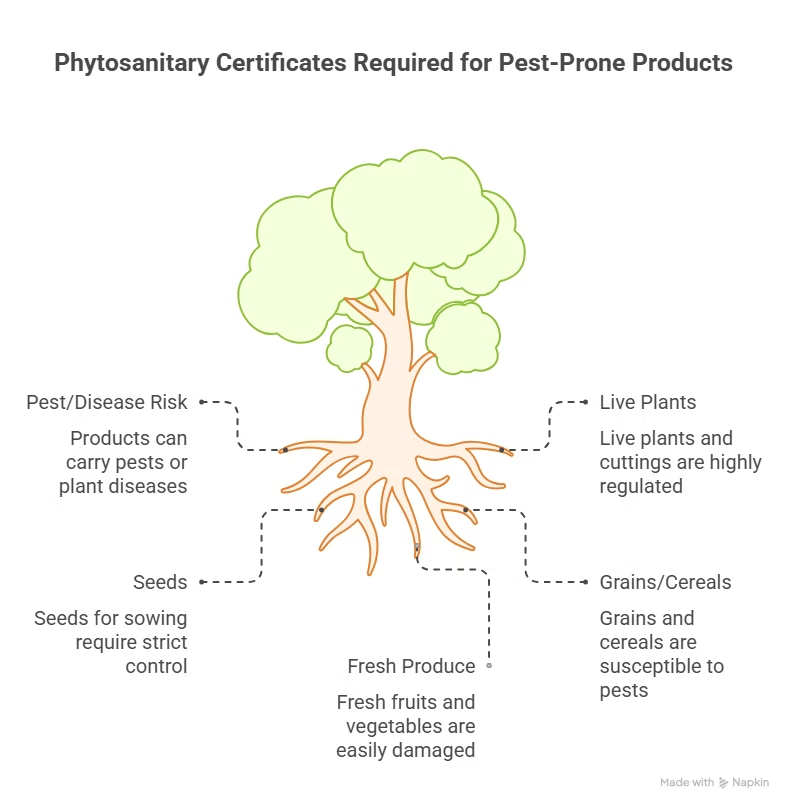
Who Needs One and for Which Products?
The requirement is set by the importing country, not by you. India does not decide that Country X needs a certificate, Country X does. That makes destination research your first job on every new lane.
Products commonly requiring a phytosanitary certificate:
- Plants, bulbs, tubers and seeds for propagation: highest risk category and the most tightly controlled
- Fresh fruits and vegetables: pomegranates, grapes, mangoes, onions, citrus and more
- Cut flowers and branches
- Grains, pulses and oilseeds
- Wood and wood products: timber, and in some cases handicrafts made from raw wood
- Cotton and fibre crops
- Growing media such as cocopeat or soil based substrates
- Other regulated articles like empty containers or vehicles, where technically justified
Under IPPC principles, importing countries should not demand a certificate for processed plant products that pose no realistic risk of carrying regulated pests. Examples that are often (not always) treated as low risk include heavily processed or roasted goods, extracts and finished packaged foods. “Often” is the key word individual countries interpret this differently, so never assume.
A Quick “Do I Need One?” Decision Guide
Work through these three questions in order:
- What exactly is the product, and how processed is it? Raw or lightly processed plant material is likely to need a certificate. Fully processed, packaged goods usually do not, but confirm.
- Where is it going? Check the destination’s official import conditions for your specific commodity (the HS code and the botanical name both help).
- What does the buyer’s import permit say? Many countries issue an import permit with named conditions. If it lists a phytosanitary certificate or additional declarations, you need one, whatever your assumptions were.
If you are still unsure after those three steps, ask the plant quarantine station or the importer’s NPPO directly. A short email now is far cheaper than a held container later.
Types of Phytosanitary Certificates
There are three forms you are likely to encounter.
| Type | When it is used | Issued by | Key requirement |
| Phytosanitary Certificate for Export | Plants or products leave the country where they were grown or processed | Exporting country’s NPPO | Inspection and compliance with destination requirements |
| Phytosanitary Certificate for Re-export | A consignment that was imported is sent on without being grown or substantially processed in the intermediate country | NPPO of the re-exporting country | Original certificate or certified copy, plus proof the consignment’s integrity was maintained |
| Electronic Phytosanitary Certificate (ePhyto) | Digital certificate exchanged between NPPO systems where the destination accepts it | Authorised NPPO through an approved electronic system | Both countries connected and the destination accepting electronic certificates |
Export vs. Re-export in Plain Terms
If you grow, pack or process the goods in India and ship them abroad, you need an export certificate. A re-export certificate applies to traders who import a plant product and send it on. The re-exporting country cannot certify what it did not inspect from origin, so it relies on the original certificate and issues its own on top.
Why ePhyto Is Growing
Paper certificates travel by courier, and couriers get delayed. Paper can also be altered or forged. An ePhyto moves directly between government systems, which brings real benefits:

- Speed: the certificate can reach the destination NPPO before the cargo does.
- Lower fraud risk: the data comes straight from the issuing authority.
- Fewer transcription errors: structured data replaces re-typed paper details.
- Less paperwork loss during transit.
Not every country accepts ePhyto yet, so confirm what your destination takes. Even where it does, you still need to track the certificate’s status and make sure your importer and broker can see it.
Reading a Phytosanitary Certificate Like an Inspector
This is the part most guides skip. Inspectors do not read your certificate top to bottom admiring the stamp. They cross check specific fields against the physical cargo and the other paperwork. Here is the standard format, field by field, with what gets checked and what typically goes wrong.
| Field | What officials look for | Typical error |
| Certificate number | Unique, legible, traceable to the issuing office | Duplicate or unreadable number on photocopies |
| Exporting and importing NPPO | Correct country names in the right boxes | Importing NPPO of the wrong country, often after a buyer reroutes cargo |
| Exporter name and address | Matches invoice and export documents | Trading name on one document, company name on another |
| Consignee name and address | Matches the importer and permit | Notify party entered instead of the consignee |
| Number and description of packages | Matches what physically arrives | Carton count differs from the packing list |
| Distinguishing marks | Marks on the cartons or containers match | Container number added late or mistyped |
| Place of origin | Region or state where the produce was grown | Packing location entered instead of growing location |
| Means of conveyance and point of entry | Mode (sea, air) and port of entry as declared | Port changed after certificate issue |
| Name of produce, quantity and botanical name | Correct scientific name, quantity within tolerance | Common name only, misspelt or outdated botanical name, quantity inflated |
| Certifying statement | The standard wording confirming inspection | Statement altered or removed |
| Additional declarations | Specific conditions the importing country demanded | Missing entirely, because nobody read the import permit |
| Treatment details | Chemical, duration, temperature, date if treatment was applied | Treatment done but not recorded, or dates after the certificate date |
| Stamp, signature, date | Authorised officer, official stamp, dated within validity | Unsigned, smudged stamp, backdated entries |
Three Mismatches That Cause the Most Trouble
1. Botanical name versus common name. “Pomegranate” and “Punica granatum” are the same thing to you, but the system checks the scientific name against the importing country’s list of permitted commodities. A misspelling can make a legal product look like an unlisted one.
2. Quantity versus packing list. The certificate describes what the officer inspected. If you load more than that, or split the shipment differently, the numbers no longer reconcile.
3. Missing additional declaration. This is the quiet killer. The importing country wrote a condition into the permit, such as the produce originating from a pest free area, and nobody transferred it to the application. The certificate looks perfect and is still non-compliant.
What Must Never Appear on the Certificate
The certificate should hold plant health information only. Leave off letters of credit, price and payment terms, pesticide residue claims, radioactivity statements, and anything about animal or human health. If a buyer insists on such wording, route it to the proper document rather than the phytosanitary certificate.
Phytosanitary vs. Fumigation vs. Plant Passport vs. Certificate of Origin
Exporters mix these up constantly, and a wrong assumption can mean a missing document at the port.
| Document | Purpose | Issued by | Used for |
| Phytosanitary certificate | Confirms plant health compliance | Exporting NPPO | International shipments of regulated plant material |
| Fumigation certificate | Records that a treatment was carried out (often for packaging or cargo) | Accredited fumigation agency | Proof of treatment may be recorded on the PC but is not the same document |
| Plant passport | Allows movement of regulated plants within a single plant health territory | Authorized operators or authorities in that territory | Movement inside a region, not international export |
| Certificate of origin | States where goods were produced or manufactured | Chamber of commerce or designated authority | Customs duties and trade agreements |
The simplest way to remember it the phytosanitary certificate answers “Is this plant material safe to let in?” the fumigation certificate answers “Was it treated?”, the plant passport answers “May it move within this territory?”, and the certificate of origin answers “Where did it come from?”
A single shipment can need several of these at once. Fresh produce in wooden crates, for example, may need a phytosanitary certificate for the produce, a record of treatment for the packaging, and a certificate of origin for customs. Check each against the importer’s checklist instead of assuming one covers the others.
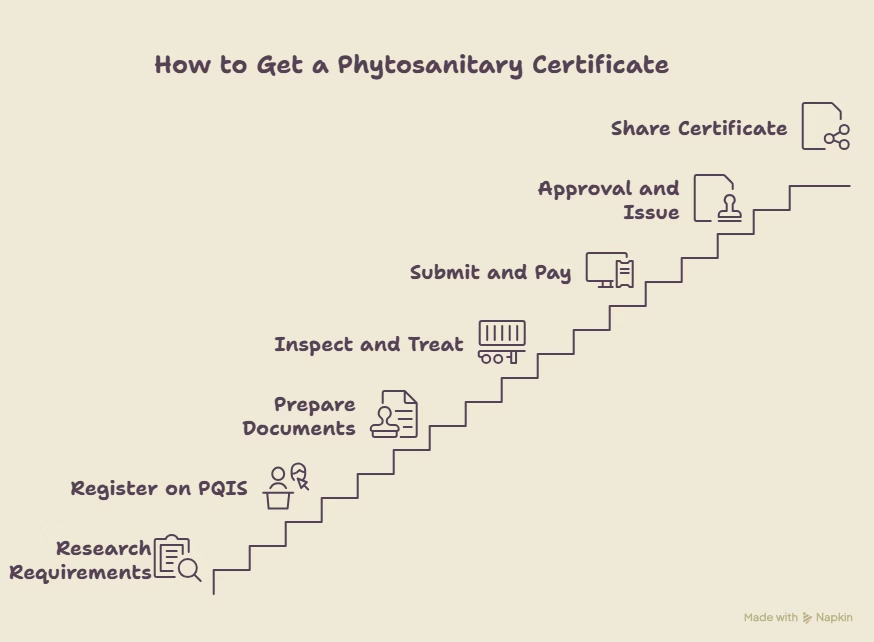
How to Get a Phytosanitary Certificate: Step by Step
In India, phytosanitary certification is handled by the Directorate of Plant Protection, Quarantine & Storage (DPPQS) under the Ministry of Agriculture & Farmers Welfare. DPPQS operates plant quarantine stations at major ports, airports and land borders, and each station’s officers carry out the inspection and issue the certificate.
Applications run through the Plant Quarantine Information System (PQIS), an online portal that replaced much of the old paper process.
Think of it as three layers DPPQS sets the policy, the plant quarantine station near your packing location or port does the physical work, and PQIS is where the application, payment and approval trail lives.
Step 1: Research the Destination’s Import Requirements
Before you pack a single carton, find out what the importing country demands for your exact product. Look for the import permit conditions, any pest free area requirement, required treatments, packaging rules (wood packaging usually has its own standard) and additional declarations. Ask your buyer for the written import permit if one exists. This step decides everything that follows.
Step 2: Register on PQIS
Create an exporter account on the PQIS portal. You will typically need your business details, your Import Export Code (IEC), contact information, and the plant quarantine station you plan to work with. Complete this well before your first shipment, account verification can take time, and you do not want to be waiting on a login the day before loading.
Step 3: Prepare the Documents
The usual set includes the application form, commercial invoice, packing list, certificate of origin where applicable, and an export license if the commodity needs one. The invoice, packing list and application must agree on every detail, because the quarantine officer will compare them. (A full checklist appears in the next section.)
Step 4: Inspection, Sampling and Treatment
The consignment is inspected, and samples may be drawn for lab testing. If the importing country requires treatment such as fumigation or heat treatment, it must be done through an approved process, and the details recorded. Do this before the final certificate, not after.
Step 5: Submit the Application and Pay Fees
File the application on PQIS with the supporting documents and pay the applicable fee online. Keep the payment receipt, it is useful if any question arises about the application later.
Step 6: Approval and Issue
Once the Plant Quarantine Officer is satisfied that the consignment meets the requirements, the certificate is approved and issued, in paper form or as an electronic certificate where the destination accepts it. Read it immediately, before it leaves your hands (see the field by field table earlier).
Step 7: Share the Certificate
Send the certificate to your importer, customs broker and shipping line as the destination requires. If it is a paper original, confirm how and when it will travel, a certificate that arrives after the cargo can be as damaging as no certificate at all.
What Happens on Inspection Day
Inspection is more practical than most first timers expect. Here is what generally happens:
- The goods must be ready. Cartons should be accessible, not stacked behind other cargo or already sealed in a container, unless the station has agreed to inspect at the container.
- Documents are checked first. The officer compares invoice, packing list and application, and checks that the product matches the declared botanical name.
- Samples are drawn. A portion of the consignment is opened and examined for pests, signs of disease, soil, and contamination.
- Treatment records are reviewed, where treatment was required.
- Decision. Clean consignments move to approval. Findings of live pests or irregular documents mean re-treatment, re-sorting or rejection.
A practical tip: Have someone present who can open cartons, answer questions about origin and harvest dates, and correct a minor discrepancy on the spot.
A Realistic Sample Timeline
This is an illustration, not an official schedule. Actual timelines vary by commodity, station workload and whether lab testing is needed.
| Day | What happens |
| Day 0 | Confirm import requirements check PQIS account is active, finalize invoice and packing list |
| Day 1 | Pack goods arrange any required treatment |
| Day 2 | Treatment completed and recorded application drafted on PQIS |
| Day 3 | Application submitted with documents and fee inspection scheduled |
| Day 4 | Inspection and sampling at packhouse or station |
| Day 5 | Officer approval and certificate issues, scanned copy sent to buyer and broker |
If lab testing is involved, add days. Build slack into your schedule, especially around holidays and peak export seasons.
Documents Required, Fees and Processing Time
The exact list depends on your commodity and destination, but this checklist covers what most applications need. The right hand column is where shipments actually go wrong.
| Document | Why it is needed | Common mistake |
| Application form (PQIS) | Formal request and declaration of consignment details | Entering details from memory instead of from the invoice |
| Commercial invoice | Shows exporter, consignee, product and quantity | Description differs from the certificate |
| Packing list | Confirms packages, weights and marks | Carton count changes after packing |
| Certificate of origin | Supports the declared place of origin where required | Origin on certificate and place of growth differ |
| Export licence (if applicable) | Needed for restricted commodities | Assuming it is not needed without checking |
| Import permit (if issued) | Shows the destination’s conditions | Not shared with the quarantine office, so declarations are missed |
| Treatment record | Proof of fumigation or other treatment | Treatment done after the date on the certificate |
| IEC and identity documents | Verifies the exporter | Details not matching across registrations |
Fees and Processing Time
Fees are set by the authority and are revised from time to time, and they can differ by commodity and consignment size. Processing time depends on inspection scheduling, whether testing is needed and how complete your application is.

Check the current figures on the official DPPQS and PQIS portals before you quote a price or a delivery date to a buyer, and do not rely on numbers copied from older articles. Complete, consistent documents are the single biggest factor you control in shortening turnaround.
Validity: How Long Does It Last?
There is no single universal validity period for a phytosanitary certificate. The window depends on the commodity, treatment, packaging, storage and transport conditions, pest risk and above all the importing country’s rules. Some countries state a number of days from issue, others look at the time between inspection and export.
A figure of around 60 days is often cited in exporter guides, and it is a reasonable planning assumption for many shipments. Treat it as a starting point and confirm the exact rule for your destination and product.
Timing Your Application
- Work backwards from arrival, not departure. Count sea transit, transhipment waits and customs clearance, not only the sailing date.
- Avoid applying too early. A certificate issued weeks before loading can expire before the cargo clears.
- Avoid applying too late. A tight schedule leaves no room for a failed inspection or a correction.
- Allow for delays. Port congestion and weather can stretch a transit that looked comfortable on paper.
For perishable goods the problem is less about the certificate expiring and more about the produce, so schedule inspection as close to loading as the station allows.
Why Certificates Get Rejected and How to Prevent It
A certificate can be refused at destination, and the reasons are surprisingly consistent. Importing countries commonly reject certificates that are illegible, incomplete, expired, altered, inconsistent with other documents, issued by an unauthorized body, based on false information, missing required declarations, or supplied as non-certified copies.
| Rejection | Typical cause | Fix |
| Illegible | Poor scan, faded print, smudged stamp | Request a clear original, scan at high resolution |
| Incomplete | Blank fields, missing signature or stamp | Check every field before the certificate leaves the station |
| Expired | Applied too early or transit longer than expected | Time the application to arrival confirm validity rules |
| Altered | Handwritten correction without official authentication | Never edit yourself, ask the issuing office to reissue or amend |
| Inconsistent | Mismatch with invoice, packing list or permit | Reconcile all documents before submission |
| Unauthorised issuer | Document not issued by the NPPO | Only use the official channel |
| False information | Wrong origin, quantity or product declared | Declare accurately the consequences are serious |
| Missing declaration | Import permit conditions not carried across | Read the permit and share it with the quarantine office |
| Non-certified copy | Photocopy sent where an original or certified copy is required | Confirm what the importer accepts |
Pre-Submission Checklist
- Botanical name is spelled correctly and matches the importing country’s list
- Quantity, packages and marks match the packing list
- Exporter and consignee names match invoice and permit exactly
- Place of origin is the place of growth
- Every additional declaration from the import permit is included
- Treatment details are recorded and dated before the certificate
- No commercial or non-plant health wording appears
- Port of entry and mode of transport are current
Exporter Pro Tips: Beyond the Basics
Check the import conditions before you buy or pack. The most expensive mistakes are made upstream. If the destination requires a pest free area or a particular treatment, sourcing from the wrong region cannot be fixed on inspection day.
Make every document tell the same story. Invoice, packing list and certificate should agree on names, numbers and descriptions. Create one master data sheet for each shipment and copy from it, rather than retyping.
Keep copies and track status. Keep digital copies of everything and, where ePhyto is used, check that the certificate has actually reached the destination’s system. Do not assume.
Work with a broker who knows plant products. A customs broker experienced with agricultural goods will catch missing declarations and timing problems that a generalist might miss.
Build a relationship with your plant quarantine station. Officers handle many applications. Exporters who submit clean, complete files and ask early questions are the ones whose shipments move smoothly.
Never alter a certificate yourself. Even a small handwritten fix can lead to rejection. Ask the issuing office to correct it.
Conclusion: Treat the Certificate as Part of the Product
The phytosanitary certificate is not a formality that follows the real work of exporting. It is part of the product. Know the destination’s requirements first, make every document agree with every other, time the application to your transit rather than your sailing date, and read the certificate like an inspector before it leaves the station.
Your next step: pick your next shipment and run the pre-submission checklist above against its documents today. If you would like a printable version, subscribe to our newsletter or request a consultation.
Official resources: FAO guidance on phytosanitary certificates, the IPPC standard ISPM 12, USDA APHIS plant export certification, and India’s PPQS import export procedure pages. Always verify fees, timelines and validity on the official portals before publishing or acting on them.
Frequently Asked Questions
Is a phytosanitary certificate mandatory?
It depends on the importing country and the product. If the destination lists your commodity as regulated, the certificate is a condition of entry. Check the import requirements before shipping.
Who issues a phytosanitary certificate in India?
The Directorate of Plant Protection, Quarantine & Storage (DPPQS), through its plant quarantine stations, issues it as India’s National Plant Protection Organization.
Can I get a phytosanitary certificate online?
Yes, you apply online through the PQIS portal. Inspection of the consignment is still carried out in person, and the certificate is issued after approval.
How much does a phytosanitary certificate cost?
Fees vary and are revised periodically, so check the current schedule on the official DPPQS and PQIS portals rather than relying on third-party figures.
Is it the same as a fumigation certificate?
No. A fumigation certificate records a treatment. A phytosanitary certificate confirms plant-health compliance, and may mention treatment as one of its details.
How long is a phytosanitary certificate valid?
There is no universal period. Around 60 days is commonly cited, but the importing country’s rules for your commodity decide, so confirm before applying.
About the Author
Hi, I’m SriHarsha, founder of shxhub.in.
I focus on explaining import export business topics in a practical, beginner friendly way, based on how exports actually work on the real ground especially documentation, quality control, and buyer expectations.




5 thoughts on “What is Phytosanitary Certificate: Complete Guide for Exporters”