
India doesn’t just grow chilli. It commands it.
With chilli exports valued at $1.41 billion in 2024, India supplies heat, color, and flavor to kitchens, food factories, and spice brands across six continents. From the scorching Teja chilli of Guntur to the deep crimson Byadgi of Karnataka, no country on earth matches India’s varietal range, production scale, or global reach in the chilli trade.
And yet most people who enter this business get it badly wrong.
Here’s the assumption that costs new exporters the most chilli export from India looks simple. Source the product. Pack it. Ship it. Get paid. Clean, linear, obvious.
Except it isn’t any of those things.
Shipments get destroyed at EU ports over aflatoxin levels invisible to the naked eye. US FDA import alerts shut down exporters who didn’t know artificial coloring was a zero tolerance offence. Green chilli consignments rot mid transit because one cold chain link broke quietly and without warning.
This guide exists because those failures are preventable.
What follows is a complete, ground level breakdown of chilli export from India overing varieties, quality standards, documentation, country wise compliance, rejection scenarios, and the export process step by step. No shortcuts. No inflated profit claims. Just what actually works.
Table of Contents
Why India Dominates Global Chilli Trade
Numbers tell part of the story. Geography tells the rest.
India is the world’s largest producer and exporter of chilli not by a narrow margin, but by a scale that competing nations have spent decades trying to close and haven’t. Roughly 30% of India’s total chilli production is exported, while the remaining 70% feeds one of the world’s most chilli dependent domestic food cultures.
That internal demand alone would sustain most countries’ entire agricultural output. India manages both simultaneously. What makes this dominance structural rather than accidental comes down to three things geography, variety, and price.
The growing regions are world class and globally recognized. Guntur in Andhra Pradesh is perhaps the most famous chilli market on earth overseas buyers don’t just say “Indian chilli,” they say “Guntur Sannam” or “Guntur Teja” because the origin matters to them.
Warangal in Telangana, Byadgi in Karnataka, and chilli belts across Tamil Nadu are similarly recognized sourcing hubs among serious international spice buyers. These aren’t just farming areas. They are ecosystems with mandis, processors, cold storage, testing labs, and generations of trade knowledge built around chilli.
Varietal diversity is India’s competitive moat. No other exporting country offers the same range. Vietnam dominates on volume with a narrower varietal profile. China competes on price but lacks the reputation for quality and traceability that premium buyers demand.
Mexico and Peru have their own niches, but neither can match the sheer breadth of what India offers from the mild, color rich Byadgi and Kashmiri varieties to the nuclear grade Bhut Jolokia, and everything in between.
Price competitiveness keeps buyers returning. Red chilli exporters in India can serve bulk commodity buyers, food processors, ethnic spice brands, and premium retail channels often simultaneously. Chilli exporters in Guntur alone handle transactions ranging from small merchant orders to multi container institutional supply contracts.
The result is a trade that has remained resilient through currency shifts, monsoon cycles, and tightening global food regulations because when buyers need reliable chilli at scale, India remains the answer most of them come back to.
Types of Chilli Products Exported from India
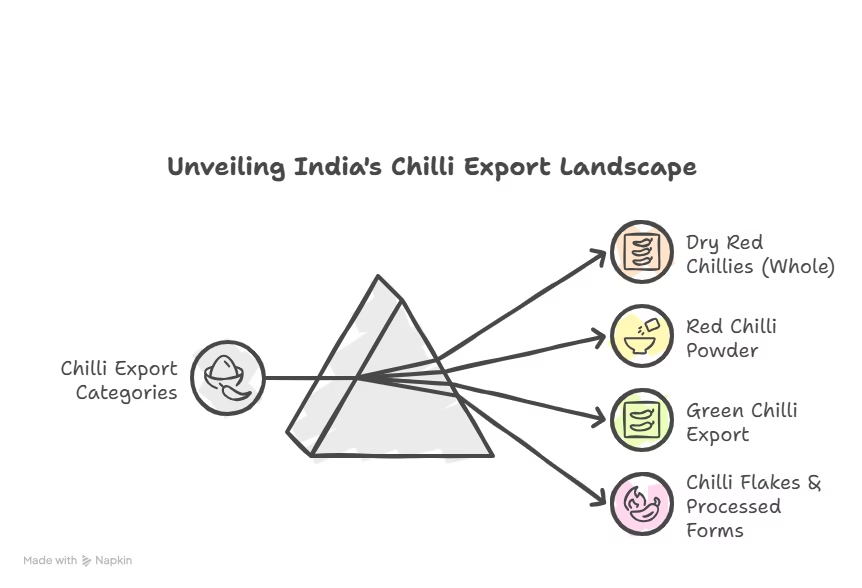
Not all chilli exports are equal. The product form you choose determines your buyer profile, compliance burden, margin potential, and risk exposure. Here’s how the four main categories actually behave in the real export market.
Dry Red Chillies (Whole)
Whole dried red chillies are the backbone of India’s chilli export trade and for good reason.
They offer superior shelf life compared to powder or fresh chilli, are easier to store and transport over long distances, and give buyers the flexibility to process them according to their own specifications. A food manufacturer in Germany and a spice blender in Dubai can both buy the same Guntur Sannam consignment and put it to entirely different uses.
Key export varieties in this category include Guntur Sannam (S4), Teja, Byadgi, and Kashmiri chilli each with a distinct flavor, heat level, and color profile that drives different buyer segments.
The risk here is deceptive. A consignment can look visually perfect bright red, uniformly dried, cleanly sorted and still fail destination lab testing for aflatoxin or pesticide residues. What the eye cannot see is exactly what overseas inspectors are trained to find.
Red Chilli Powder
Red chilli powder exporters operate under heavier scrutiny than whole chilli exporters and the gap is widening.
The reason is straightforward powder is easier to adulterate. Inferior or old chillies can be blended in during grinding. Artificial coloring agents can be added to boost visual appeal. Starch or flour can be used to increase volume. Importing authorities in the EU, USA, and Gulf markets know this, and they test accordingly.
What serious buyers check for in chilli powder:
- ASTA colour value — the benchmark for natural colour intensity
- Artificial dye detection — zero tolerance in US and EU markets
- Microbial load — Salmonella and E. coli are tested routinely
- Adulteration markers — starch presence, foreign grain content
The opportunity in red chilli powder is real margins are higher than whole chilli, and demand from food manufacturers is consistent. But the compliance bar is higher. Exporters who cut corners on powder don’t just lose a shipment. They lose the buyer permanently and risk being flagged across markets.
Green Chilli Export from India
Green chilli export is a different discipline entirely faster, riskier, and less forgiving than dry chilli trade.
Fresh green chillies are highly perishable. A temperature deviation during transit, a delay at cargo terminals, or a gap in cold chain management can turn a viable shipment into an unsellable one within hours. Unlike dry red chilli, there is no margin for logistical error.
Exporters in this segment must manage:
- Cold chain continuity from farm to destination, without interruption
- Phytosanitary certification — mandatory and destination specific
- Rapid documentation processing — delays cost quality, not just time
- Residue compliance — EU MRLs and GCC-SFDA MRLs are particularly strict
The dominant markets for green chilli are the Middle East and Southeast Asia driven by large South Asian diaspora populations and established ethnic food retail networks. These buyers prioritize freshness and firmness over price. A supplier who delivers consistently firm, residue compliant green chillies commands loyalty in this segment.
Chilli Flakes & Processed Forms
Chilli flakes, crushed chilli, and chilli based processed products represent a smaller but quietly growing slice of India’s chilli export portfolio.
Demand is rising particularly in EU and US retail markets, where consumers want convenience formats pizza toppings, spice blends, condiment ingredients. Food service chains and packaged food manufacturers are consistent buyers of crushed chilli and chilli infused products.
The opportunity here is margin. Processed formats command higher per kilogram value than whole or powder exports. The trade off is that processing adds compliance layers packaging requirements, labelling rules, and shelf life declarations vary significantly by destination market.
For exporters looking to move up the value chain without entering the green chilli cold chain game, chilli flakes represent a logical and increasingly viable next step.
Major Chilli Varieties and What Buyers Actually Want
Most guides list chilli varieties the same way a textbook lists species name, heat level, done. That approach misses the point entirely.
In real export transactions, variety selection is a buyer communication problem, not a botany exercise. The question isn’t which chilli does India grow? It’s which chilli does this specific buyer need for their specific application? Get that wrong and you’re either overselling heat to a color buyer, or underselling pungency to a hot sauce manufacturer who needed fire and got flavor.
Here’s how India’s major export varieties actually map to buyer intent.
| Variety | Heat (SHU) | Key Export Use | Top Markets |
| Guntur Sannam (S4) | 30,000–40,000 | Whole & powder | EU, US, Middle East |
| Teja | 90,000–170,000 | Heat-driven products | Asia, Middle East |
| Byadgi | 8,000–15,000 | Colour & oleoresin | EU, food processors |
| Kashmiri | 1,000–2,000 | Natural colouring | Middle East, UK |
| Bhut Jolokia | 800,000+ | Specialty sauces | US, Europe |
| Jwala | Moderate | Green chilli export | Middle East, SE Asia |
| G4 (Hybrid) | Variable | Large-scale bulk | Global |
Guntur Sannam (S4) is the workhorse of chilli export from India to globally recognized, consistently demanded, and versatile enough to serve both whole chilli buyers and powder manufacturers. When overseas buyers search for chilli exporters in Guntur, this is typically the variety anchoring the conversation. Stable demand, but aflatoxin vigilance is non-negotiable.
Teja is the heat specialist. At 90,000 to 170,000 SHU(Scoville Heat Units), it serves buyers building hot sauces, spicy snack seasonings, and high pungency food products. Asian and Middle Eastern buyers drive Teja demand heavily. The risk is its high moisture retention makes aflatoxin and mold management more critical than most other varieties.
Byadgi is about color, not fire. Food processors and oleoresin manufacturers in Europe pay a premium for Byadgi’s deep, natural red pigment often preferring it specifically because the heat is low. If a buyer’s application is visual and not thermal, Byadgi is the answer.
Kashmiri chilli shares Byadgi’s logic mild heat, rich color, strong demand from Middle Eastern and UK markets where vibrant natural color in curry blends and marinades is the primary requirement. It’s also one of the varieties most frequently scrutinized for adulteration, which means traceability matters especially here.
Bhut Jolokia — the ghost pepper sits at the extreme end of the spectrum at over 800,000 SHU. It’s not a beginner’s export variety. Specialty sauce brands and novelty food manufacturers in the US and Europe pay well for it, but volumes are smaller and buyer requirements are highly specific.
Jwala dominates the green chilli export segment moderate heat, distinctive flavor, strong recognition among South Asian diaspora communities in the Middle East and Southeast Asia. Its export life is measured in days, not weeks, which makes cold chain reliability the make-or-break factor.
G4, a hybrid variety, is the large scale buyer’s preference uniform size, consistent quality, predictable yield. It doesn’t carry the regional prestige of Guntur Sannam or Byadgi, but institutional buyers running high volume operations value its consistency above everything else.
The closing reality of variety selection is price is the last conversation, not the first. Before quoting a rate, a serious exporter asks what the buyer is making, where it’s going, and what quality parameters they’re working to. The right variety for the right application is what turns a one time transaction into a repeat relationship.
Top Export Markets for Indian Chilli
India’s chilli export market spans six continents, but not all destinations are equal in terms of volume, value, compliance complexity, or growth potential. Understanding what each market actually buys and what it demands in return is what separates exporters who scale from those who stall after one or two shipments.
Asia — Volume, Speed, and Competitive Pricing
China, Bangladesh, Thailand, and Vietnam collectively represent the highest volume destination bloc for Indian chilli exports. These are bulk buyers food manufacturers, spice processors, and wholesale distributors operating at scale.
What they buy: primarily dry red chillies and chilli powder, with strong demand for high pungency varieties like Teja.
What they demand: competitive pricing, consistent supply, and basic quality compliance. While standards are less stringent than EU or US markets, rising food safety awareness in China and Thailand is gradually tightening import scrutiny.
Opportunity level: High volume, moderate margins. Best suited for exporters who can move large quantities reliably.
Middle East — Steady Demand, Bulk Buying Power
UAE and Saudi Arabia anchor India’s Middle East chilli trade, with consistent demand driven by large South Asian expatriate populations and well established ethnic food retail networks.
What they buy: dry red chillies, chilli powder, and green chillies across both retail and food service channels.
What they demand: Gulf Cooperation Council (GCC)-Saudi Food and Drug Authority (SFDA) maximum residue limit compliance, halal certification where applicable, and clean labelling. Green chilli exporters targeting this market must prioritize cold chain and phytosanitary documentation.
Opportunity level: Steady and reliable. Not the highest margins, but buyer relationships here tend to be long term and repeat oriented.
North America — High Value, Zero Tolerance
The United States is the most demanding and most rewarding destination for Indian chilli exporters who get compliance right.
What they buy: chilli powder, whole dried chillies, chilli flakes, and specialty varieties like Bhut Jolokia for the premium and hot sauce segment.
What they demand: FDA facility registration, Prior Notice filing before every shipment, and absolute zero tolerance for artificial coloring agents. US import alerts once issued ,are damaging and difficult to reverse. Pesticide residue standards are strict and actively enforced.
Opportunity level: High value, high margin but only for exporters with rigorous quality systems and full documentation discipline.
Europe — The Highest Bar, The Best Returns
UK and Germany represent the premium tier of the global chilli export market. EU import standards are among the strictest in the world particularly around aflatoxin limits, pesticide MRL(Maximum Residue Limit), and full supply chain traceability.
What they buy: high color varieties like Byadgi and Kashmiri, chilli powder for food manufacturing, and increasingly, organic and traceable chilli products commanding premium pricing.
What they demand: complete traceability from farm to port, rigorous pre-shipment lab testing, and compliance with EU maximum residue limits. A single RASFF (Rapid Alert System for Food and Feed) alert the EU’s rapid food safety notification system can damage an exporter’s reputation across the entire bloc simultaneously.
Opportunity level: Highest margins available in the global market. Requires the most preparation, but rewards consistent exporters with sustainable, long term buyer relationships.
Africa — The Emerging Frontier
African markets particularly Kenya, Nigeria, and East Africa broadly represent a growing destination for Indian chilli exports, driven by rapid urbanization, expanding food processing industries, and strong cultural appetite for spice.
What they buy: primarily dry red chillies and chilli powder at competitive price points.
What they demand: price sensitivity remains the dominant factor, though food safety inspection standards are tightening gradually across major African import ports.
Opportunity level: Emerging and promising particularly for exporters able to offer consistent quality at competitive pricing while compliance requirements in these markets continue to evolve.
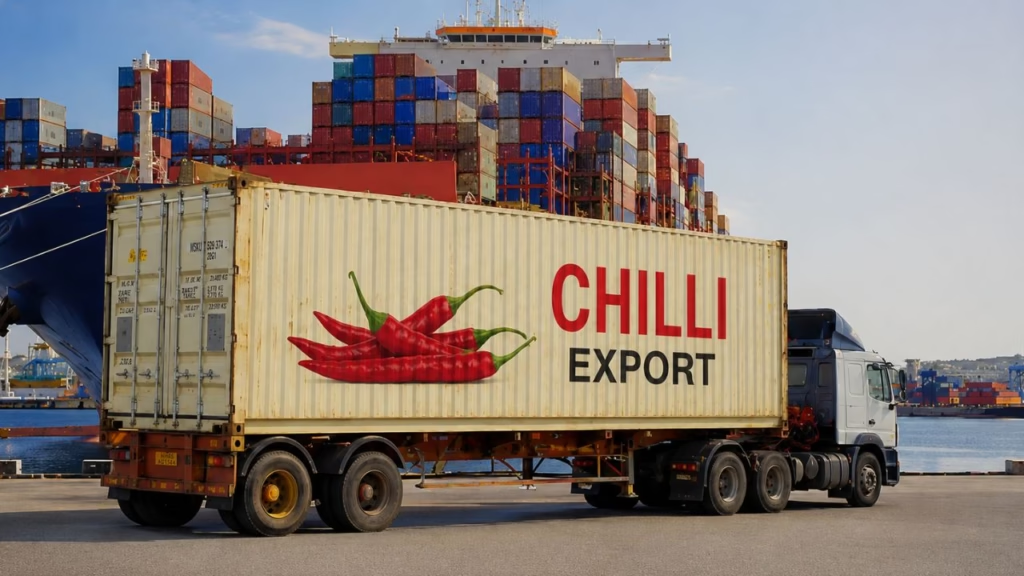
9 Non-Negotiable Quality Standards for Chilli Export from India
Quality in chilli export isn’t a checklist you complete once before shipping. It’s a discipline you build into every stage of the operation sourcing, processing, storage, and documentation. Miss any single standard and the consequences aren’t just financial. They’re reputational, and in international trade, reputation travels faster than any shipment.
Here are the nine standards that separate exporters who build lasting buyer relationships from those who exit quietly after their first rejection.
1. Moisture Content — The Foundation of Everything
What it is: The percentage of water retained in dried chilli, measured before packaging and shipment.
Why it matters: Excess moisture is the silent enabler of every other quality failure. High moisture creates conditions for mold growth, aflatoxin development, and microbial proliferation all during transit, invisible inside sealed packaging.
The standard: Dry red chillies must stay consistently below 10–12% moisture content for safe export.
What failure looks like: A visually perfect consignment loaded at Mundra port arrives in Rotterdam with fungal growth inside bags. The chilli looked fine at departure. Moisture did its work quietly across 30 days at sea.
2. Aflatoxin Compliance — The Number One Rejection Cause
What it is: Aflatoxins are toxic compounds produced by Aspergillus moulds, which thrive in improperly dried or stored chilli.
Why it matters: The EU enforces some of the world’s strictest aflatoxin limits and tests aggressively for them. Indian chilli has historically been one of the most flagged categories in EU RASFF food safety alerts, making this the single most critical compliance point for any exporter targeting European markets.
What failure looks like: An exporter clears Indian port inspection. EU customs tests the same shipment. Aflatoxin levels breach EU limits. The entire consignment is destroyed at the importer’s cost, the exporter is flagged in RASFF, and future Indian shipments from that supplier face heightened examination across the bloc.
Passing domestic tests is not a guarantee of passing destination tests. Never treat it as one.
3. Pesticide Residue Limits (MRLs) — Country-Specific, Not Universal
What it is: Maximum Residue Limits define the highest legally permitted concentration of pesticide residues in food products at point of import.
Why it matters: What clears Indian domestic standards may fail in the EU, USA, or Japan because each market sets its own MRL thresholds, and they vary significantly. Exporters who source from farms without controlling pesticide usage are essentially gambling with every shipment.
What failure looks like: A chilli powder consignment destined for Germany fails MRL testing for a commonly used Indian agricultural pesticide that is permitted domestically but exceeds EU thresholds. Import is refused. The cost product, freight, and relationship falls entirely on the exporter.
4. ASTA Colour Value — The Buyer’s Benchmark for Quality
What it is: The ASTA (American Spice Trade Association) color measurement system quantifies the natural red pigment intensity of chilli and chilli powder.
Why it matters: For powder buyers particularly food manufacturers and spice blenders ASTA color value is often the primary purchasing specification. It determines the visual appeal of their end product. Buyers specify minimum ASTA values in contracts, and shipments falling short face rejection or price renegotiation.
What failure looks like: An exporter ships chilli powder without conducting ASTA testing. The buyer’s own lab reports a color value 20% below the contracted specification. Price is renegotiated downward or the shipment is refused entirely.
5. Foreign Matter & Cleanliness — Basic But Still Failing
What it is: The presence of stones, stems, dust, insect fragments, or other non-chilli material in a consignment.
Why it matters: Manual sorting alone is no longer adequate for serious buyers. Mechanical cleaning, optical sorting, and metal detection have become baseline expectations not premium offerings in the current export environment.
What failure looks like: A pre-shipment buyer audit finds stones and stem fragments in bagged chilli. The shipment is rejected before loading. The exporter loses freight costs, storage charges, and the order.
6. Microbial Load — Salmonella and E. coli Are Actively Tested
What it is: The presence of harmful microorganisms particularly Salmonella and E. coli in chilli products.
Why it matters: EU and US markets conduct routine microbial testing on spice imports. Poor storage conditions, damp warehouses, and unhygienic grinding environments are the most common contamination sources. A microbial failure in the US triggers FDA import alerts that follow an exporter across future shipments.
What failure looks like: A chilli powder exporter using an inadequately sanitized grinding facility ships product with Salmonella contamination. US FDA issues an import alert. The exporter is effectively locked out of the US market until the alert is resolved a process that takes months and significant documentation.
7. Uniform Grading & Size Consistency — Repeat Orders Depend on This
What it is: The consistency of chilli size, shape, and visual appearance within a consignment.
Why it matters: Buyers building retail spice products or food manufacturing lines need predictable inputs. Inconsistent grading creates problems in their own production and signals to the buyer that the exporter lacks process control.
What failure looks like: A buyer receives a consignment with significant size variation. Product clears customs but generates complaints at the buyer’s processing stage. The next order goes to a different supplier without explanation.
8. Packaging Standards — Protection Is the Point
What it is: The quality, thickness, and design of export packaging including inner liners, outer bags, moisture barriers, and labelling.
Why it matters: Export grade packaging protects color, aroma, and moisture levels across long transit times and variable storage conditions. Inadequate packaging transfers risk to the product itself and gives buyers grounds for claims on arrival condition.
What failure looks like: An exporter uses thin single layer bags to reduce costs. Transit humidity compromises the chilli inside. Buyer documents arrival condition, files a quality claim, and recovers cost from the shipment payment.
9. Traceability & Batch Documentation — The Non-Negotiable for Premium Markets
What it is: The ability to track a chilli consignment back to its source farm, harvest season, processing batch, and lab test records.
Why it matters: European buyers increasingly require full supply chain traceability as a baseline condition, not a premium feature. Without it, exporters are disqualified from consideration before price is even discussed.
What failure looks like: A large German spice brand asks for batch traceability records as part of supplier onboarding. The exporter cannot provide them. The contract goes to a competitor who can.
The Step by Step Chilli Export Process from India
Understanding what buyers want is half the work. Getting the product to them legally, safely, and profitably is the other half. Here is how a complete chilli export transaction actually moves from registration to payment.
Step 1: Business Registration — Get the Legal Foundation Right
Before sourcing a single kilogram of chilli, the legal structure must be in place.
Essential registrations:
- IEC (Import Export Code) — issued by DGFT mandatory for all export activity
- GST Registration — required for tax compliance and refund claims
- PAN — prerequisite for IEC and banking
- APEDA Registration — mandatory for agricultural and processed food exports including spices
APEDA registration in particular unlocks access to export promotion schemes, quality certification support, and recognition in destination market documentation. Skipping it is not an option for chilli exporters targeting regulated markets.
Step 2: Sourcing — Mandi vs Contract Farming
Most beginners source from mandis the wholesale agricultural markets in Guntur, Warangal, and other chilli hubs. It’s fast, flexible, and accessible. It’s also harder to control for quality consistency, residue compliance, and traceability.
Serious exporters progressively shift toward contract farming arrangements working directly with farmer groups or FPOs (Farmer Producer Organizations) to control pesticide usage, harvest timing, and post harvest handling at source.
Supplier audits matter here. Visiting a farm or processing unit before finalizing a source is not excessive due diligence it’s basic risk management that prevents rejections downstream.
Step 3: Quality Testing — Test Before You Pack
Pre-shipment lab testing is not optional for any regulated market destination. It is the difference between a shipment that clears and one that gets destroyed.
Tests to conduct before every export shipment:
- Aflatoxin (B1 and total)
- Pesticide residue panel (MRL compliance for destination market)
- Moisture content
- ASTA colour value (for powder)
- Microbial testing (Salmonella, E. coli) for EU and US shipments
Use NABL (National Accreditation Board for Testing and Calibration Laboratories) accredited laboratories. Keep all test reports batch referenced and archived buyers and customs authorities will ask for them.
Step 4: Sorting, Drying & Processing
For whole dry chillies: mechanical sorting and optical grading have replaced manual sorting as the baseline expectation among serious buyers. Sun drying alone is insufficient for consistent moisture control mechanical drying with temperature monitoring produces more reliable results.
For chilli powder: the grinding environment matters as much as the chilli itself. Controlled, sanitized grinding facilities with proper ventilation and cleaning protocols between batches are essential for microbial compliance. This is where most powder exporters cut corners and where most powder rejections originate.
Step 5: Packaging
Export grade packaging for chilli typically involves:
- Inner moisture barrier (food grade liner)
- Outer woven PP or jute bag for structural protection
- Correct labelling — product name, variety, net weight, country of origin, batch number, HS code
Labelling errors on packaging create customs delays and, in some markets, automatic holds. Get labelling right before bags are sealed.
Step 6: Documentation
Complete, accurate, and consistent documentation is what moves a shipment through customs without delay. A single mismatch between invoice and packing list can hold a container for days. Full documentation checklist is detailed in Section 7.
Step 7: Freight Booking — FCL, LCL, and Cold Chain
FCL (Full Container Load) is standard for large chilli shipments typically 14–18 metric tons per 20-foot container for dry chilli.
LCL (Less than Container Load) works for smaller trial shipments or niche product volumes useful for first orders with new buyers.
For green chilli: refrigerated containers (reefers) are non-negotiable. Temperature must be maintained from farm cold room through port handling to destination. Any break in this chain even a short one at a transit hub can compromise an entire consignment.
Step 8: Customs Clearance & Shipping
The shipping bill is filed through ICEGATE, India’s customs portal. A licensed customs broker (CHA) Customs House Agent handles the technical clearance process and coordinates with port authorities.
Key checkpoints:
- Phytosanitary certificate issued by Plant Quarantine authorities (mandatory for most destinations)
- Certificate of Origin from authorized issuing bodies
- Shipping bill approval and let export order from customs
Exporters targeting the US must file Prior Notice with US FDA before the vessel departs. Missing this step means the shipment can be held or refused at the US port of entry.
Step 9: Payment & Post-Shipment
Payment terms in chilli export typically run on Letter of Credit (LC) for new buyer relationships, or Telegraphic Transfer (TT) advance or against documents for established ones.
Post-shipment, exporters must file the Export General Manifest (EGM), submit shipping documents to the bank for negotiation, and track shipment arrival with the buyer.
IGST refund claims are filed after EGM confirmation a step many new exporters delay, unnecessarily leaving working capital tied up.
Complete Documentation Checklist for Chilli Export from India
If quality is what gets your chilli into a container, documentation is what gets that container through customs. A single mismatch a weight discrepancy between invoice and packing list, a missing certificate, an incorrectly declared HS code can hold a shipment for days, trigger storage charges, and frustrate buyers who have production schedules dependent on your delivery.
Bookmark this section. Come back to it before every shipment.
The Core Documents
1. Commercial Invoice The financial and legal record of the transaction. Must state exporter and importer details, product description, quantity, unit price, total value, currency, payment terms, and HS code. Every other document must align with the invoice discrepancies here cascade across the entire documentation set.
2. Packing List Itemizes every carton, bag, or pallet in the shipment net weight, gross weight, dimensions, and number of units. Customs authorities cross reference this against the invoice and physical cargo. Inconsistencies cause holds.
3. Shipping Bill India’s primary export customs document, filed electronically through ICEGATE. The Let Export Order (LEO) issued after shipping bill approval is what legally permits cargo to leave Indian territory.
4. Bill of Lading / Airway Bill Issued by the shipping line or airline the title document for the cargo. Original Bill of Lading is required for LC based payment negotiations with the bank. For air freight shipments of green chilli, the Airway Bill serves this function.
5. Phytosanitary Certificate Issued by India’s Plant Quarantine authorities certifies that the chilli consignment is free from pests and plant diseases. Critical and mandatory for green chilli exports. Also required by most destinations for dry chilli. Apply early processing delays at Plant Quarantine can hold up shipment schedules.
6. Certificate of Origin Confirms the product’s Indian origin required for customs duty calculation at destination and for preferential trade agreement benefits where applicable. Issued by FIEO(Federation of Indian Export Organizations), Export Inspection Council, or Chamber of Commerce depending on destination requirements.
7. Lab Test Reports Pre-shipment lab reports are increasingly treated as mandatory supporting documents rather than optional attachments particularly for EU and US shipments.
Reports must cover:
- Aflatoxin (B1 and total)
- Pesticide residue panel (MRL-compliant for destination)
- Microbial testing (Salmonella, E. coli)
- ASTA colour value (for chilli powder)
Use NABL accredited labs. Ensure reports are batch referenced and dated within acceptable windows for the destination authority.
8. APEDA Registration Certificate Confirms the exporter’s registration with the Agricultural and Processed Food Products Export Development Authority. Required for agri product exports and frequently requested by overseas buyers as a credibility document.
9. FDA Prior Notice (USA-bound shipments) Mandatory for all food shipments entering the United States. Must be filed electronically through the US FDA’s Prior Notice System Interface before the vessel departs. Missing or late filing means the shipment can be held or refused at the US port regardless of product quality.
10. Halal Certificate (GCC markets where applicable) Required for certain chilli products entering Saudi Arabia, UAE, and other GCC markets particularly processed forms. Issued by an approved halal certification body. Confirm destination specific requirements before shipment, as GCC (Global Capability Center) member states vary in their individual halal documentation requirements.
HS Code Reference — Get This Right on Every Document
The Harmonized System code declared on your shipping bill, invoice, and packing list must be accurate. Wrong HS codes affect duty calculation, customs clearance speed, and trade data accuracy and in some markets, deliberate misclassification carries penalties.
| Product | ITC HS Code |
| Dry red chilli (whole) | 0904 20 10 |
| Chilli powder | 0904 20 20 |
| Fresh green chilli | 0709 60 10 |
Green chilli and dry chilli are classified under entirely different chapters a distinction that matters for duty treatment, phytosanitary requirements, and import licensing in several destination markets. Treat them as separate products, not variants of the same one.
Country Wise Compliance Requirements for Chilli Export
Knowing your product is only half the compliance equation. Knowing exactly what each destination market demands and what it will not tolerate is what keeps shipments moving and buyer relationships intact. Here is the ground level compliance reality for India’s five key chilli export markets.
European Union — The World’s Strictest Standard
The EU operates the most rigorous food import framework in the global chilli trade, and Indian chilli has historically been one of the most scrutinized categories within it.
What to prepare:
- Full aflatoxin testing to EU limits which are significantly stricter than Indian domestic thresholds
- Complete supply chain traceability documentation, from farm origin through processing and export
- MRL compliant pesticide residue reports using an EU approved testing panel
- Microbial testing results for Salmonella and other pathogens
- Accurate labelling aligned with EU food information regulations
What to avoid: Any assumption that Indian clearance equals EU clearance. The RASFF Rapid Alert System for Food and Feed is the EU’s real time food safety notification network. An alert against your consignment is publicly visible, shared across all EU member states simultaneously, and triggers enhanced inspection of all future shipments from that exporter. One alert can effectively close the entire EU market to a supplier for months.
Opportunity: Highest margins in the global market for exporters who consistently meet the standard. EU buyers building long term supplier relationships are loyal and high value.
United States — High Value, Zero Tolerance
The US market rewards quality and punishes non-compliance with unusual speed and permanence.
What to prepare:
- FDA facility registration — mandatory before any food product can be exported to the US
- Prior Notice filing for every shipment, completed before vessel departure
- Pesticide residue testing aligned with US EPA MRL standards distinct from EU and Indian thresholds
- Full documentation of processing environment and quality controls for chilli powder shipments
What to avoid: Artificial coloring agents in any form. US FDA enforces a genuine zero tolerance position on undeclared color additives in spice products and tests for them routinely. An import alert issued by FDA is publicly listed on the FDA website, visible to all US buyers, and can follow an exporter for years. Recovery is possible but slow, expensive, and documentation intensive.
Opportunity: Premium pricing for quality compliant Indian chilli particularly Bhut Jolokia, Byadgi for oleoresin, and high ASTA powder for food manufacturing applications.
Middle East (GCC) — Compliance With Cultural Context
The Gulf Cooperation Council markets Saudi Arabia, UAE, Kuwait, Qatar, Bahrain, and Oman represent consistent, relationship driven demand for Indian chilli across both retail and food service channels.
What to prepare:
- GCC-SFDA MRL compliance the Saudi Food and Drug Authority sets residue limits that apply across much of the Gulf and must be tested against specifically
- Halal certification for applicable processed chilli products requirements vary by GCC member state, so confirm destination specific rules before shipment
- SASO (Saudi Standards, Metrology and Quality Organization) conformity for Saudi bound shipments
- Clean, accurate Arabic and English labelling for retail format products
What to avoid: Assuming GCC compliance is uniform across member states. Saudi Arabia, UAE, and Kuwait each maintain specific documentation and labelling requirements. A certificate acceptable in Dubai may not satisfy Riyadh’s requirements without modification.
Opportunity: Strong diaspora driven demand, established trade relationships, and consistent repeat buying patterns make the Middle East one of India’s most reliable chilli export regions.
Southeast Asia — Appearance, Price, and Phytosanitary Compliance
Thailand, Vietnam, Malaysia, and Indonesia are significant volume buyers of Indian chilli particularly for food manufacturing and wholesale distribution.
What to prepare:
- Phytosanitary certificates — consistently required and actively checked at Southeast Asian ports
- Visual quality compliance — Southeast Asian buyers are particularly attentive to colour uniformity, surface appearance, and freedom from foreign matter
- Competitive pricing with reliable volume commitment — this market moves on both quality and price together
What to avoid: Underestimating phytosanitary requirements. Port rejection for inadequate plant health documentation is common in this region and creates significant logistical complications for time sensitive shipments.
Opportunity: Growing food processing industries across Southeast Asia are creating sustained demand for Indian chilli as a manufacturing input a segment that rewards consistent, volume capable suppliers.
Africa — The Emerging Market with Rising Standards
Kenya, Nigeria, Ethiopia, and broader East and West Africa represent a growing frontier for Indian chilli exports driven by urbanization, expanding food processing sectors, and deep cultural familiarity with spiced food.
What to prepare:
- Competitive pricing structure — African buyers are acutely price sensitive and will compare multiple source country options
- Basic food safety documentation — certificates of origin, phytosanitary certificates, and lab reports are increasingly expected even where not yet strictly enforced
- Flexible packaging formats — retail and wholesale buyers in Africa often require smaller pack sizes than traditional bulk export formats
What to avoid: Treating Africa as a compliance free market. Port inspection standards are tightening across major African import hubs, and exporters who ship lower grade product assuming reduced scrutiny are increasingly finding themselves on the wrong side of that assumption.
Opportunity: First mover advantage for exporters who establish reliable supply relationships now before African import standards fully align with global norms and competition for compliant suppliers intensifies.
Real Rejection Scenarios & How to Avoid Them
Every experienced chilli exporter carries at least one of these stories. A shipment that cleared every Indian checkpoint, sailed across an ocean, and got destroyed at destination. A buyer relationship built over months, ended in a single lab report. A documentation error that turned a profitable order into a demurrage bill.
These scenarios aren’t rare edge cases. They are the recurring patterns of how chilli export goes wrong and understanding them is the fastest way to make sure they don’t happen to you.
Case 1: EU Aflatoxin Failure — After Indian Clearance Passed
A dry red chilli exporter from Guntur ships a container to Germany. Indian pre-shipment inspection passes without issue. The shipping bill clears. The vessel departs.
At Hamburg port, EU customs conducts routine testing. Aflatoxin B1 levels in the consignment exceed EU maximum limits. The importer has no legal option the cargo is ordered for destruction.
The exporter absorbs the loss of product and freight. The buyer relationship ends immediately. Within weeks, a RASFF alert is issued publicly visible across all 27 EU member states and future shipments from that exporter face mandatory enhanced examination at every EU port of entry.
The pattern: The exporter trusted Indian clearance as a proxy for EU compliance. It isn’t. EU aflatoxin thresholds are stricter, and EU labs test more aggressively. The gap between passing in India and failing in Europe is real and well documented.
How to avoid it: Commission aflatoxin testing at an NABL accredited lab using EU specific limit benchmarks not just Indian standards before every EU bound shipment. Control storage conditions between procurement and loading. Never let chilli sit in humid godowns between drying and dispatch.
Case 2: US FDA Artificial Color Detection — Import Alert Issued
A chilli powder exporter adds a permitted synthetic colorant to improve the visual consistency of a batch before shipping to a US buyer. The assumption, it’s a common practice, buyers won’t test for it, and the color improvement justifies the risk.
US FDA tests the shipment on arrival. The artificial colorant is detected. An import alert is issued and published publicly on the FDA website visible to every US food buyer who searches that exporter’s name.
The immediate buyer relationship ends. Future shipments from the same exporter are automatically detained at US ports pending testing an expensive, time consuming process that effectively makes the US market inaccessible until the alert is resolved.
The pattern: The exporter treated colour adulteration as a calculated risk rather than a zero tolerance violation. In US chilli powder exports, it is always the latter.
How to avoid it: Never add undeclared colorants to any export product. Invest in sourcing high ASTA chilli varieties naturally Byadgi and Kashmiri chilli command color value without artificial enhancement. Test every powder batch for color additives before shipment.
Case 3: Green Chilli Cold Chain Failure — Buyer Withholds Payment
A green chilli exporter ships a consignment to a UAE buyer via air freight. Cold chain management at the origin cold room is sound. But a handling delay at the transit hub outside the exporter’s direct control results in a temperature excursion of several hours.
The chilli arrives soft, with early signs of fungal development. The buyer documents arrival condition with photographs and a third party inspection report. Payment is withheld. The exporter receives a fraction of the agreed value after weeks of negotiation.
The pattern: Green chilli cold chain failure doesn’t always originate with the exporter’s negligence. But the financial consequence lands on the exporter regardless. Transit risk in perishable export is real, shared unevenly, and rarely covered without the right insurance and contractual protections in place.
How to avoid it: Use established freight forwarders with documented cold chain handling protocols at transit hubs. Insure perishable shipments explicitly. Negotiate arrival condition inspection clauses with buyers upfront not after a dispute has already started.
Case 4: Documentation Mismatch — Demurrage at Port
A dry red chilli exporter ships a container to Saudi Arabia. The commercial invoice states the net weight as 18,000 kg. The packing list, prepared separately by a junior staff member, states 17,800 kg. The discrepancy is 200 kg less than 1.2% of the total shipment.
Saudi customs flags the inconsistency. The container is held pending clarification. The resolution takes eleven days — eleven days of port storage charges accumulating on a container that the buyer needed for a production run.
The order was profitable. After demurrage charges and the buyer’s penalty clause for delayed delivery, the margin was gone.
The pattern: Documentation errors are almost always preventable and almost always avoidable with a single internal cross check before submission. The cost of checking is minutes. The cost of not checking can be tens of thousands of rupees in storage, penalties, and goodwill.
How to avoid it: Implement a mandatory pre-submission document reconciliation every figure on every document checked against every other document before a single paper goes to customs or the bank. Invoice, packing list, shipping bill, and certificate of origin must align precisely on weight, quantity, product description, and HS code.
The Pattern Across All Four Cases
Look at what connects every rejection scenario above:
- Assumption substituted for verification — trusting domestic clearance, assuming buyers won’t test, assuming cold chain will hold, assuming documents are consistent
- Shortcuts taken at a stage where shortcuts have compounding consequences
- No internal system to catch the failure before it became irreversible
A rejection proof chilli export operation isn’t built on perfect luck or flawless suppliers. It’s built on systems testing protocols, document checklists, cold chain contracts, and supplier audits that make the most common failure points structurally difficult to miss.
Challenges and Opportunities in Chilli Export from India in 2025
The chilli export business from India in 2025 is neither uniformly easy nor uniformly difficult. It is a market that is tightening in some directions and opening in others simultaneously and the exporters who thrive are those who read both movements clearly.
The Challenges Are Real
Price volatility remains the most unpredictable variable in the chilli export business. Chilli prices in India are deeply linked to monsoon performance a delayed or deficient monsoon in Andhra Pradesh or Telangana can compress supply and spike prices within a single season, disrupting long term contracts and squeezing margins on orders already committed at earlier rates.
Tightening residue standards in the EU and US are not a temporary trend. Both markets are progressively lowering MRL thresholds and expanding the pesticide panels they test against. Exporters who haven’t yet built farm level pesticide control into their sourcing process are accumulating risk that will eventually surface as a rejection.
Rising competition from Vietnam and Peru is reshaping buyer options. Vietnam has become a credible large volume chilli supplier with improving quality infrastructure. Peru is carving out a niche in specific high heat varieties. Indian exporters who compete on price alone will find this competitive pressure increasingly difficult to absorb.
The Opportunities Are Equally Real
Oleoresin and chilli extract represent the most significant value chain opportunity in India’s chilli export future. Global food manufacturers are moving toward natural color and flavor extracts and Indian chilli, particularly Byadgi, is uniquely positioned as a raw material source. Oleoresin demand from EU and US food manufacturers is growing consistently.
The ethnic food retail boom in the UK, US, and Canada is generating sustained, high margin demand for authentic Indian chilli varieties among diaspora communities and mainstream consumers alike. Branded, traceable, origin specific chilli products Guntur Sannam, Kashmiri chilli are finding shelf space in premium grocery retail that commodity bulk export never reaches.
Organic and traceable chilli is the clearest premium positioning opportunity in the current market. EU and US buyers are paying meaningful price premiums for certified organic Indian chilli with documented farm-to-port traceability. The certification investment is real, but so is the margin separation from commodity competition.
The chilli export business from India rewards exporters who move up the value chain, control their supply at source, and build compliance systems that don’t just meet current standards but anticipate where those standards are heading next.
Conclusion
Chilli export from India is not a business that rewards impatience. It rewards discipline applied consistently, at every stage, without exception.
The exporters who build lasting, scalable chilli businesses are not necessarily the ones with the largest networks or the lowest prices. They are the ones who treat quality, compliance, and documentation as non-negotiable pillars rather than variable costs the ones who test before they ship, verify before they sign, and prepare before they promise.
India’s position in the global chilli trade is genuinely exceptional. The varieties, the scale, the sourcing infrastructure, and the buyer demand are all there. What separates exporters who capitalize on that position from those who exit quietly after one costly rejection is almost always operational discipline not market opportunity.
The opportunity is real. The standards are clear. The next step is yours.

Frequently Asked Questions
1. Is chilli export from India profitable ?
Yes for exporters who manage quality and compliance rigorously. India’s chilli export market was valued at approximately $1.41 billion in 2024, reflecting sustained global demand across food manufacturing, retail spice, and ethnic food channels.
Profitability depends less on market conditions and more on rejection avoidance, buyer relationship quality, and whether the exporter is moving commodity bulk or value-added product forms like powder, flakes, or oleoresin-grade chilli.
2. Which countries import the most Indian chillies?
India’s largest chilli export destinations include China, Bangladesh, Thailand, the USA, UAE, Saudi Arabia, the UK, Germany, and Vietnam. Asia represents the highest volume destination bloc, while the EU and USA offer the highest per-unit margins for exporters who meet their compliance standards consistently.
3. Is lab testing mandatory for chilli export?
For regulated markets like EU, USA, UK, and GCC pre-shipment lab testing is effectively mandatory. Tests covering aflatoxin, pesticide residues, microbial load, and ASTA color value are expected by importing authorities and serious buyers alike.
Skipping lab testing to reduce costs is one of the most reliable ways to generate a costly rejection at destination.
4. What is the HS code for chilli export from India?
The correct ITC HS codes for chilli export from India are:
Dry red chilli (whole): 0904 20 10
Chilli powder: 0904 20 20
Fresh green chilli: 0709 60 10
Using the correct HS code on all export documents — commercial invoice, shipping bill, packing list is essential for accurate customs clearance, correct duty treatment, and compliance with destination market import classification requirements.
5. How do I get APEDA registration for spice export?
APEDA registration is obtained through the APEDA online portal at apeda.gov.in. The process requires a valid IEC (Import Export Code), GST registration, bank certificate, and basic business documentation.
Registration is mandatory for exporting agricultural and processed food products including chilli and spices from India, and is typically completed within a few working days of submitting a complete application.
About the Author
Hi, I’m SriHarsha, founder of shxhub.in.
I focus on explaining import export business topics in a practical, beginner friendly way, based on how exports actually work on the real ground especially documentation, quality control, and buyer expectations.