
Two Exporters, One Monday Morning, Two Very Different Weeks
Two garment exporters in the same industrial belt shipped near identical FCL orders on the same Monday. Both had containers booked, both had cargo ready, both had customs paperwork in order.
Exporter A sent their cargo to the nearest CFS. By Wednesday, the container still hadn’t been stuffed the CFS was congested, labor was short that week, and the shipping line’s cut off came and went. The shipment rolled to the next sailing, and detention charges alone added close to ₹15,000 to the invoice.
Exporter B had factory stuffing permission. The empty container arrived at their gate by 11am, their own trained labor loaded it by early afternoon, the e-seal went on, and the container was at the port well ahead of cut off. Same cargo, same distance to port, completely different week.
Neither exporter did anything wrong. They just answered a question they’d never really sat down to think through where should this container actually be loaded?
That’s what this guide is really about. Not the dictionary definition of “stuffing” you can find that in thirty other articles but the actual decision behind factory stuffing vs CFS stuffing, the one that determines whether your shipment moves like Exporter B’s or gets stuck like Exporter A’s.
By the end, you won’t just know what each term means. You’ll have a working framework for deciding which one your business should be using and why the “cheaper” option on paper isn’t always the cheaper option in practice.
Table of Contents
Quick Answer: Factory Stuffing vs CFS Stuffing
If you ship regular FCL loads, have space for a container truck at your premises, and hold (or can get) self-sealing permission → factory stuffing usually wins on cost, speed, and control.
If you ship LCL cargo, export occasionally, operate from a cramped or urban site, or don’t have loading equipment → CFS stuffing is the practical choice, even though it costs more per container in handling fees.
There’s no universal “cheaper” option it depends on your distance to the port/ICD, shipment frequency, and cargo type. The full cost math is below, but if you need the one line rule factory stuffing rewards volume and infrastructure; CFS stuffing rewards flexibility and low overhead.
What Actually Happens on the Ground
Forget the flowcharts for a second. Here’s what the container stuffing process actually looks like once you’re the one making the calls.
Factory Stuffing: A Day at the Gate
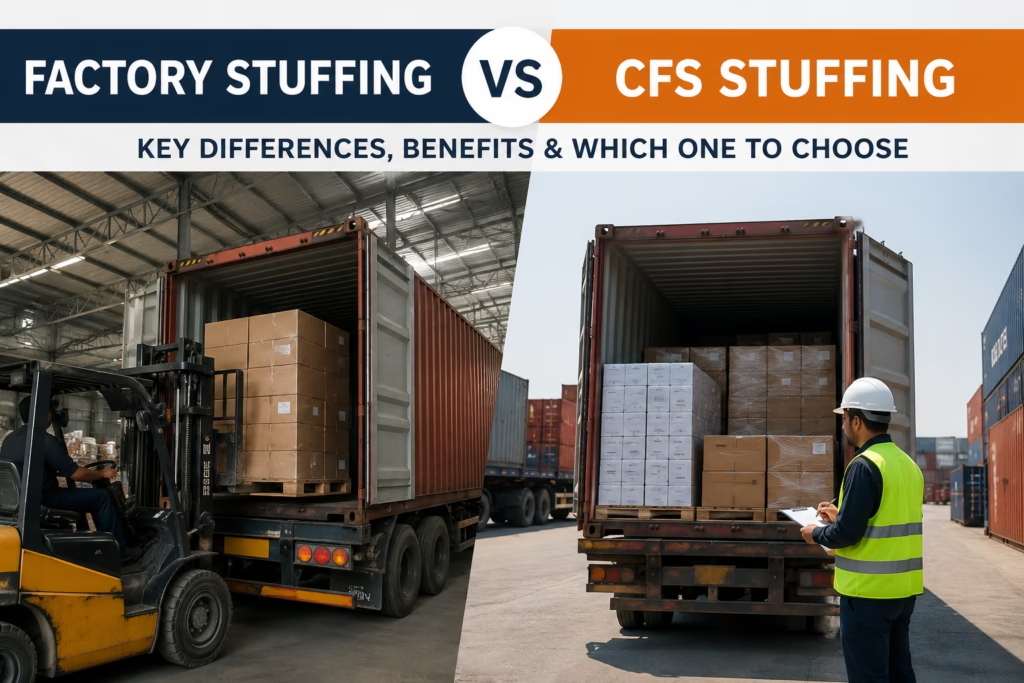
It starts the evening before, with a phone call to your CHA confirming the empty container has been released from the CFS (Container Freight Station) or ICD (Inland Container Depot) and is enroute to your factory. You don’t control this leg you’re at the mercy of the trailer operator’s schedule, and in most cities, that means the truck shows up somewhere between 10am and 1pm, rarely earlier.
This is where the first real friction point shows up, and it’s one most guides skip entirely can your factory road actually take a 40-foot trailer’s turning radius? If your access lane was built for delivery vans and not container trucks, you’ll find out the hard way with a trailer stuck at the turn while your labor stands around waiting. Exporters who’ve done this a few times scout the approach road before ever applying for self sealing permission.
Once the container is positioned, your own team not CFS labor checks it for cleanliness, floor condition, and any lingering odor or damage from the last cargo it carried. Then loading begins cartons or pallets go in by forklift or by hand, stacked and secured according to your own loading plan, often photographed step by step as a quality record.
By late afternoon, the container is full. This is the moment that defines factory stuffing, you personally affix the e-seal, and the shipment details IEC, shipping bill number, seal number, sealing time, destination customs station get uploaded through the e-seal vendor’s portal before the truck leaves your gate. From here, the sealed box heads straight for the port, no detours.
CFS Stuffing: A Different Kind of Wait
What is CFS in export terms, practically speaking? It’s the facility where the waiting happens somewhere other than your own premises.
Your packed cargo often on your own trucks arrives at the nominated Container Freight Station, where it gets weighed, recorded, and placed into a holding area. If your shipment is flagged for customs examination, this is where it sits until an officer gets to it, which can be same day or can stretch into the next.
Once cleared, CFS labor not yours positions a container and loads your cargo alongside the paperwork trail tally sheets, a container load plan, sometimes a stuffing report. The container gets sealed under the CFS’s procedure, and only then does it move toward the port.
The friction point here isn’t a narrow gate it’s congestion and queue position. On a busy week, “we’ll stuff it tomorrow” is a sentence you’ll hear more than once.
The Self Sealing / E-Seal System, Explained Properly
If you’re weighing factory stuffing vs CFS stuffing, this is the section that actually decides whether factory stuffing is even available to you and it’s the part most blogs reduce to a single sentence.
What Changed in 2018
Before 2018, factory stuffing meant a jurisdictional Central Excise or Customs officer had to physically show up at your premises, watch the loading, and seal the container themselves. That system had an obvious bottleneck, officer availability. If the officer was tied up elsewhere, your container waited sometimes for a full day.
In 2018, Customs replaced physical supervision with electronic self-sealing, shifting the responsibility (and the seal itself) to the exporter. This is the single biggest reason factory stuffing became a realistic option for a much wider range of exporters, not just large manufacturers with standing customs relationships.
Who’s Eligible
Self sealing permission for export is open to any exporter registered under GST this isn’t restricted to large scale manufacturers. That said, the permission comes in two tiers:
- Manufacturer exporters get an initial validity of 5 years
- Merchant exporters get validity of just 1 year, after which renewal is required
This distinction matters for planning if you’re a merchant exporter, factor in the annual renewal cycle when deciding whether the switch to factory stuffing is worth the paperwork.
How the E-Seal Process Actually Works
- Register for self sealing permission (originally handled through the GST/Excise office now aligned with current Customs procedure).
- Procure an e-seal from a Customs authorized vendor each seal carries a unique RFID chip storing electronic shipment data.
- Complete stuffing at your factory as described above.
- Affix the e-seal immediately after loading.
- Upload shipment data IEC code, shipping bill number and date, seal number, sealing date/time, destination customs station, container number, and truck number through the e-seal vendor’s web portal, per ICEGATE‘s reporting requirements.
- Lock the entry. Once submitted, this data typically cannot be edited, so accuracy at the point of entry matters a wrong digit here creates problems at the port, not at your factory.
- Port verification. When the container reaches the terminal, a customs officer scans the e-seal. A “Not Tampered” reading clears the container for onward formalities without reopening it.
The practical upshot factory stuffing permission under GST isn’t a one time application you forget about. It’s an ongoing compliance relationship vendor supplied seals, accurate data entry, and renewal tracking for merchant exporters and treating it casually is exactly how exporters end up with tampered seal flags or rejected e-seal submissions at the worst possible moment.
Side by Side: Factory Stuffing vs CFS Stuffing at a Glance
Once you’ve seen how each process actually plays out on the ground, the comparison table below should read less like abstract definitions and more like a recap of what you already know. Use it as a quick reference when you’re pressure-testing a decision, not as your only research.
| Factor | Factory Stuffing | CFS Stuffing |
| Stuffing location | Exporter’s own factory/warehouse | Container Freight Station |
| What travels | Empty container to your gate | Packed cargo to the CFS |
| Handling stages | Typically 1 (direct load) | Typically 2-3 (unload, store, reload) |
| Who seals it | Exporter, via e-seal | CFS, under its own procedure |
| Control over loading | Full your labor, your sequence | Shared with CFS handling team |
| Compliance overhead | Self sealing permission + e-seal reporting | Minimal CFS handles most of it |
| Main cost drivers | Empty container haulage, own labor, e-seal fee | CFS handling, storage, documentation charges |
| Best fit | Regular FCL shippers with factory space | LCL shippers, occasional exporters, tight urban sites |
The pattern to notice factory stuffing shifts cost and responsibility onto you in exchange for control and fewer touchpoints. CFS stuffing shifts it onto the facility in exchange for convenience. Neither is “better” they’re optimized for different shipping profiles, which is exactly what the cost math below will make concrete.
The Real Cost Comparison With Actual Numbers
Every article on this topic tells you factory stuffing “may reduce CFS charges” and leaves it there. That’s not useful. Here’s what the cost actually breaks down into on each side, and why the answer to “is factory stuffing cheaper than CFS” flips depending on one number, distance.
What You’re Actually Paying For
Factory stuffing costs:
- Empty container haulage (port/ICD → your factory → port)
- Your own loading labor and equipment (forklift/crane rental if you don’t own one)
- E-seal purchase fee (per container, from an authorized vendor)
- Documentation and e-seal data submission
- Truck waiting/detention charges if loading runs long
CFS stuffing costs:
- Cargo transport to the CFS (shorter haul, usually)
- CFS receiving and weighment charges
- Storage charges (per day, if cargo sits before stuffing)
- Labor and stuffing charges (CFS managed)
- Documentation/handling fees
- Possible examination support charges if flagged
The Distance Problem, Worked Out
The commonly quoted saving for factory stuffing is ₹2,000–3,000 per container in avoided CFS charges. That figure gets repeated everywhere but it only holds up at short distances. Here’s what happens when you actually run the math for two exporters shipping the same cargo, same container type, different geography:
| Cost component | Exporter A (factory 12km from ICD) | Exporter B (factory 45km from ICD) |
| Empty container haulage (round trip) | ~₹3,500 | ~₹9,500 |
| Own loading labor | ~₹1,500 | ~₹1,500 |
| E-seal fee | ~₹350 | ~₹350 |
| Documentation | ~₹500 | ~₹500 |
| Total factory stuffing cost | ~₹5,850 | ~₹11,850 |
| CFS stuffing total (for comparison) | ~₹7,500–8,500 | ~₹7,500–8,500 |
(Figures are illustrative, based on typical per km haulage and handling rates always confirm current rates with your transporter and CFS before deciding.)
Notice what happened Exporter A saves roughly ₹1,500–2,500 by factory stuffing right in line with the commonly cited figure. Exporter B, at 45km, actually loses money going the factory route, because the extra 66km of round trip haulage (empty container in, loaded container out) eats past whatever CFS charges it was supposed to avoid.
This is the counter example most blogs never run the ₹2,000–3,000 saving isn’t a fixed truth, it’s a distance dependent outcome. Past a certain radius from your ICD or port, CFS stuffing becomes the cheaper option even though its per container handling fee is higher on paper.

A Simple Decision Formula
Before committing, run this rough check:
If (empty container haulage cost) − (CFS handling/storage fees you’d otherwise pay) > ₹0, CFS stuffing is likely cheaper. If it’s negative, factory stuffing wins.
In practice, get a haulage quote for your actual factory to ICD distance, get a CFS handling quote for your typical container size, and subtract. Whichever number comes out ahead should drive the decision not the general rule of thumb everyone quotes.
Who Should Choose What Four Questions, In Order
Skip the checklists for a second. If you actually want an answer for your business, walk through these four questions in sequence each one either settles the decision or narrows it enough that the next question finishes the job.
Question 1: How often are you shipping?
If you’re exporting containers regularly weekly or near weekly volumes the fixed overhead of getting self sealing permission (and staying eligible for it) pays for itself quickly. If you export occasionally, a handful of shipments a year, that compliance overhead is dead weight. Go straight to CFS stuffing and stop reading the rest of this section.
Still shipping regularly? Move to Question 2.
Question 2: Is it FCL or LCL?
This is where FCL vs LCL shipping stops being a side note and becomes the actual fork in the road. Factory stuffing only makes sense for FCL cargo you need to fill (or nearly fill) a whole container yourself. If you’re shipping LCL, your cargo is being consolidated with other exporters’ goods into a shared container, which by definition has to happen at a CFS, since that’s where the consolidation itself takes place.
There’s no factory stuffing equivalent for LCL. If your shipments are LCL, the decision is already made CFS stuffing, full stop.
Shipping FCL regularly? Move to Question 3.
Question 3: Can your factory actually handle it?
This is the question people skip and then regret. Walk your access road and ask honestly can a 40 foot trailer turn into your gate? Do you have a loading dock, forklift, or crane or the budget to rent one for each shipment? Is there a flat, stable surface to position the container? Is there enough security and lighting if loading runs into the evening?
If the answer to any of these is “not really,” factory stuffing will cost you more in delays and damaged goods than it saves in fees regardless of what the cost math says. Who is eligible for factory stuffing isn’t just a legal question about GST registration it’s an infrastructure question your factory has to pass first.
Infrastructure checks out? Move to Question 4.
Question 4: How sensitive is your cargo?
If you’re shipping fragile goods, temperature sensitive agricultural products, or anything where extra handling meaningfully increases damage risk, factory stuffing’s core advantage fewer touchpoints becomes a real, measurable benefit, not just a nice to have.
If your cargo is robust and standardized (think industrial hardware, packaged bulk goods), this factor won’t tip the decision either way, and you can default to whichever option came out cheaper in your cost comparison.
Answer all four questions honestly, and most exporters find the decision makes itself well before Question 4.
Advantages & Disadvantages —As Trade offs, Not Lists
Every “pros and cons” list treats advantages and disadvantages as separate columns. In practice, they’re usually the same fact viewed from two angles. Here’s what that looks like for both options.
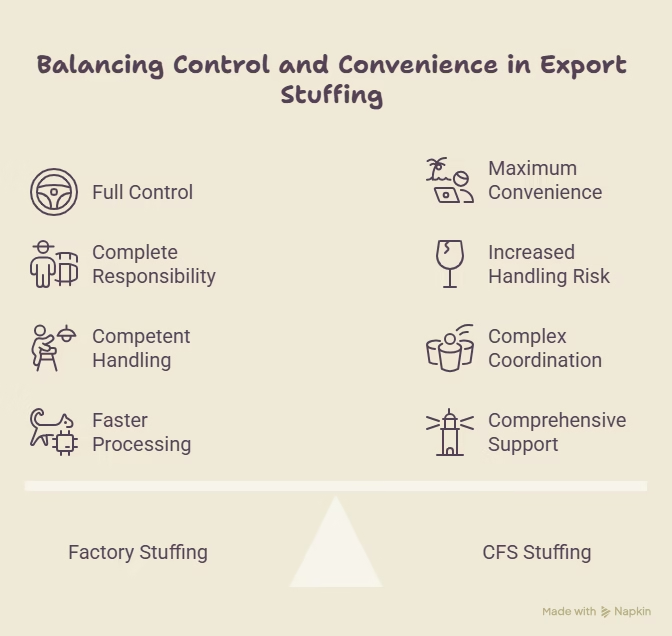
Factory Stuffing: Control vs. Responsibility
The core trade off in factory stuffing is this the same control that protects your cargo also means you own every mistake that happens.
When you supervise loading yourself, you can pack fragile goods exactly how you want, control weight distribution, and photograph every stage as proof of condition. But that control comes with full accountability if the quantity doesn’t match the invoice, if the container exceeds weight limits, or if the e-seal data gets entered wrong, there’s no CFS staff to catch it before it becomes your problem at the port.
Similarly, fewer handling stages reduce damage risk but only if your own team knows what it’s doing. CFS labor handles containers all day, every day your factory staff might load a container once a week. The “fewer touchpoints” advantage assumes competent handling at each touchpoint, and that competence has to be built, not assumed.
And the compliance system that gives you speed the e-seal is also the system that removes your safety net. Once that data is submitted, it typically can’t be edited. The convenience of skipping officer supervision is inseparable from the responsibility of getting it right the first time, with no one checking your work.
CFS Stuffing: Convenience vs. Handling Risk
CFS stuffing’s trade off runs the opposite direction the same infrastructure that makes it accessible to any exporter is exactly what introduces more hands into your cargo’s journey.
You don’t need loading docks, forklifts, or self sealing permission the CFS provides all of it. That’s a genuine advantage for small or occasional exporters. But “providing all of it” means your cargo gets unloaded, stored, and reloaded by people who aren’t your employees, using a sequence and a schedule you don’t control. Every one of those extra movements is a chance for a carton to get misplaced, a pallet to sit too long in the wrong storage conditions, or paperwork to fall out of sync with the physical cargo.
The consolidation capability that makes CFS the only real option for LCL cargo is the same capability that puts your goods in proximity to other exporters’ shipments more coordination, more paperwork cross referencing, more chances for a mix up during deconsolidation or loading.
And the customs/documentation support a CFS offers genuinely valuable if you’re new to exporting comes bundled with charges for exactly that support receiving, storage, labor, and handling fees that a self sufficient factory stuffing exporter simply doesn’t pay.
Neither list is really about factory stuffing being “better” or CFS being “worse.” Each option’s strength and its weakness are the same feature, just depending on whether it’s working for you or against you that week.
Common Mistakes We’ve Seen Sink Shipments
Most guides list mistakes as a bullet checklist. The problem is that checklists don’t convey how ordinary these errors look right before they blow up a shipment. Here’s what they actually look like in the wild.
The unauthorized e-seal. An exporter, in a hurry to make a sailing, used a leftover seal from a previous vendor relationship instead of waiting two extra days for a properly registered e-seal. The container sailed fine. The problem surfaced at the destination port, when the seal couldn’t be verified against any authorized vendor’s RFID record triggering exactly the kind of scrutiny self sealing was supposed to avoid.
The lesson isn’t “use a seal” it’s that an e-seal is only as good as its registration trail, and a seal that doesn’t match an authorized vendor’s records is functionally the same as no seal at all.
Missing the cut off by twenty minutes. A factory stuffed container was loaded, sealed, and dispatched right on schedule except the exporter hadn’t confirmed the terminal’s actual gate cut off, which had shifted an hour earlier that week due to vessel scheduling changes.
The truck arrived to a closed gate. The container waited for the next sailing, and the exporter absorbed a week of delay plus detention charges not because loading went wrong, but because nobody double checked a number that changes more often than people assume.
The invoice that didn’t match the container. A packing list said 480 cartons but the container held 462. Nobody caught it during loading because nobody counted against the invoice they counted against a rough estimate of “looks about right.” Customs did catch it, during a routine document cross check, and the shipment was held for clarification for three days. A five minute count against the actual paperwork would have caught this before the container ever left the factory gate.
Other recurring ones worth naming quickly loading cargo without properly inspecting the container’s floor and doors first (leading to moisture damage claims later), assuming a sealed container is automatically exempt from examination (it isn’t customs can still select it), and delaying the sealed container’s departure from the factory, which erodes the transit time buffer that made factory stuffing worth doing in the first place.
None of these are exotic errors. They’re the kind that happen on an otherwise normal Tuesday which is exactly why they’re worth naming specifically instead of burying in a generic checklist.

Beyond Factory vs. CFS: Other Stuffing Types Worth Knowing
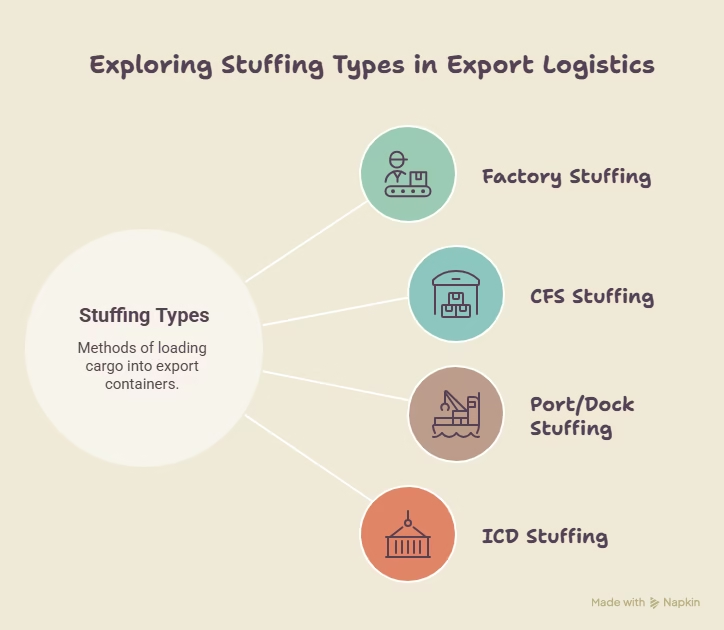
If you’ve made it this far assuming factory and CFS are the only two options, it’s worth knowing the full picture of types of stuffing in export because depending on your location and cargo, one of these might actually fit better than either option covered so far.
Port/dock stuffing. This happens directly at the port terminal or dock area rather than at a separate CFS. Loose or containerized cargo is brought to the port, and stuffing takes place right there before the container moves to the yard for loading onto the vessel. It’s particularly common for cargo that needs a final inspection close to departure, or for shippers whose nearest handling facility simply is the port itself rather than a separate CFS.
Some logistics providers manage this on behalf of clients specifically to minimize the risk of missed cut offs since there’s no additional transport leg between stuffing and vessel loading.
ICD stuffing. For exporters located far from a coastal port, an Inland Container Depot (ICD) functions much like a CFS but sits inland, often near industrial clusters that don’t have direct sea access. The stuffing process itself mirrors CFS stuffing closely cargo arrives, gets processed, gets loaded but the container then moves by rail or road to the nearest port rather than directly.
If your factory is nowhere near a coastal city, your real comparison usually isn’t “factory vs. CFS” at all it’s “factory stuffing vs. ICD stuffing,” with the ICD serving the same role a CFS would for a coastal exporter.
Knowing these variants matters because the terminology overlaps in casual conversation a freight forwarder might say “CFS” when they actually mean a nearby ICD, or “port stuffing” when they mean dock stuffing at a container terminal. Confirming exactly which facility and procedure applies to your shipment avoids assumptions that don’t match what’s actually available at your nearest port.
Three Scenarios, Three Different Answers
Abstract rules only get you so far. Here’s how the decision actually plays out for three exporters who each fit a common real world profile.
Scenario 1: The Bengaluru Electronics Manufacturer
A mid sized electronics manufacturer near Bengaluru ships two to three FCL containers a week to Southeast Asia and Europe. Their factory sits in an industrial layout with wide access roads, an existing loading dock, and a forklift they already own for internal material handling. They’re GST registered and have shipped long enough to justify the 5 year manufacturer exporter self sealing permission.
Recommendation: Factory stuffing, without much debate. Their shipment frequency justifies the compliance overhead, their FCL volume matches the model perfectly, and their infrastructure already clears the hardest bar trailer access and loading equipment.
The e-seal reporting becomes routine within a few shipments, and the reduced handling protects circuit boards and components that don’t tolerate rough transfers well. The only real management task is keeping e-seal data entry accurate, since electronics shipments often carry higher per container value where a documentation error gets expensive fast.
Scenario 2: The Small Merchant Exporter in a Congested City
A merchant exporter working out of a dense urban cluster ships LCL cargo handicrafts sourced from multiple small workshops maybe once every six to eight weeks. Their “factory” is really a rented storage space with no trailer access and no equipment beyond hand trucks.
Recommendation: CFS stuffing, and it isn’t close. LCL cargo requires consolidation, which by nature has to happen at a CFS. Even setting that aside, the shipment frequency doesn’t come close to justifying self sealing permission’s paperwork (merchant exporters face annual renewal, remember), and there’s no infrastructure to support factory loading regardless.
This exporter should focus energy on choosing a reliable, well rated CFS and a good customs broker not on chasing factory stuffing eligibility that doesn’t fit their profile.
Scenario 3: The Agricultural Exporter Needing Temperature Control
An exporter of processed spices and dehydrated agricultural products ships regular FCL loads, but the cargo is sensitive to moisture and temperature swings every extra hour of handling in open air conditions is a real quality risk.
Recommendation: Factory stuffing, with extra emphasis on speed. Beyond the standard case for FCL shippers, the fewer touchpoints advantage isn’t a nice to have here it’s the deciding factor. Even if the cost math came out roughly even with CFS stuffing, the reduced exposure time and direct control over container ventilation and loading sequence make factory stuffing worth a small cost premium.
This exporter should prioritize getting the sealed container to the port as fast as possible after loading, since the earlier common mistake delaying departure after sealing is the one that would hurt them most.
Make the Call With a Framework, Not a Guess
Factory stuffing and CFS stuffing aren’t competing “right answers” they’re tools built for different shipping profiles, and the exporters who get burned are usually the ones who picked one out of habit rather than fit. Run your own numbers, walk your own factory gate, and let your actual shipment frequency and cargo type make the decision for you.
Before your next shipment, run through this checklist:
- Frequency check — Are you shipping FCL regularly enough to justify self sealing permission’s paperwork?
- FCL vs LCL check — Is your cargo consolidated with others? If yes, CFS is your only real option.
- Infrastructure check — Can a 40ft trailer actually access and turn at your factory gate?
- Distance math — Have you compared empty container haulage cost against CFS handling fees for your actual distance?
- Cargo sensitivity check — Does your product genuinely benefit from fewer handling stages, or is this a non-factor?
- Compliance readiness — If choosing factory stuffing, do you have an authorized e-seal vendor and accurate shipment data ready before the truck arrives?
If you’re still unsure which side of this decision your business falls on, that’s usually a sign it’s worth a conversation with your freight forwarder or CHA or you can comment down below before your next booking not after a container’s already stuck at the wrong gate.
Frequently Asked Questions
Is factory stuffing mandatory for FCL shipments?
No. Factory stuffing is an option available to FCL exporters who hold self sealing permission it’s not a requirement. An FCL exporter without self sealing permission, or without the factory infrastructure to support it, can still stuff their container at a CFS or port terminal. FCL simply makes factory stuffing possible; it doesn’t make it mandatory.
How long is self sealing permission valid?
Validity depends on exporter type manufacturer exporters get an initial validity of 5 years, while merchant exporters get 1 year before needing to reapply. After expiry, renewal is required to continue using factory stuffing with self-sealing.
Can a sealed container still be examined by customs?
Yes. A common misconception is that a sealed, e-seal verified container is automatically exempt from inspection. It isn’t. Customs retains the right to select any container for examination based on risk management criteria, regardless of whether it was factory stuffed or CFS stuffed. Assuming otherwise is one of the more costly mistakes exporters make.
What happens if the e-seal shows “tampered”?
If a customs officer’s scan of the e-seal returns a “tampered” or unverifiable result instead of “Not Tampered,” the container is typically flagged for further scrutiny or physical examination before it can proceed.
This is why using an authorized vendor’s registered e-seal and entering shipment data accurately and on time matters an improperly sourced or misregistered seal can trigger this exact flag even if the cargo inside is perfectly fine.
Is CFS stuffing compulsory for LCL cargo?
Effectively, yes. LCL cargo requires consolidating multiple exporters’ shipments into a single shared container, and that consolidation can only happen at a facility equipped to receive, sort, and combine cargo from different sources which is what a CFS does. There’s no factory stuffing equivalent for LCL, since a single exporter’s factory can’t consolidate other exporters’ goods.
How much do CFS charges typically add per container?
This varies significantly by CFS, port, container size, and cargo type, but typically includes receiving, weighment, storage, labor, stuffing, and documentation fees layered together. As a rough guide, factory stuffing is often cited as saving ₹2,000–3,000 per container compared to CFS handling though as covered earlier, that saving can disappear or reverse entirely if your factory is far from the port or ICD. Always get a current quote from your specific CFS rather than relying on general figures.
Can new exporters get self-sealing permission immediately?
Any exporter registered under GST is generally eligible to apply for self sealing permission it isn’t restricted to businesses with years of export history. That said, “eligible to apply” isn’t the same as “instantly approved.”
New exporters should expect a registration and verification process, and should factor in the 1 year (merchant exporter) validity if they don’t yet qualify as manufacturer exporters.
What’s the difference between CFS and ICD?
A Container Freight Station (CFS) is typically located near a coastal port and handles receiving, examination, stuffing, and de-stuffing of export/import cargo close to the seaport itself.
An Inland Container Depot (ICD) performs a similar function but is located inland, serving exporters in regions without direct sea access cargo is processed at the ICD and then moved by rail or road to the nearest port. Functionally, they serve the same role; the difference is mainly geographic.
About the Author
Hi, I’m SriHarsha, founder of shxhub.in.
I focus on explaining import export business topics in a practical, beginner friendly way, based on how exports actually work on the real ground especially documentation, quality control, and buyer expectations.


2 thoughts on “Factory Stuffing vs CFS Stuffing: A Complete Decision Guide for Exporters”