
Vignesh had his first export order confirmed.
A buyer in Germany. Forty cartons of hand embroidered textiles. Everything was ready the goods, the invoice, the packing list. All that was left was booking the shipment. His freight forwarder gave him two options: FCL or LCL. Vignesh had no idea what either meant. The forwarder said LCL was cheaper. Vignesh chose LCL.
Three weeks later, his buyer called frustrated, not happy. The cargo had arrived late. The destination charges were higher than expected. Some cartons had visible handling marks. And buried in the fine print was a storage fee from the Container Freight Station that nobody had mentioned at origin.
Vignesh lost that buyer on the second order.
Not because of the product. Because of the shipment choice.
This is not a rare story. It plays out across India every week in Tirupur, Moradabad, Rajkot, Chennai. Exporters who understand FCL vs LCL survive. Exporters who don’t understand it pay for it silently, in delays, disputes, and disappearing buyers.
This guide explains FCL and LCL in export the way a freight professional would explain it to a friend not with textbook definitions, not with shipping line marketing language, but with what actually happens on the ground.
By the end of this guide, you will know:
- What FCL and LCL actually mean in real export operations
- Which one costs more and why the answer isn’t what the quote says
- How transit time, cargo safety, and buyer experience are affected
- When to choose LCL, when to shift to FCL, and what signs tell you it’s time
Before we go further which stage are you at right now?
Table of Contents
FCL meaning in shipping
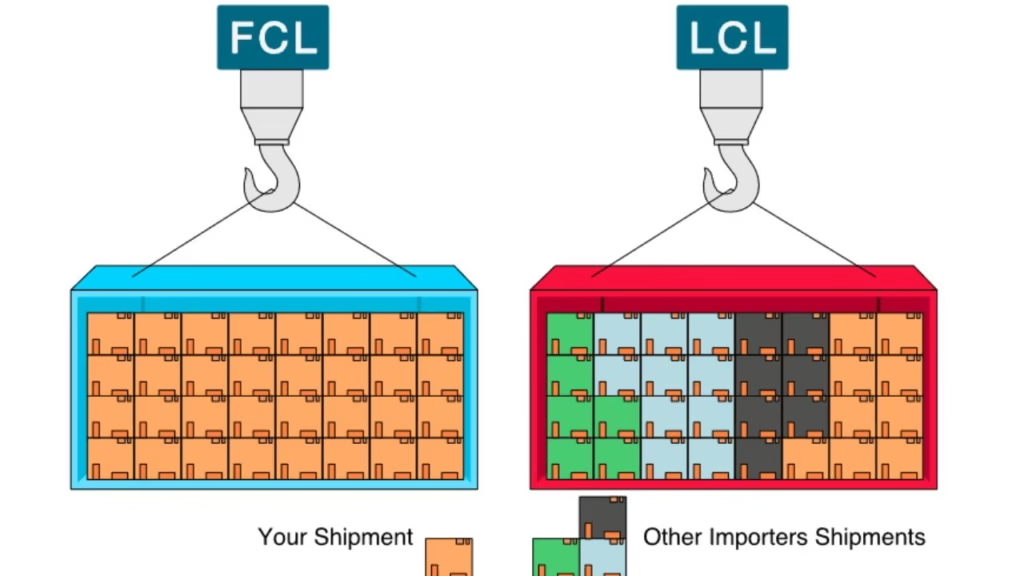
FCL stands for Full Container Load.
In plain terms: one exporter, one container, no sharing.
When you book an FCL shipment, you are not just booking space inside a container. You are booking the entire container whether it is packed to the roof or half-empty. The container is sealed at origin and opened only at the destination. Nobody else’s cargo goes in. Nobody else’s handling is involved.
This single fact sealed at origin, opened at destination is what makes FCL the preferred choice for exporters who care about cargo safety, predictable timelines, and professional buyer experience.
How FCL works — step by step
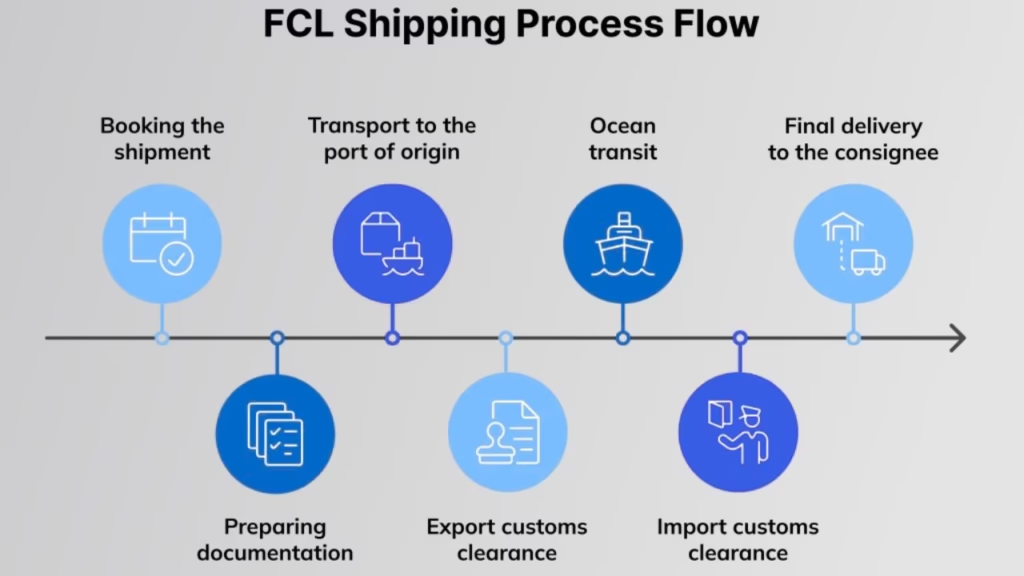
Understanding FCL becomes much simpler when you follow the cargo through its actual journey.
Step 1 — Stuffing at factory or warehouse Your cargo is loaded directly into the container at your premises or at an Inland Container Depot (ICD). You control the packing, the arrangement, and the seal.
Step 2 — Container moves to the Container Yard (CY) The sealed container is transported to the port’s Container Yard. This is where FCL containers are received, stacked, and prepared for vessel loading. No cargo consolidation happens here. Your container stays intact.
Step 3 — Loaded onto the vessel At the CY, your container is lifted directly onto the ship. One booking reference, one container number, one Bill of Lading.
Step 4 — Ocean transit The container travels as a single, sealed unit across the ocean. You can track it by container number at every vessel milestone.
Step 5 — Arrival at destination CY At the destination port, the container is offloaded into the destination CY. Your buyer or their customs broker arranges clearance and pickup directly from the yard.
No consolidation. No separation. No waiting for other shippers.
Container sizes in FCL — what exporters actually use
FCL shipments move in standard ISO containers. The size you book determines your volume ceiling and your freight rate. Here are the three most common:
| Container | Internal volume (approx.) | Best for |
| 20ft standard | ~25–28 CBM | Dense, heavy cargo machinery, tiles, granite |
| 40ft standard | ~55–58 CBM | Moderate volume, regular goods |
| 40ft high cube | ~67–72 CBM | Light, bulky cargo garments, furniture, packaging |
One important clarification: an FCL booking does not require you to fill the container. If you book a 20ft and only use 18 CBM, the container still moves as FCL. You pay the flat container rate regardless of how full it is. This is why the break even decision between FCL and LCL matters and we cover that in detail in Section 4.
Exporter control points in FCL
This is where FCL earns its reputation among experienced shippers. At every stage of the journey, the exporter holds control:
- Stuffing sequence and packing method — your call
- Sealing — done under your supervision
- Container number — visible and trackable from day one
- Cut-off timing — predictable, tied to vessel schedule only
- Destination coordination — direct between buyer and terminal
That control translates directly into fewer surprises, cleaner documentation, and a shipment experience that buyers remember positively.
LCL meaning in shipping
LCL stands for Less than Container Load.
In plain terms: your cargo shares a container with other exporters’ cargo.
When your shipment volume is not large enough to justify booking an entire container, LCL offers a practical alternative. Instead of paying for space you don’t use, you pay only for the volume or weight your cargo occupies. On paper, this sounds like the sensible, economical choice especially for smaller exporters.
In practice, it is more complicated than it appears.
The moment your cargo enters the LCL system, it leaves your direct control and enters a chain of consolidation, handling, and deconsolidation that involves multiple parties, multiple handling points, and multiple cost layers many of which will not appear in the original quotation.
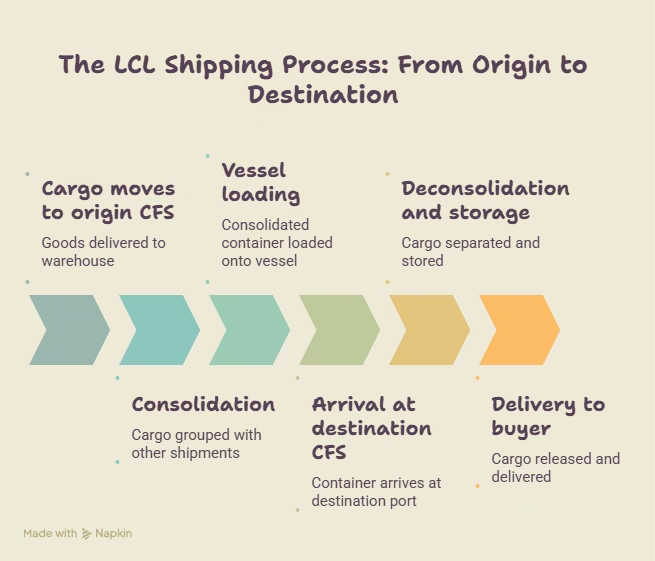
How LCL works — step by step
Step 1 — Cargo moves to origin CFS Your goods are delivered to a Container Freight Station a large warehouse where multiple exporters’ cargo is collected and sorted.
Step 2 — Consolidation A freight forwarder or NVOCC (Non-Vessel Operating Common Carrier) groups your cargo with shipments from other exporters heading to the same destination. Everything is packed into a shared container.
Step 3 — Vessel loading The consolidated container is loaded onto the vessel. Your cargo is now sharing a box with strangers’ goods, moving under a Master Bill of Lading issued to the forwarder not directly to you.
Step 4 — Arrival at destination CFS The container arrives at the destination port and moves to another CFS. Here, it is opened and all shipments are separated.
Step 5 — Deconsolidation and storage Your cargo is identified, separated, and held at the destination CFS until your buyer completes customs clearance. If clearance is slow, storage charges begin to accumulate and the buyer will not be happy about it.
Step 6 — Delivery to buyer Once cleared, the cargo is finally released and delivered.
That is six steps and at four of those steps, hands other than yours are touching your cargo.
Who manages an LCL shipment — and why it matters
In FCL, you deal with one main party: the shipping line. In LCL, the chain is longer:
- Your freight forwarder books space with an NVOCC or directly at the CFS
- The CFS operator physically handles your cargo during consolidation
- At destination, a separate CFS operator handles deconsolidation
- A local agent coordinates clearance on behalf of your buyer
More parties means more coordination requirements, more documentation touchpoints, and more opportunities for errors that show up as delays or disputes.
How LCL pricing works — W/M basis
LCL freight is charged on a W/M basis Weight or Measurement, whichever is greater:
- Weight basis: calculated per 1,000 kg (1 metric tonne)
- Measurement basis: calculated per cubic metre (CBM)
The carrier compares both and charges the higher figure. This protects freight providers from light, bulky cargo that takes up volume without adding weight.
For an exporter, this means the quoted per CBM rate is only the ocean freight component. The full LCL cost picture includes:
- Origin CFS handling charges
- Documentation fees
- Ocean freight (W/M basis)
- Destination CFS handling
- Deconsolidation fees
- Storage (if clearance is delayed)
This is the cost reality that the original quotation rarely shows in full and it is the subject of Section 4 in detail.
House Bill of Lading vs Master Bill of Lading in LCL
This distinction matters more than most exporters realize.
In an LCL shipment, you receive a House Bill of Lading (HBL) issued by your freight forwarder. The shipping line issues a Master Bill of Lading (MBL) to the forwarder not to you. This means your buyer at destination needs to coordinate with the forwarder’s local agent, not directly with the shipping line, to release the cargo.
In FCL, you receive a straight Bill of Lading directly from the shipping line. Fewer parties, cleaner title, faster release.
This documentation chain is one of the reasons LCL shipments are more prone to delays and disputes at destination and why markets with strict import compliance, such as the EU and USA, tend to prefer FCL for regular shipments.
FCL vs LCL: the complete difference, factor by factor
Most comparisons of FCL and LCL stop at cost and speed. In real export operations, the difference runs deeper through documentation, cargo safety, buyer experience, and how much control you hold at every stage of the shipment.
Here is the complete picture.
| Factor | FCL — full container load | LCL — less than container load | Verdict |
| Cost model | Flat rate per container. Predictable from day one. | Per CBM or tonne (W/M). Looks low at quote stage; destination charges add up significantly. | FCL wins on total landed cost once volume grows |
| Handling touchpoints | 2 — stuffed once at origin, opened once at destination | 4 or more — CFS in, consolidation, deconsolidation, CFS out | FCL wins — fewer hands, fewer risks |
| Transit speed | Faster. No waiting for other shippers’ cargo at origin. | Slower. Consolidation wait and CFS queues at destination add days. | FCL wins — especially for tight delivery timelines |
| Cargo security | High. Container sealed at origin, opened only at destination. | Lower. Cargo moves alongside unknown goods; pilferage and damage risk rises with every handling point. | FCL wins — critical for fragile or high-value goods |
| Documentation | Straight Bill of Lading direct from the shipping line. Fewer parties. | House BL from forwarder plus Master BL to carrier. More parties, more room for error. | FCL wins — cleaner paperwork chain |
| Tracking visibility | One container number, direct vessel milestones, easy to share with buyer. | Consolidated container number. Visibility gaps appear at CFS stages. | FCL wins — buyers appreciate live, clear updates |
| Minimum volume | Typically justifiable from 12 to 15 CBM upward, depending on route. | No minimum. Suitable for 1 CBM shipments and small trial orders. | LCL wins for genuinely small volumes |
| Best for | Repeat buyers, high-value cargo, time-sensitive shipments, compliance markets | First orders, market testing, samples, irregular small consignments | Depends on your stage and volume |
The one line summary that experienced freight professionals use, FCL is about control. LCL is about flexibility. The right choice depends on whether you currently need flexibility more than you need control and at what point that equation flips.
CY to CY vs CFS to CFS — what this means on the ground
Every comparison of FCL and LCL eventually leads to two terms: CY and CFS. These are not just abbreviations they describe the physical logic of each shipment type.
CY stands for Container Yard. This is a port terminal area where full, sealed containers are received, stacked, and loaded directly onto vessels. FCL shipments live here. Your container enters the CY as a sealed unit and leaves the destination CY as a sealed unit. Nobody opens it in between.
CFS stands for Container Freight Station. This is a bonded warehouse where loose cargo from multiple exporters is received, sorted, and consolidated into a shared container. LCL shipments live here at both ends of the journey.
Your cargo enters a CFS at origin, waits, gets packed into a shared box, travels across the ocean, then enters another CFS at destination where it is unpacked and separated from the other shippers’ cargo before your buyer can collect it.
The simple rule that experienced freight professionals use: FCL is CY to CY. LCL is CFS to CFS.
Understanding this single line explains why FCL is faster, safer, and easier to track and why LCL involves more parties, more time, and more cost points that do not appear in the original ocean freight quote.
Cost reality: which is actually cheaper?
This is the question every exporter asks. And it is the question where the most money is lost not because exporters are careless, but because the LCL cost structure is designed in a way that makes the real number invisible at the quotation stage.
Why LCL looks cheaper at quotation stage
When a freight forwarder quotes LCL, the number presented first is the ocean freight rate per CBM. For popular trade lanes out of India, this typically ranges between USD 30 and USD 90 per CBM depending on destination and season.
For a small shipment say, 4 CBM that looks very manageable. The exporter sees a modest ocean freight figure and thinks why would I pay for an entire container when I only need 4 CBM of space? This logic is correct on the ocean freight line alone. It breaks down the moment you follow the cargo all the way to the buyer’s door.
The hidden LCL charges that appear at destination
LCL costs are not collected at one place. They are collected at multiple points across the journey, and the charges that hurt most appear at destination where the buyer sees them before the exporter does.
Here is what a complete LCL cost picture looks like for a 4 CBM shipment on a sample India–Europe lane:
| Charge | Where it appears | Visibility at quote stage |
| Ocean freight | Origin | Usually quoted |
| Origin CFS handling | Origin | Usually quoted |
| Origin documentation fee | Origin | Sometimes quoted |
| Destination CFS handling | Destination | Rarely quoted |
| Deconsolidation fee | Destination | Rarely quoted |
| Destination documentation fee | Destination | Rarely quoted |
| Storage (if clearance is delayed) | Destination | Never quoted |
The pattern is consistent across trade lanes origin charges are quoted upfront because the forwarder controls them. Destination charges are either estimated loosely or left out entirely because they are handled by a separate agent at the other end.
For comparison, an FCL 20ft container on the same trade lane carries a flat rate that covers ocean freight, Terminal Handling Charges at both ends, and the Bill of Lading fee. No CFS handling. No deconsolidation. No per-CBM documentation charge applied separately at destination. What is quoted is largely what is paid.
These are illustrative figures for a sample trade lane. Actual rates vary by route, shipping line, season, and forwarder. The pattern not the numbers is what matters. LCL destination charges routinely equal or exceed origin charges, and they almost never appear in the original quotation.
The break-even point — when FCL becomes cheaper
There is no universal number, because the break even between LCL and FCL depends on the trade lane, the destination country’s CFS charge structure, and the forwarder involved. However, across Indian export trade, a consistently observed threshold is this:
Once your shipment reaches approximately 12 to 15 CBM on a standard 20ft container route, the total landed cost of LCL often begins to match or exceed the FCL rate for the same container.
At 18 CBM or above, experienced freight professionals in India typically recommend moving to FCL even if the container is not fully packed. The predictability and control you gain outweigh the small difference in cost per CBM.
This is the number most forwarders will not volunteer. It is worth asking directly every time you book.
How FCL cost behaves differently
FCL pricing follows a fundamentally different logic. You pay a flat rate for the container not for the cargo inside it. That flat rate covers ocean freight for the full container, Terminal Handling Charges at both ends, and the Bill of Lading issuance fee. That is largely the full picture.
There is no CFS handling at destination. There is no deconsolidation fee. There is no per-CBM documentation charge applied separately at the buyer’s end. The cost is visible, agreed upon, and predictable before the cargo leaves your premises.
This predictability is worth more than it appears. It means your buyer knows their landed cost before the shipment arrives. That single factor no destination cost surprises is one of the primary reasons experienced buyers prefer receiving FCL shipments from regular suppliers.
Who actually feels the LCL cost surprise — and what it does to buyer relationships
When LCL destination charges hit, they do not land in the exporter’s inbox. They land in the buyer’s.

At destination, the buyer’s customs broker or local agent presents the CFS handling charges, deconsolidation fee, and documentation fee as part of the clearance bill. The buyer, who budgeted based on the product price and a rough freight estimate, is suddenly looking at unexpected costs that nobody mentioned when the order was placed.
The buyer calls the exporter. The exporter is surprised too because they never saw the destination charge schedule either.
This single scenario played out thousands of times across Indian export operations damages more buyer relationships than product quality problems do. The buyer does not necessarily understand that these destination charges are a structural feature of LCL shipping. What they know is that this shipment cost more than expected, and they feel misled.
The most effective way to protect yourself from this conversation is either to move to FCL as soon as volume allows, or if LCL is genuinely the right choice for your current volume to proactively request a destination charge estimate from your forwarder and share it with your buyer before the shipment is booked. Transparency about LCL costs, communicated early, keeps relationships intact. Silence does not.
Transit time: FCL vs LCL shipment speed
When exporters compare FCL and LCL transit times, they usually look at the ocean leg alone. That is the wrong number to compare.
The ocean leg — the number of days the vessel spends at sea is identical for both FCL and LCL shipments on the same route. A vessel sailing from Nhava Sheva to Felixstowe takes the same number of days regardless of what is inside the containers on board.
What is not identical is everything that happens before the vessel departs and after it arrives. That is where LCL loses significant time quietly, and without appearing on the original transit time estimate.
Why LCL takes longer before the vessel even departs
In an LCL shipment, your cargo must reach the origin CFS before the CFS cut-off date. This cut-off is typically two to four days before the vessel’s departure date. Your cargo arrives at the CFS, gets checked in, and then waits alongside cargo from other exporters until the consolidation is complete.
Consolidation cannot happen until enough cargo has arrived from all the shippers sharing that container. If one shipper’s cargo is delayed, the cut-off may be missed entirely, bumping your shipment to the next available vessel. This is not a rare scenario. It happens regularly on busy trade lanes, particularly during peak export seasons.
In an FCL shipment, your container is booked directly to a vessel. You stuff it, seal it, move it to the Container Yard, and it loads. There is no waiting for other exporters. Your cut-off is tied only to your container and your vessel nobody else’s cargo affects your schedule.
Why LCL takes longer after the vessel arrives
The delay does not stop at origin. At the destination port, the shared container moves to a destination CFS before your buyer can access their cargo. The CFS must receive the container, log it, open it, separate all the shippers’ cargo, and make each consignment individually available for customs clearance.
This deconsolidation process takes time. At busy destination ports like Rotterdam, Felixstowe, Los Angeles CFS queues during peak periods can add three to seven working days to the delivery timeline, beyond the vessel’s arrival date. If your buyer’s customs broker is not ready the moment the cargo is released, storage charges begin accumulating simultaneously.
In an FCL shipment, the container moves directly from the vessel to the destination Container Yard. Your buyer’s broker files for clearance against one container number, the container is released, and delivery is arranged. There is no deconsolidation queue. There is no CFS wait.
The real transit time comparison
On a typical India–Europe trade lane, the ocean leg runs 20 to 28 days for both FCL and LCL. But the total door-to-door time tells a different story. An FCL shipment on the same lane typically delivers within 28 to 34 days total. An LCL shipment on the same lane routinely runs 35 to 45 days sometimes longer once CFS cut-off waits at origin and deconsolidation queues at destination are factored in.
That gap of one to two weeks may seem manageable in isolation. It is not manageable when your buyer has a production deadline, a retail shelf date, or a seasonal window that the shipment is meant to supply.
When delivery timing directly affects buyer relationships
Buyers who work with production schedules garment manufacturers, furniture retailers, industrial buyers build their planning around committed delivery dates. When an LCL delay pushes a shipment past that date, the cost does not show up in the freight invoice. It shows up in the buyer’s operations a production line that sits idle, a retail promotion that launches without stock, a client who had to source the same product from a competitor.
Experienced exporters know this. A buyer who has waited an extra week for an LCL shipment once will ask about FCL on the next order. A buyer who has waited twice will start looking for a different supplier. Delivery reliability, far more than price, is what drives repeat orders in export business.
Cargo safety and risk: FCL vs LCL
If transit time is underestimated by most exporters, cargo safety is underestimated even more. The assumption is that cargo either arrives or it does not, and that insurance covers the difference. Neither assumption holds up well in practice.
The handling touchpoint problem
Every time cargo is physically handled moved, lifted, repacked, sorted it faces a risk of damage. FCL shipments are handled twice in their entire journey, once when stuffed at origin and once when unloaded at destination. The container is sealed in between.
LCL shipments are handled a minimum of four times, when received at the origin CFS, during consolidation into the shared container, during deconsolidation at the destination CFS, and when sorted and released to the buyer’s agent. On busier routes with transshipment ports, the count goes higher.
Each additional handling touchpoint is not just a damage risk it is also a pilferage(small-scale theft of goods.) risk, a documentation mismatch risk, and a delay risk. The more times hands touch your cargo, the more opportunities there are for something to go wrong.
The risk types exporters face in LCL
Physical damage is the most visible LCL risk. Cargo that is not packed to withstand multiple handlings forklift movement, restacking, CFS warehouse conditions arrives with dents, cracks, compression damage, or broken packaging. The exporter often finds out only when the buyer sends photographs.
Pilferage is less discussed but equally real. In a shared container, cargo from multiple exporters is handled simultaneously at the CFS. High value items in unmarked or loosely packed cartons are particularly vulnerable. FCL shipments, sealed at origin and opened only at destination, carry near zero pilferage risk.
Moisture and contamination are risks that most exporters do not consider until they affect a shipment. At the origin CFS, your cargo may sit alongside goods that emit odours, moisture, or chemical fumes. Textile exporters, food product exporters, and pharmaceutical exporters have all encountered contamination through shared CFS storage. In an FCL container, you control what goes in and how it is arranged. Nobody else’s cargo is present.
Cross-contamination in documentation is a fourth risk that is less physical but equally damaging. When multiple shippers’ cargo is consolidated, labelling errors, incorrect carton counts, and misrouted consignments do occur at CFS facilities. These errors at destination lead to clearance holds, re-inspection requirements, and delays that the exporter is expected to resolve remotely.
Cargo categories that should never travel LCL
Certain product types carry significantly elevated risk in LCL, and experienced freight professionals consistently recommend FCL for them regardless of volume:
Fragile goods — ceramics, glassware, decorative items, and precision equipment cannot absorb the repeated handling of LCL without higher damage rates. Even with robust packing, the risk premium is too high.
Food products and organic goods — face contamination and moisture risks in shared CFS storage. Regulatory standards in import markets like the EU and USA make contamination during transit a compliance issue, not just a quality concern.
High value cargo — electronics, jewellery components, speciality chemicals presents a pilferage risk that the LCL handling chain cannot adequately mitigate. The cost of one pilfered consignment can erase months of freight savings.
Hazardous or regulated goods carry documentation and segregation requirements that are harder to guarantee in a shared LCL container environment.
Insurance implications for FCL and LCL
Marine cargo insurance is available for both FCL and LCL shipments, and exporters should carry it for either. However, the claims experience differs significantly.
LCL claims are more frequent, more complex to settle, and more often disputed. When damage occurs in a shared container environment, establishing exactly when and how the damage happened and therefore which party is liable is genuinely difficult. Was it at the origin CFS? During consolidation? At the destination CFS? The more handling points involved, the harder the answer.
FCL claims are relatively straightforward. If a sealed container arrives damaged, the cause and timeline are far easier to establish. Insurance underwriters recognize this FCL shipments carry lower risk profiles, and in some cases attract slightly more favorable premium structures for repeat shippers.
The hidden cost of LCL packing
LCL shipping requires stronger, more protective packing than FCL. Because your cargo will be handled multiple times by parties who do not know its contents, and because it will share space with unknown goods, every carton and pallet needs to be built to withstand more stress than it would in a sealed FCL environment.
Stronger cartons, additional internal cushioning, better strapping, and moisture resistant outer wrapping all add cost. This packing premium is rarely factored into the LCL versus FCL cost comparison at the quotation stage. When it is included, the cost gap between the two shipment types narrows further particularly for fragile or moisture sensitive product categories.
Documentation and compliance: FCL vs LCL
Documentation is where many export shipments quietly fall apart. The product is right, the price is agreed, the cargo is ready and then a paperwork error at a CFS holds the shipment at destination for days while the buyer waits and storage charges accumulate. Understanding why this happens more often in LCL than FCL starts with understanding how the documentation chain is structured in each case.
How FCL documentation works
In an FCL shipment, the documentation chain is direct and clean. The shipping line issues a Bill of Lading specifically, a straight Bill of Lading or a negotiable Bill of Lading depending on the payment terms directly to the exporter. This single document covers the entire container, names the shipper and consignee clearly, and is recognized directly by the destination port and customs authority.
The parties involved are few the exporter, the shipping line, and the buyer’s customs broker at destination. Fewer parties means fewer points where information can be entered incorrectly, misread, or delayed.
How LCL documentation works — and where it gets complicated
In an LCL shipment, the documentation chain has an additional layer. The exporter receives a House Bill of Lading issued by the freight forwarder or NVOCC not by the shipping line. The shipping line issues a separate Master Bill of Lading to the forwarder, covering the entire consolidated container.
This means the buyer at destination cannot deal directly with the shipping line to release their cargo. They must coordinate with the forwarder’s local agent, who holds the corresponding House Bill of Lading at destination. If that local agent is slow, unresponsive, or operating in a different time zone, cargo release is delayed and the exporter is expected to chase the resolution from India.
NVOCCs — Non-Vessel Operating Common Carriers manage a large portion of LCL consolidation in Indian export trade. They are legitimate operators, but their involvement adds a contractual layer between the exporter and the actual carrier. In a dispute or a delay, that layer complicates accountability significantly.
Documentation errors in LCL — why they happen more
Documentation errors in LCL shipments occur more frequently than in FCL for a structural reason more parties are entering data about the same cargo at different stages. The exporter provides packing list details to the forwarder. The forwarder enters data into the CFS system. The CFS operator labels and stacks the cargo. At destination, a separate agent processes the House BL against the physical cargo.
Each data entry point is an opportunity for a mismatch in carton count, gross weight, HS code, or consignee details. A mismatch between the packing list, the House BL, and what the destination customs authority sees in their system triggers a discrepancy notice, which can mean a physical inspection, a clearance hold, or a penalty in strict import markets.
Compliance requirements in EU, USA, and regulated markets
Export markets with rigorous import compliance frameworks the European Union, the United States, the United Kingdom, and Australia place heavy documentation scrutiny on all arriving cargo. In these markets, the additional documentation complexity of LCL creates proportionally more exposure.
US Customs and Border Protection requires Importer Security Filing commonly called ISF or 10+2 to be submitted at least 24 hours before loading in LCL shipments. Any error or late filing attracts penalties that the buyer absorbs.
The EU’s Import Control System similarly requires advance cargo information that must match the House BL and packing list exactly. For LCL shipments, where multiple parties handle data entry, achieving that exact match requires unusually tight coordination.
FCL shipments, with a single Bill of Lading and a direct exporter-to-carrier relationship, carry fewer compliance failure points. This is why buyers in regulated markets particularly those who have been through customs audits or import compliance reviews tend to specify FCL as a standard requirement for regular orders.
Packing list, labelling, and CFS coordination in LCL
For LCL shipments, the packing list and cargo labelling requirements are more demanding than most exporters initially expect. Each carton must be clearly marked with the shipper name, consignee name, destination port, carton number, and gross weight.
At the origin CFS, operators handle dozens of shippers’ cargo simultaneously. A carton that is unlabelled, incorrectly labelled, or labelled in a font size that is difficult to read in a busy warehouse environment is at genuine risk of being misplaced, mis-stacked, or incorrectly consolidated.
The CFS coordinator typically a representative of the forwarder is responsible for ensuring your cargo is correctly received, counted, and entered into the system. Confirming this process directly with your forwarder, rather than assuming it has been handled, is one of the simplest steps an exporter can take to reduce LCL documentation risk.
Tracking: FCL vs LCL shipment visibility
Tracking sounds like a back-office concern until the moment a buyer calls to ask where their cargo is and the honest answer is somewhere between the consolidation warehouse and the destination CFS, exact status unclear. At that point, tracking becomes a relationship issue.
How FCL shipment tracking works
FCL tracking is straightforward because the logic is straightforward. One container, one container number, one vessel booking. From the moment the container is sealed and moved to the origin Container Yard, every milestone is visible and tied to that single reference number.
The tracking sequence in FCL is clean and predictable gate-in at origin CY, vessel loaded, vessel departed, vessel arrived at destination, container discharged, available at destination CY. Each of these milestones is updated by the shipping line in real time and is accessible through the line’s online tracking portal Maersk, MSC, Hapag-Lloyd, CMA CGM, and all major carriers provide this as a standard feature.
The exporter can share the container number with the buyer on day one. The buyer can check status independently at any point in the journey without needing to contact the exporter. This self-service visibility is something experienced import buyers have come to expect as a baseline from their suppliers.
How LCL shipment tracking works — and where it breaks down
LCL tracking runs on a different and less transparent structure. Your cargo travels inside a consolidated container that belongs to the forwarder or NVOCC not to you. The container number visible on shipping line portals is the master container number, which covers all shippers’ cargo inside it. Your individual consignment does not have a dedicated vessel-level tracking reference.
What you typically receive is a House BL number from your forwarder. Tracking against this number depends entirely on the forwarder’s own internal system how frequently it is updated, whether the destination agent pushes status updates back into the system, and whether the origin forwarder has a functioning online portal in the first place.
The result is a set of visibility gaps that appear exactly where buyers are most anxious after the cargo arrives at destination. Once the consolidated container is discharged from the vessel, it moves to the destination CFS. Inside that CFS, the cargo is invisible to any external tracking system.
The buyer’s question is my cargo available yet? cannot be answered by checking a portal. It requires a phone call or email to the destination agent, who may or may not respond within the same business day.
What buyers expect vs what exporters can deliver
Buyers in established import markets Europe, North America, the Middle East increasingly expect proactive shipment updates. They want to know when the vessel departs, when it arrives, and when their cargo is cleared and out for delivery. In an FCL shipment, an exporter can provide all of these updates independently, with links to the shipping line portal, without depending on a third party to supply the information.
In an LCL shipment, the exporter’s ability to provide accurate real time updates is constrained by the forwarder’s system and the destination agent’s communication habits. When a buyer asks for a status update and the honest answer is “I am waiting to hear from the agent at destination,” the gap between expectation and reality is immediately visible and it reflects on the exporter, not on the forwarder.
Practical tracking tools for both shipment types
For FCL shipments, all major shipping line websites offer container tracking by container number or BL number. Third party platforms including Searates, Project44, and Portcast provide consolidated tracking across multiple carriers and add predictive ETA functionality that is particularly useful for buyers managing production schedules.
For LCL shipments, tracking depends on the forwarder’s platform. Some larger NVOCCs and freight forwarders Flexport, Freightos, and a number of Indian forwarders offer House BL tracking through their own customer portals.
The quality and update frequency of these systems varies significantly. Before booking an LCL shipment with a new forwarder, it is worth asking directly what tracking visibility will my buyer have, and at which stages will updates be unavailable?
When to choose FCL vs LCL: real scenarios
Definitions and comparisons give you the framework. What actually makes the decision is recognizing which situation you are in. Here are six scenarios drawn from real export operations and what the right shipment choice looks like in each one.
Scenario 1: First export order, small quantity (2–3 CBM)
You have confirmed your first international order. The buyer has ordered a trial quantity 50 cartons, approximately 2 to 3 CBM. You are exporting to a new market you have never shipped to before.
The right choice here is LCL.
At 2 to 3 CBM, booking an FCL container makes no financial sense. You would be paying for 22 to 25 CBM of empty space. LCL lets you move this shipment at a cost proportional to its size. Yes, there will be destination CFS charges. Yes, transit will take a few extra days. But the goal at this stage is not cost optimization it is getting the order to the buyer, establishing the relationship, and proving you can deliver.
Use LCL for what it is genuinely good for low-volume entry into a new relationship or a new market. Just make sure your buyer knows about destination charges before the shipment arrives.
Scenario 2: Repeat buyer, monthly orders of 12–15 CBM
Your relationship with a European buyer has matured. They are placing monthly orders, each coming in at 12 to 15 CBM. You have been shipping LCL for six months. The buyer has complained twice about unexpected destination charges. Transit times have been inconsistent.
This is the scenario where most exporters stay in LCL longer than they should because the volume still does not fill a 20ft container.
The right choice here is to make the case for FCL.

At 12 to 15 CBM per month, the total landed cost of LCL origin CFS, ocean freight, destination CFS, deconsolidation, documentation is approaching or matching the FCL rate for a 20ft container. The buyer gets cleaner delivery, predictable charges, and faster transit.
You get a sealed container, fewer handling risks, and a tracking reference you can share with confidence. The container will not be full. That is acceptable. The operational advantages of FCL at this volume outweigh the cost of unused space.
Have this conversation with your forwarder and your buyer together. Most experienced buyers in Europe and North America will support the move to FCL once the total cost picture is laid out clearly.
Scenario 3: Fragile or high-value cargo
You are exporting handmade ceramics from Khurja, precision engineered components from Pune, or consumer electronics from a contract manufacturer. The unit value is high, or the goods are fragile, or both.
The right choice is FCL regardless of volume.
One damaged LCL shipment of high value goods can erase the freight savings of an entire year. The multiple handling touchpoints in LCL origin CFS, consolidation, deconsolidation, destination CFS each introduce a damage risk that does not exist in a sealed FCL container. For fragile or high value cargo, the question is not whether you can afford FCL. It is whether you can afford not to use it.
If your volume genuinely does not justify a 20ft container, speak with your forwarder about a groupage FCL arrangement with a known co-loader this is different from standard LCL and involves fewer unknown parties handling your cargo.
Scenario 4: Time-sensitive or seasonal shipments
Your buyer is a garment retailer in the UK preparing for the winter season. Your buyer is a food importer in Germany restocking ahead of a festival period. Your buyer is an industrial client who has a production line starting on a fixed date.
The right choice is FCL.
LCL transit times are estimates, not guarantees. Consolidation delays, missed vessel cut-offs, and destination CFS queues all make LCL delivery windows unreliable. When a buyer has a hard deadline retail floor date, production start date, promotional launch missing it by even a few days has consequences that no freight saving can compensate for.
FCL shipments run on vessel schedules that are predictable and trackable from day one. When delivery timing matters more than anything else in a particular shipment, FCL is the only mode that gives you and your buyer a realistic chance of planning with confidence.
Scenario 5: Exporting to strict compliance markets — EU, USA, UK
Your target market has rigorous import compliance requirements. US Customs requires ISF filing. EU customs requires precise advance cargo data that matches documentation exactly. Your buyer undergoes periodic import audits and needs clean, traceable shipment records.
The right choice is FCL.
As covered in Section 07, LCL documentation involves more parties, more data entry points, and more opportunities for mismatches that trigger customs holds or compliance flags. In markets where a documentation error means a physical inspection, a penalty, or a delayed clearance, the additional complexity of LCL is a liability that experienced importers in these markets have already encountered once.
Many buyers in the EU and USA specify FCL as a standard condition for regular orders precisely because they have been through the LCL compliance headache and do not want to repeat it. If your buyer has not specified this yet, getting to FCL ahead of their request signals that you understand how professional export operations work.
Scenario 6: Testing a new market with no established buyer
You want to enter a new market say, the Middle East or Southeast Asia and you are sending a mixed consignment of product samples and small trial quantities to a potential distributor. There is no confirmed repeat order yet. The relationship is exploratory.
The right choice is LCL.
This is exactly what LCL is built for. The volume is small, the relationship is unproven, and the priority is getting product in front of the buyer at minimum cost and commitment. Use LCL, communicate the destination charge structure clearly upfront, and treat this shipment as a market entry investment rather than a commercial transaction to optimize.
If the distributor comes back with a real order, you will have the information you need to quote the next shipment properly including whether FCL makes sense at their expected order volumes.
Decision checklist: five questions before you book
Before confirming FCL or LCL on any shipment, run through these five questions:
One — what is my cargo volume in CBM? If it is below 10 CBM, LCL is likely the right starting point. Above 15 CBM, model the total landed cost of both options before deciding.
Two — is my buyer new or established? New buyer relationships can absorb LCL complexity more easily because expectations are still being set. Established buyers who have experienced LCL destination charges once are rarely forgiving the second time.
Three — can my cargo tolerate multiple handling? If the answer is no, because the cargo is fragile, high-value, food grade, or sensitive to contamination choose FCL regardless of volume.
Four — does my buyer have a hard delivery deadline? If a delay of even one week has real commercial consequences for the buyer, LCL’s variable transit time is a risk that is not worth taking.
Five — what does the total landed cost look like, not just the ocean freight? Ask your forwarder to provide a destination charge estimate for LCL alongside the FCL rate. Compare total numbers, not headline rates.
Your answers will make the right choice clear in almost every situation.
Scaling your export business: the LCL to FCL journey
Almost every successful Indian exporter starts with LCL. This is not a mistake it is the logical entry point for a business that is finding its footing in international trade. The mistake is staying in LCL after the business has grown past the point where it makes sense.
Why most exporters start with LCL
The reasons are practical and entirely reasonable. In the early stage of an export business, order volumes are small and unpredictable. Capital is limited. The cost of booking an entire container even a 20ft one feels disproportionate when you only have 4 or 5 CBM of cargo to fill it with. LCL removes the volume barrier and lets you move cargo without overcommitting on freight costs.
There is also a learning curve consideration. A new exporter dealing with their first international shipment has enough to manage documentation, compliance, buyer communication, payment terms. LCL hands off a significant portion of the cargo handling and consolidation coordination to the forwarder, which reduces the operational load at a stage when the exporter is still building experience.
These are valid reasons to start with LCL. They are not valid reasons to stay there indefinitely.
Signs it is time to move to FCL
The signals that an export business has outgrown LCL are consistent and recognizable. You are shipping more than 12 CBM per consignment regularly. Your buyer is placing repeat orders on a monthly or bi-monthly cycle. You have received buyer complaints about destination charges or inconsistent delivery timelines more than once.
Your forwarder’s LCL quotes are climbing and the total landed cost is approaching FCL rates anyway. Your product category involves fragile goods, food items, or high-value merchandise that keeps sustaining damage or raising insurance concerns.
Any one of these signals warrants a conversation with your forwarder about FCL. Two or more of them together mean the conversation is overdue.
FCL as a signal of professionalism to buyers
There is a perception dimension to FCL that experienced exporters understand and new exporters rarely consider. When a buyer receives an FCL shipment from a supplier for the first time, it signals something about that supplier’s scale and seriousness. A sealed container with a direct Bill of Lading, predictable delivery, and clean documentation tells the buyer that this is not a small occasional exporter this is a business with volume and process.
This perception matters in buyer negotiations. Exporters who consistently ship FCL are easier to audit, easier to plan production around, and easier to build long-term supply agreements with. In competitive product categories where multiple Indian suppliers are pitching the same buyer, the exporter who can offer FCL reliability at competitive pricing has a genuine commercial advantage over one who is still managing variable LCL timelines.
How freight forwarders steer exporters — what to watch
This is a dynamic that most exporters discover too late. Freight forwarders earn margin on LCL shipments through the consolidation process by aggregating multiple shippers’ cargo and charging each one per CBM while managing the container as a fixed cost. The incentive structure favors keeping exporters on LCL longer than may be optimal for the exporter’s business.
This does not mean forwarders are acting dishonestly. It means their commercial interest and the exporter’s commercial interest do not always align perfectly. A forwarder who pushes back on your FCL enquiry saying your volume is not quite there yet, or that LCL is still cheaper for your cargo size may be right. Or they may be protecting a margin source.
The way to navigate this is to ask for numbers, not opinions. Request a total landed cost comparison not just ocean freight for both FCL and LCL on your next shipment. Include destination charges in the LCL calculation. Then make the decision based on the full picture.
LCL as a stepping stone, not a permanent home
The exporters who build sustainable, scalable businesses treat LCL the way a growing business treats a small rented office useful at the start, outgrown with success, and replaced when the time is right. LCL got you into international trade with lower risk and lower commitment. FCL is where you operate once the business justifies it.
The transition from LCL to FCL is one of the clearest markers of an export business that is growing with intention rather than drifting with habit. The exporters who make that transition deliberately at the right volume, with the right buyer communication almost always look back and wish they had made it sooner.
Common mistakes exporters make with FCL and LCL
Experience in export trade reveals a short list of mistakes that appear repeatedly across businesses of every size. None of them are complicated. All of them are costly.
Choosing LCL based only on the ocean freight quote
This is the most common and most expensive mistake in FCL vs LCL decision making. The forwarder presents an LCL quote showing a per-CBM ocean freight rate. The exporter compares it to the FCL container rate, sees a lower number, and books LCL. The destination charges CFS handling, deconsolidation, documentation were never part of the comparison because nobody asked for them.
The fix is straightforward always request a total landed cost estimate for both options before booking. Ask your forwarder specifically for destination side charges on the LCL quote. If they cannot provide an estimate, find a forwarder who can. Booking a shipment without this number is making a financial decision with incomplete information.
Not communicating destination charges to buyers before the shipment
This mistake does not cost the exporter money directly. It costs them the buyer.
When LCL destination charges appear in the buyer’s clearance bill without prior warning, the buyer feels misled even if the exporter was equally unaware. The professional standard in export trade is to communicate all known and estimated charges to the buyer before the cargo is booked, not after it arrives.
A short email outlining the expected LCL destination charges, sent before shipment, protects the relationship. Silence does not.
Using LCL for fragile, food-grade, or high-value cargo
Sending ceramics, glassware, electronics, food products, or pharmaceutical goods via LCL to save on freight cost is a false economy. The damage rates, contamination risks, and pilferage exposure in a multi handling LCL environment are disproportionately high for these product categories.
One damaged LCL consignment of high value goods typically wipes out the freight savings of multiple shipments. One contamination complaint on a food product shipment can trigger an import rejection that ends a buyer relationship permanently. The freight cost difference between LCL and FCL is always recoverable. A lost buyer rarely is.
Staying in LCL when volume clearly justifies FCL
Many exporters recognize intellectually that they should move to FCL but delay the decision indefinitely waiting for volumes to grow a little more, or for a buyer to ask for it, or for a forwarder to suggest it. Meanwhile, they absorb repeated destination charge complaints, inconsistent transit times, and cargo handling risks that FCL would eliminate.
The threshold is not a full container. It is the point at which total LCL landed cost approaches FCL cost typically between 12 and 15 CBM on most trade lanes. Once your regular shipment size crosses that threshold, the case for FCL is already made. The only thing left is the decision to act on it.
Ignoring buyer feedback on clearance experience
Buyers who have had a difficult LCL clearance experience unexpected charges, delays at the destination CFS, documentation discrepancies will mention it. Sometimes directly, sometimes indirectly through slower reorder cycles or reduced order quantities. Exporters who treat this feedback as a logistics complaint rather than a business signal miss the connection between shipment type and buyer retention.
When a buyer says clearance was complicated, or that they received unexpected charges, or that the cargo took longer than expected to be released that is a signal to review your shipment type, not your product. The buyers who never mention it a second time are often the ones who quietly moved their business to a supplier who ships FCL.
Final verdict and decision framework
FCL and LCL are not competing options where one is universally better than the other. They are tools designed for different situations, and the right one depends entirely on where you are in your export journey, what your cargo requires, and what your buyer relationship can absorb.
That said, the evidence from real export operations points consistently in one direction most exporters underuse FCL and overuse LCL, primarily because the ocean freight quote makes LCL look cheaper than it actually is once the full cost picture is assembled.
The principle that resolves most FCL vs LCL decisions is never compare ocean freight rates. Compare total landed cost. The moment you include destination CFS charges, deconsolidation fees, documentation costs, storage risk, transit variability, and cargo handling exposure in the calculation, the right choice becomes visible in the majority of situations.
If you are a new exporter with small volumes and an unproven buyer relationship, LCL is the correct starting point. Use it, learn the cost structure, communicate destination charges to your buyer proactively, and treat it as a training ground.
If you are an established exporter with regular buyers, volumes approaching 12 CBM or more per shipment, and any history of buyer complaints about destination charges or delivery delays, the case for FCL is already made. The conversation to have is not whether to move it is when and with which shipment.
Questions to bring to your freight forwarder
Before your next booking, ask these directly:
What is the total landed cost of this shipment via LCL, including all destination charges? What is the FCL rate for a 20ft container on the same lane? At what volume does FCL become cheaper than LCL on this trade lane? What tracking visibility will my buyer have at each stage? What are the destination CFS cut-off and release timelines?
A forwarder who answers these questions clearly and completely is one worth working with. The answers will make your next FCL vs LCL decision straightforward.
Frequently asked questions
What is FCL and LCL in export?
FCL means Full Container Load one exporter uses an entire container exclusively for their cargo, sealed from origin to destination. LCL means Less than Container Load your cargo shares a container with other exporters’ goods. The choice between them affects your total cost, transit time, cargo safety, and buyer experience. It is one of the most important decisions an exporter makes before booking a shipment.
What is the main difference between FCL and LCL?
The core difference is control versus sharing. FCL gives you the entire container sealed, dedicated, and handled only twice across the full journey. LCL places your cargo in a shared environment managed by multiple parties at origin and destination. This difference determines your transit time, handling risk, documentation complexity, tracking visibility, and the likelihood of unexpected charges reaching your buyer at destination.
Which is cheaper — FCL or LCL?
At the ocean freight quotation stage, LCL looks cheaper because you pay only per CBM. At the total landed cost stage once destination CFS handling, deconsolidation fees, and documentation charges are included LCL frequently matches or exceeds FCL cost for shipments above 12 to 15 CBM. Never compare ocean freight rates alone. Always request a full destination charge estimate before deciding.
How does FCL and LCL shipment tracking differ?
FCL gives you one container number tied directly to the shipping line, with real-time milestones visible on any carrier portal that your buyer can check independently. LCL tracking runs through your forwarder’s House BL number and loses visibility at CFS stages, where status requires direct communication with the destination agent rather than a portal check.
Is FCL safer than LCL?
Yes. FCL cargo is handled twice stuffed at origin and unloaded at destination with the container sealed throughout. LCL cargo passes through a minimum of four handling points across two CFS facilities, increasing the risk of physical damage, pilferage, moisture exposure, and contamination. For fragile goods, food products, and high-value cargo, FCL is the strongly preferred choice regardless of volume.
What is CFS in shipping?
CFS stands for Container Freight Station a bonded warehouse near the port where LCL cargo is consolidated at origin and deconsolidated at destination. At origin, your cargo waits at the CFS until the forwarder fills the shared container with other shippers’ goods.
At destination, the container is opened and your cargo is held at the CFS until customs clearance is complete. CFS facilities charge handling fees at both ends, and these charges are among the most frequently overlooked costs in LCL shipping
About the Author
Hi, I’m SriHarsha, founder of shxhub.in.
I focus on explaining import export business topics in a practical, beginner friendly way, based on how exports actually work on the real ground especially documentation, quality control, and buyer expectations.



2 thoughts on “FCL and LCL Explained: Cost, Risk, Speed and When to Choose Each”