
Here’s a number that should make every exporter pause businesses moving money across borders can lose close to 9% of a transaction’s value to charges they never see coming. Multiply that across a year of shipments, and it’s not a rounding error it’s real margin, quietly leaking out of your business through fees nobody itemizes on an invoice.
If you’ve ever wired money internationally and watched your buyer say “I only received $4,780, not $5,000,” you already know this problem exists. You just didn’t know it had a name, a pattern, and more importantly a fix.
Most articles on TT payment in export stop at the definition what TT stands for, how SWIFT works, maybe a table comparing it to Letters of Credit. That’s useful, but it’s only half the picture. The real question exporters are asking isn’t “what is TT payment” it’s “why does the amount I send never match the amount my buyer receives, and how do I stop losing money on every single transfer?”
This guide answers both. We’ll start with the fundamentals what TT actually means, how the payment physically moves from your buyer’s bank to yours, and the different payment structures and terms you can negotiate.
Then we’ll go somewhere most guides don’t a full breakdown of the hidden charges buried inside every TT transfer, a worked example showing advertised cost versus actual cost, a practical comparison of banks versus fintech platforms, and a step by step playbook for cutting your fees without giving up security.
We’ll also cover the compliance side FIRA, FIRC, e-BRC, and purpose codes because getting paid is only half the job documenting it correctly is what keeps your export business audit ready.
This isn’t written from a textbook. It’s written the way exporters actually experience TT payments messy, fee heavy, and full of details nobody explains until you’ve already lost money learning them the hard way.
Table of Contents
What Is TT Payment in Export?
What Does TT Mean in Export Business?
TT stands for Telegraphic Transfer an electronic, bank to bank transfer of funds used to settle international trade payments. The name is a holdover from an era when banks literally sent payment instructions over telegraph lines. Nobody uses telegraphs anymore, but the name stuck, and today a TT payment is functionally identical to what most people call a SWIFT wire transfer.
That naming quirk actually causes real confusion in international trade. In the UK, Australia, and New Zealand, exporters and buyers routinely say “telegraphic transfer” or “TT.” In the United States, the same exact transaction is almost always called a “wire transfer.” If you’re an Indian or Southeast Asian exporter dealing with buyers across these regions, it helps to know you’re negotiating the same payment mechanism just under two different names.
Here’s the distinction that trips up most first time exporters:
TT is the payment method. It describes how money moves electronically, bank to bank, via SWIFT.
TT payment terms describe when and how much gets paid for example, “30% advance via TT, 70% before shipment via TT.”
You can use the same payment method (TT) with completely different terms depending on how much you trust the buyer, the order size, and whether the goods are custom made.
Confusing these two ideas is one of the most common mistakes in export contracts exporters write “payment via TT” and assume that alone protects them, when the real risk sits in the terms, not the method itself. We’ll unpack exactly how to structure those terms in the sections ahead.
How TT Payment Works: The Real Journey of Your Money
Step by Step: How a TT Payment Actually Moves From Buyer to Exporter
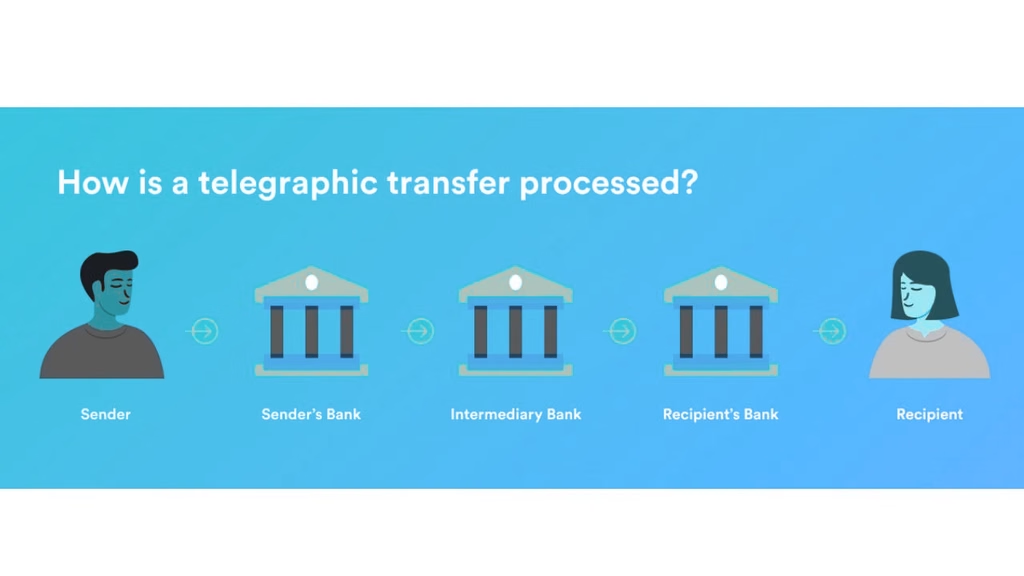
Understanding the SWIFT transfer process matters because every delay, every deducted dollar, and every compliance document you’ll ever deal with happens somewhere along this chain. Here’s what actually happens between the moment your buyer agrees to pay and the moment funds land in your account.
Step 1 – Contract & Payment Terms Agreement Before any money moves, buyer and exporter agree on the payment structure say, 30% advance and 70% before shipment. This gets written into the sales contract or purchase order. This step is where most future disputes are either prevented or planted, depending on how precisely the terms are worded.
Step 2 – Invoice & Bank Details Shared The exporter issues a proforma or commercial invoice containing the beneficiary bank account, SWIFT/BIC code, and payment instructions. Any error here a mistyped account number, an outdated SWIFT code is one of the most common causes of failed or delayed transfers later.
Step 3 – Buyer Initiates SWIFT Transfer The buyer instructs their bank to send funds via the SWIFT network. Importantly, SWIFT doesn’t move money itself it moves instructions. Think of it as a highly secure messaging system that tells banks “release this amount, to this account, from this sender.”
Step 4 – Journey Through Correspondent/Intermediary Banks This is the step most guides skip explaining. If the buyer’s bank and the exporter’s bank don’t have a direct relationship with each other, the payment has to hop through one or more correspondent banks that do have relationships with both.
Each of these intermediary banks exists purely to bridge that gap and each one is entitled to deduct a handling fee before passing the payment along. This is exactly why a $5,000 transfer can shrink before it ever reaches you the money isn’t lost, it’s paying toll fees at each bridge it crosses.
Step 5 – Credit & FIRA/FIRC Issuance Once funds reach the exporter’s bank, they’re credited to the account, and the bank issues a FIRA (Foreign Inward Remittance Advice) or FIRC (Foreign Inward Remittance Certificate) proof of the incoming payment, which becomes essential for compliance and tax purposes later.
Step 6 – Shipment & Document Dispatch Only after the agreed payment (full or partial) clears does the exporter ship the goods and send original documents Bill of Lading, Commercial Invoice, Packing List to the buyer.
Rough Timeline:
| Stage | Typical Duration |
| Buyer initiates transfer | Day 0 |
| Passes through 1–3 correspondent banks | Day 1–3 |
| Credited to exporter’s account | Day 2–5 |
| FIRA/FIRC issued | Same day to +1 day after credit |
A “same day” wire is rare in cross border trade 2 to 5 business days is the realistic norm, longer around weekends or public holidays in either country.
Types of TT Payment Timing (Often Confused)
TT in Advance vs TT at Sight vs TT After Shipment What’s the Difference?
Exporters often lump “TT terms” and “TT structures” together, but timing deserves its own conversation it’s the single biggest lever for controlling your risk exposure.
TT in Advance Payment is sent before production begins or before goods ship. The exporter holds all the leverage the buyer carries all the risk of the goods never arriving or not matching spec. This is standard for new buyer relationships, custom orders, or small trial orders where trust hasn’t been established yet.
TT at Sight Payment is released once the buyer (or their bank) is presented with shipping documents typically a scanned Bill of Lading. Risk is more balanced here the exporter has already shipped, but payment arrives before the buyer physically takes possession of the goods.
TT after X Days (Deferred Payment) Payment is due a fixed number of days after shipment or after the buyer receives the goods 30, 60, or 90 days being common. This is essentially trade credit, and it puts almost all the risk on the exporter, who has shipped and possibly received nothing yet.
| Timing Type | Risk Level | Best Used For | Who Holds Leverage |
| TT in Advance | Low (for exporter) | New buyers, custom/small orders | Exporter |
| TT at Sight | Moderate | Established buyers, repeat orders | Balanced |
| TT after X Days | High (for exporter) | Long-term trusted relationships | Buyer |
The mistake many exporters make is treating “TT” as one uniform, safe option because it’s fast and electronic. In reality, when the TT is triggered changes the risk profile completely the payment rail is the same, but the deal you’re actually agreeing to is very different.
Common TT Payment Structures Used in Export Contracts
5 Common TT Payment Structures Exporters Use (With Risk Levels)
Once you’ve settled on TT as your payment method and picked a timing model, the next decision is the actual structure how the payment gets split, and what triggers each portion. Here are the five structures that cover the vast majority of real-world export contracts.
| Structure | How It Works | Exporter Risk | Best Suited For |
| 100% Advance | Full payment before production/shipment | Lowest | New buyers, small trial orders, custom/made to order goods |
| 30% Advance / 70% Before Shipment | Deposit funds production balance clears before goods leave the port | Moderate | Ongoing orders with semi-trusted buyers |
| 30% Advance / 70% Against B/L | Balance released once exporter shares a scanned Bill of Lading | Higher | Established buyers wanting proof of shipment before final payment |
| 100% After Delivery | Full payment only after goods arrive at destination | Highest | Long term, high trust relationships |
| Open Account Hybrid (partial TT + credit period) | Small TT upfront, remainder on 30/60/90-day credit terms | Very High | Strategic accounts where volume outweighs risk |
Notice the pattern, risk shifts steadily from buyer to exporter as you move down the table. Every structure below “100% Advance” is really the exporter extending some degree of trust and trust, in international trade, is usually earned in stages rather than assumed upfront.
Which Structure Fits New Buyers vs Long Term Buyers
For a first time buyer, defaulting to 100% advance or, at most, a heavily front loaded 50/50 split isn’t excessive caution it’s standard practice. You have no payment history with them, no proof of reliability, and often no easy legal recourse if they don’t pay.
For long term buyers with a track record of timely payments, exporters can reasonably move toward 30/70 against B/L or even short deferred terms, because the relationship itself has become a form of collateral.
A Simple Decision Framework: 3 Questions Before You Pick a Structure
Before locking in a payment structure, ask:
- How long have you worked with this buyer? No history → lean advance heavy. Multiple completed orders → some flexibility is reasonable.
- How large is this order relative to your working capital? A structure that’s fine for a $2,000 trial order could sink your cash flow on a $200,000 shipment if things go wrong.
- Is the product customized or standard? Custom or made to spec goods are hard to resell if a buyer backs out this alone justifies leaning toward higher advance percentages, regardless of buyer history.
Treat these three questions as a quick filter before every new contract they take two minutes and can prevent a very expensive mistake.
Documents Required for TT Payment in Export
Documents You Need Before, During, and After a TT Payment
A TT payment might be electronic and fast, but it’s still trade finance and trade finance runs on paperwork. Missing a single document can delay payment, complicate customs clearance, or create compliance headaches months later. Here’s what you need at each stage.
Pre Shipment Documents
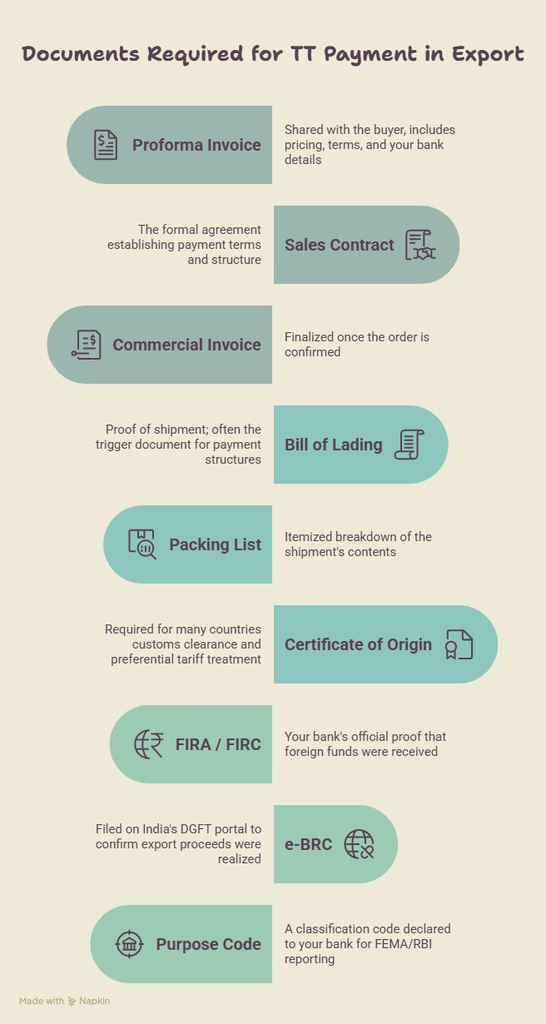
- Proforma Invoice – shared with the buyer, includes pricing, terms, and your bank details
- Sales Contract / Purchase Order – the formal agreement establishing payment terms and structure
- Commercial Invoice (draft/final) – finalized once the order is confirmed
Shipment Documents
- Bill of Lading (B/L) or Airway Bill – proof of shipment; often the trigger document for “against B/L” payment structures
- Packing List – itemized breakdown of the shipment’s contents
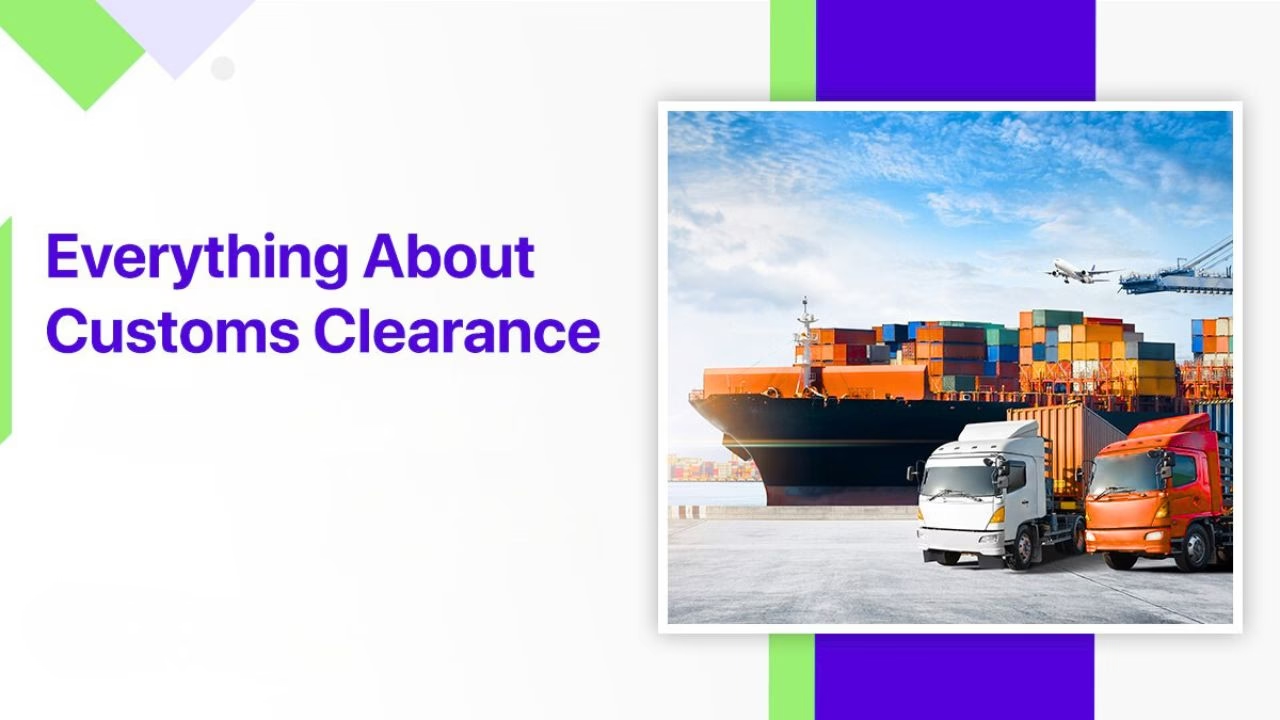
- Certificate of Origin – required for many countries customs clearance and preferential tariff treatment
Post Payment Compliance Documents
- FIRA / FIRC (Foreign Inward Remittance Advice/Certificate) – your bank’s official proof that foreign funds were received
- e-BRC (Electronic Bank Realization Certificate) – filed on India’s DGFT portal to confirm export proceeds were realized, required for regulatory and incentive purposes
- Purpose Code – a classification code (e.g., “P0102 Export of Goods”) declared to your bank for FEMA/RBI reporting
Quick Checklist Before You Ship:

- Signed sales contract with TT payment terms specified
- Proforma invoice sent with correct bank details
- Advance payment (if applicable) confirmed and credited
- Bill of Lading, packing list, and certificate of origin prepared
- FIRA/FIRC requested from bank upon payment receipt
- Purpose code correctly declared
- e-BRC filed after realization (for Indian exporters)
Keeping this checklist on hand per shipment isn’t just good practice for many exporters, it’s what stands between a smooth GST refund or loan application and months of chasing paperwork later.
Drafting TT Payment Terms: Clauses Every Exporter Should Include
How to Write Bulletproof TT Payment Terms in Your Export Contract
A payment structure is only as strong as the contract language backing it. Vague terms are where disputes are born “buyer will pay via TT” says almost nothing. Every export contract should spell out:
- Payment Currency – state the exact currency (USD, EUR, etc.) to remove any ambiguity about which exchange rate applies
- Payment Timeline – precise triggers, e.g., “30% advance within 5 days of contract signing; 70% balance within 3 days of B/L issuance”
- Payment Method – explicitly named as “via TT/SWIFT wire transfer” so there’s no confusion with other methods
- Bank Charges Clause – specify who absorbs intermediary and receiving bank fees (this single clause prevents most of the “why did I receive less than invoiced” disputes)
- Late Payment Penalty – a defined interest rate on overdue balances gives you contractual leverage, not just a moral argument
- Compliance Clause – confirms the exporter will provide FIRA/FIRC upon receipt, reassuring buyers who need proof of payment for their own records
Sample Clause Language
“Payment shall be made in [Currency] via TT/SWIFT transfer to the beneficiary account below. 30% of the total invoice value is due within [X] days of order confirmation the remaining 70% is due within [X] days of Bill of Lading issuance. All intermediary and receiving bank charges shall be borne by the Buyer (OUR charges). Amounts overdue by more than [X] days shall accrue interest at [X]% per month. Seller shall furnish FIRA/FIRC confirmation within [X] business days of fund realization.”
Short, specific, and leaves no room for either party to claim they “didn’t know” what was expected.
Payment Terms Email Template (Rewritten)
Subject: Payment Terms & Bank Details — Order #[XXXX]
Hi [Buyer Name],
Confirming the agreed terms for this order:
- 30% advance via TT before production begins
- 70% balance via TT before shipment, against scanned Bill of Lading
Bank Details: Beneficiary: [Company Name] | Bank: [Bank, Branch] | Account No: [XXXXXX] | SWIFT/BIC: [XXXXXXX] | Currency: USD
Kindly arrange for all bank charges to be settled on your end (OUR option) so we receive the full invoiced amount. FIRA will be shared as soon as payment is confirmed.
Best regards, [Your Name]
The Real Cost of TT Payments: Hidden Charges Breakdown
7 Hidden Charges That Quietly Eat Into Your TT Payment
Here’s what almost no one explains clearly a TT payment doesn’t have one fee it has a chain of fees, each justified by a different piece of banking infrastructure the payment passes through. Understanding why each charge exists is the only way to actually negotiate around it.
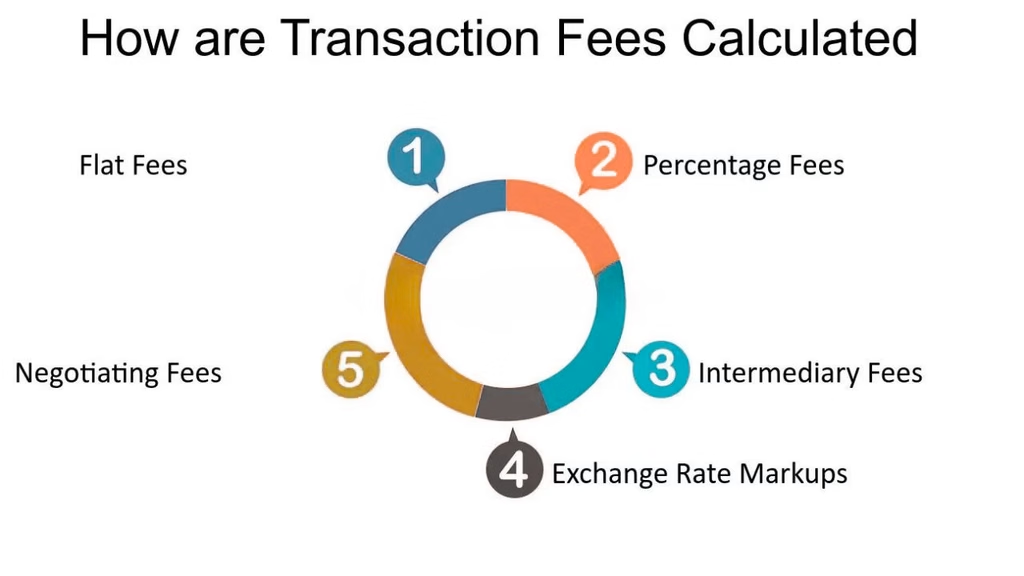
1. Exchange Rate Markup Banks rarely give you the true “mid market” exchange rate the rate banks use when trading currency among themselves. Instead, they quote you a marked up rate, often 1–5% worse, and pocket the difference. This markup exists because banks are effectively acting as a currency dealer, not a neutral pass through, and the spread is their profit margin on the conversion separate from any explicit “fee” they show you.
2. Intermediary/Correspondent Bank Fees As covered earlier, when your buyer’s bank and your bank don’t have a direct relationship, the payment routes through correspondent banks that bridge the gap. Each of these banks charges a handling fee typically $15–$50 simply for relaying the payment onward. This isn’t a scam it’s the actual cost of maintaining the global banking relationships that make cross border transfers possible. The problem is transparency you rarely know in advance how many banks will touch your payment.
3. Receiving Bank Charges Once funds land at the destination bank, that bank often deducts its own processing charge before crediting your account because from their perspective, they’re doing the compliance checks, currency conversion (if needed), and account crediting work on their end, and that labor isn’t free.
4. Currency Conversion Fees Separate from the exchange rate markup, some banks apply an additional flat or percentage based conversion fee, particularly for less commonly traded currency pairs where the bank itself has to source that currency through additional intermediary channels adding both cost and time.
5. Weekend & Holiday Rate Risk Currency markets are less liquid outside standard trading hours. Banks compensate for this thinner liquidity by widening their rate margins around weekends and public holidays effectively pricing in the risk that they can’t immediately offset your currency exposure on their own books.
6. Compliance & Regulatory Screening Fees Every international payment is screened against sanctions lists and anti-money laundering rules before release. This screening isn’t optional it’s a regulatory requirement banks must satisfy but the operational cost of running these checks is often quietly folded into your overall fee structure rather than itemized separately.
7. Payment Failure & Amendment Charges If any transfer detail is wrong an outdated SWIFT code, a mismatched beneficiary name banks charge for manual correction (often ~$30) or cancellation (~$35 plus additional agent bank fees). These exist because a “failed” SWIFT message still has to be manually traced and corrected by a human, unlike the fully automated happy path transfer.
Individually, each of these charges sounds minor. Stacked together across a single transfer and multiplied across every payment you receive in a year they routinely add up to 3–6% of transaction value, sometimes more for exotic currency pairs or higher risk corridors.
Worked Example: What You Actually Receive on a $5,000 / $50,000 TT Transfer
Real Numbers: Advertised Cost vs Actual Cost of a TT Transfer
The gap between what a bank advertises and what you actually net is where most exporters get their first unpleasant surprise. Here’s a realistic breakdown at two different transfer sizes.
| Cost Component | $5,000 Transfer | $50,000 Transfer |
| Advertised sending fee | $25–35 | $30–50 |
| Exchange rate markup (2–3%) | $100–150 | $1,000–1,500 |
| Intermediary bank fees (1–3 banks) | $15–90 | $30–120 |
| Receiving bank charge | ~$15 | ~$15–25 |
| Weekend/holiday premium (if applicable) | $10–20 | $50–150 |
| Realistic total cost | $165–310 (3.3–6.2%) | $1,125–1,845 (2.3–3.7%) |
Small Transfer Example ($5,000)
On paper, a $5,000 payment might look like it costs a flat $30 wire fee. In reality, once the exchange rate markup and two intermediary banks take their cut, the exporter’s buyer could see roughly $205 disappear before the funds are even credited meaning an exporter expecting a clean $5,000 might actually receive closer to $4,795.
At the small transaction level, percentage wise this is the most painful bracket, because fixed fees (intermediary charges, receiving bank fees) don’t scale down with transaction size a $20 intermediary fee is 0.4% of $5,000 but only 0.04% of $50,000.
Larger Transfer Example ($50,000+)
At $50,000, the fixed fee components (sending fee, intermediary charges, receiving bank fee) shrink dramatically as a percentage of the total but the exchange rate markup, which scales with transaction size, becomes the dominant cost.
A 2–3% markup on $50,000 alone is $1,000–1,500, dwarfing every other fee combined. This is precisely why larger exporters investing serious volume in TT payments obsess over exchange rate transparency far more than transfer fees at scale, the rate, not the flat charges, is where the real money leaks.
A composite scenario worth internalizing: picture a mid sized textile exporter shipping $45,000 worth of goods to a European buyer on a 30/70 TT structure. The 30% advance ($13,500) arrives with a barely noticeable $60 in combined fees small enough to go unquestioned. But the 70% balance ($31,500), transferred weeks later during a rate dip and processed over a long weekend, loses nearly $950 to a combination of markup and holiday rate widening.
The exporter never sees a line item labeled “$950 fee” they simply see a bank credit that’s smaller than expected, and often just accept it as “normal.” Multiply that gap across a dozen shipments a year, and it becomes a five figure leak nobody budgeted for.
TT vs Other Export Payment Methods
TT vs LC vs DP vs DA vs Open Account — Which Is Best for Exporters?
TT is only one tool in the export payment toolbox. Choosing the right one is really a trade off between how much risk you’re willing to absorb and how much you’re willing to pay to offload that risk onto someone else usually a bank.
| Method | Risk for Exporter | Relative Cost | Speed | Documentation Burden |
| TT (Telegraphic Transfer) | Moderate (depends on terms) | Low–Medium | 2–5 days | Low |
| LC (Letter of Credit) | Low | High (bank fees) | 5–10 days | High |
| DP (Documents Against Payment) | Moderate | Medium | 3–7 days | Medium |
| DA (Documents Against Acceptance) | High | Medium | 3–7 days | Medium |
| Open Account | Highest | Low | N/A (post-delivery) | Low |
When TT Is the Smarter Choice
TT makes sense when speed and low cost matter more than a bank backed guarantee typically for established buyer relationships, smaller order values where LC fees would eat disproportionately into margins, or situations where the exporter can structure enough advance payment to offset the lack of a bank guarantee.
When LC Is Worth the Extra Cost
A Letter of Credit shifts payment risk from the buyer’s willingness to pay to the buyer’s bank’s obligation to pay, provided documents are presented correctly. This is worth the higher fees and slower timeline when dealing with a brand new buyer in a higher risk market, a very large order where the downside of non-payment is severe, or a country where currency controls or political risk make direct bank transfers unpredictable.
The Risk Cost Tradeoff Curve
It helps to think of these five methods as sitting along a single curve rather than as unrelated options. On one end sits Open Account cheapest and fastest, but the exporter absorbs almost all the risk of non-payment. On the other end sits LC most expensive and slowest, but risk is transferred almost entirely to banks. TT, DP, and DA sit in between, each trading a bit more cost or documentation for a bit less exposure.
The practical takeaway don’t ask “which payment method is best?” in the abstract ask “how much risk can this specific deal afford, and how much am I willing to pay to remove it?” A new buyer on a large custom order justifies sliding toward the LC end of the curve, even at higher cost. A long standing buyer on a modest repeat order justifies staying near the TT/open account end, where speed and low cost matter more than an ironclad guarantee you probably won’t need anyway.
Banks vs Digital Platforms vs Fintechs for TT Payments
Where Should You Send/Receive TT Payments From Bank, PayPal, or Fintech?
The infrastructure behind TT payments has diversified well beyond traditional banks. Choosing the right channel can be as impactful as negotiating better contract terms.
Traditional Bank TT
Banks remain the default choice for most exporters, and for good reason they offer maximum regulatory compliance, established trust, and the ability to handle very large transactions without limits. The trade off is cost and speed fees typically run 3–6% of transaction value once markup and intermediary charges are factored in, with settlement taking 2–5 business days. Banks make the most sense for high value, infrequent transfers where security and institutional trust outweigh the cost premium.
Digital Platforms (PayPal, Stripe)
These platforms trade bank level formality for convenience. PayPal charges a flat fee plus a variable percentage, while Stripe charges roughly 2.9% plus $0.30 per transaction. Stripe supports a far wider range of currencies (130+) than PayPal (around 25), but both come with payment size limitations that make them impractical for large B2B trade transactions. They’re best suited to exporters handling smaller ticket, high frequency sales think ecommerce style exports rather than bulk B2B shipments.
Fintech Specialists (Wise, Skydo, Karbon)
Purpose built cross border payment platforms have emerged specifically to undercut traditional bank pricing. These typically charge 0.5–1.5% in total fees a fraction of bank markups and settle in minutes rather than days by using local banking rails instead of the traditional correspondent bank chain.
Skydo, for example, uses transparent flat fee tiers rather than hidden markups, and offers free instant FIRA generation, while Wise applies a transparent conversion fee close to the mid market rate. For exporters processing regular international payments, these platforms often deliver the biggest single fee reduction of any strategy in this guide.
Decision Table:
| Business Profile | Best Fit |
| Occasional, very high value transfer (e.g., one large annual order) | Traditional bank security and institutional trust matter more than fee savings |
| Frequent, small to mid value B2B payments | Fintech specialist (Wise, Skydo, Karbon) lowest fees, fastest settlement |
| Small ticket ecommerce style export sales | Digital platform (PayPal, Stripe) convenience and buyer familiarity |
| Mixed portfolio (some large, some recurring small) | Maintain relationships with both a bank and a fintech, and route by transaction type |
How to Reduce TT Payment Fees: Practical Exporter Playbook
6 Ways Exporters Can Cut TT Payment Costs (Without Sacrificing Security)
Knowing where the fees hide is only useful if you act on it. Here’s a practical playbook.
1. Use Mid Market Rate Platforms Prioritize providers that convert currency at or near the true mid market rate rather than padding it with a hidden markup. This single switch alone can save 3–5% compared to a traditional bank on the currency conversion step often the single largest cost component on any sizable transfer.
2. Negotiate the OUR Charge Code SWIFT transfers let the sender choose who absorbs bank charges OUR (sender pays all fees), SHA (shared), or BEN (beneficiary/receiver pays all). Requesting OUR ensures you receive the exact invoiced amount without unexpected deductions, shifting the fee burden to the buyer’s side of the table instead of eating into your revenue.
3. Time Your Payments Strategically Avoid initiating transfers right before weekends or public holidays, when banks widen their exchange rate margins to hedge against thin market liquidity. Mid week transfers, during overlapping trading hours between major financial centers, generally get tighter, more competitive rates.
4. Batch and Automate Recurring Payments If you’re paying suppliers or receiving from buyers on a regular schedule, consolidating multiple small transfers into fewer, larger ones reduces the impact of fixed fees. Some platforms also offer locked in exchange rates for recurring transfers, protecting you from rate volatility over time.
5. Verify Fees Against the Mid Market Rate Before Invoicing Before finalizing an invoice, check your provider’s quoted rate against the actual mid-market rate (easily found via a quick search). This single habit exposes hidden markups immediately and gives you a concrete number to negotiate down with your bank or provider.
6. Negotiate Bank Charge Sharing Clauses Upfront Not After a Dispute This is the step most exporters skip deciding who absorbs intermediary and receiving bank charges should be settled in the contract, before the first payment is ever sent not argued over after a buyer complains about receiving less than invoiced. Building a simple charge sharing clause into your standard contract template turns a recurring point of friction into a non issue, and it costs you nothing to add.
Applied together, these six steps won’t eliminate TT costs entirely some fees are simply the price of moving money internationally but they routinely cut the effective cost of a transfer by half or more, turning a leaky 5–6% loss into a manageable 1–2%.
Post Payment Compliance for Indian Exporters
What Indian Exporters Must Do After Receiving a TT Payment (FEMA/RBI/DGFT)
Receiving a TT payment is only half the job for Indian exporters the other half is documenting it correctly to stay compliant with FEMA, RBI, and DGFT regulations. Skipping this step doesn’t just risk penalties it can block future GST refunds, export incentives, and loan approvals.
Obtain FIRA/FIRC from Your Bank As soon as payment is credited, request the Foreign Inward Remittance Advice/Certificate from your bank. This document is your primary legal proof that the payment genuinely originated from a foreign buyer, and it’s required for virtually every downstream compliance step.
File the e-BRC on the DGFT Portal The Electronic Bank Realisation Certificate confirms that export proceeds have actually been realized in your account. This isn’t optional paperwork — it’s tied directly to your eligibility for export incentive schemes, and delays in filing can hold up benefits you’re otherwise entitled to.
Declare the Correct Purpose Code Every inward remittance must be tagged with a Purpose Code (e.g., “P0102 Export of Goods”) for RBI reporting. Using the wrong code can trigger unnecessary compliance queries or misclassify the nature of the transaction.
Match Export Proceeds to Shipping Bills RBI compliance requires that the payment received be reconciled against the corresponding shipping bill for that shipment. This matching process is what regulators use to confirm that goods actually left the country in exchange for the payment received a mismatch here is a common source of audit flags.
Maintain Records for GST and Income Tax FIRA/FIRC and e-BRC documentation also directly support GST refund claims (particularly for zero-rated exports) and income tax filings. Keeping organized, shipment wise records isn’t just good hygiene it’s often the difference between a smooth refund cycle and months of back and forth with tax authorities.
Common Mistakes Exporters Make With TT Payments
5 Mistakes That Cost Exporters Money on TT Payments
Most TT payment losses aren’t caused by fraud or bad luck they’re caused by small, repeatable oversights. Here are the five most common.
1. Not Specifying Charge Sharing (OUR/SHA/BEN) Leaving the bank charge arrangement unspecified in the contract almost guarantees a dispute. Without an explicit OUR, SHA, or BEN designation, intermediary and receiving bank fees get deducted by default usually from the exporter’s side leaving you to absorb costs you never budgeted for.
2. Ignoring FX Timing Sending or receiving transfers right before weekends, holidays, or during periods of high currency volatility exposes you to wider spreads and unpredictable rate swings entirely avoidable with basic timing awareness.
3. Missing FIRC/e-BRC Filing Deadlines Treating compliance documentation as a “someday” task rather than a per shipment habit leads to backlogs that delay GST refunds and export incentive claims sometimes for months.
4. Relying on Open Account Terms With New, Unverified Buyers Extending post shipment payment terms to a buyer with no track record is one of the highest risk decisions an exporter can make. Trust should be earned through completed transactions, not assumed at the first order.
5. Not Verifying Buyer Bank Details Independently Fraudsters increasingly intercept email threads and send fake “updated bank details” mid transaction. Always verify any change in payment instructions through a separate, independently confirmed channel a phone call, not a reply to the same email thread before releasing goods or accepting a payment redirect.

Conclusion
TT payment has earned its place as the backbone of modern export finance it’s fast, flexible, universally accepted, and lets exporters structure risk through smart use of advance payments and timing. But as this guide has shown, “fast and flexible” doesn’t mean “cheap by default.” Left unmanaged, TT payments quietly leak 3–6% of transaction value through exchange rate markups, intermediary bank fees, and charges nobody itemizes clearly.
The good news is that every one of these costs is manageable once you know where to look. Structuring your payment terms carefully, specifying charge sharing in every contract, timing transfers strategically, and choosing the right provider for each transaction type can turn a leaky 6% loss into a controlled 1–2% cost of doing business.
Before your next shipment, take five minutes to check your current provider’s exchange rate against the real mid market rate. That single comparison will tell you, in concrete numbers, exactly how much your business has been losing and whether it’s time to renegotiate, switch providers, or simply rewrite your payment terms clause. In export business, the margin you protect on payments is just as real as the margin you earn on the sale itself.
FAQs
What is TT payment full form in export?
TT stands for Telegraphic Transfer an electronic bank to bank payment method used to settle international trade transactions. The name dates back to when payment instructions were transmitted via telegraph today it functions identically to a SWIFT wire transfer.
In the US, the same transaction is typically called a “wire transfer” rather than TT, though UK, Australian, and New Zealand exporters still commonly use the original term.
Is TT payment safe for exporters?
TT is secure in the sense that the transfer itself moves through a highly regulated, traceable banking network but unlike a Letter of Credit, it carries no bank guarantee of payment. The real safety comes from how you structure the terms, not the method itself.
A well negotiated TT arrangement sufficient advance payment, clear charge sharing clauses, and verified bank details can be just as reliable as an LC for established buyer relationships, while remaining far cheaper and faster.
TT vs LC which is better for small exporters?
For most small exporters, TT is the more practical choice. LC fees can consume a disproportionate share of margin on smaller order values, and the documentation burden often isn’t worth it unless the buyer is new, the order is unusually large, or the destination market carries elevated payment risk.
A good rule of thumb use TT with a sensible advance percentage for regular business, and reserve LC for the few transactions where the downside of non-payment would genuinely hurt.
How long does a TT payment take?
Most TT payments settle within 1–5 business days, depending on how many correspondent banks the payment routes through, the currency pair involved, and whether it’s initiated near a weekend or public holiday. Fintech platforms using local banking rails can settle in minutes rather than days, while transfers through multiple intermediary banks on less common currency routes can stretch toward the longer end of that range.
What is OUR, SHA, BEN in SWIFT charges?
These are charge sharing codes that determine who pays the bank fees on a transfer. OUR means the sender covers all fees, so the recipient gets the full invoiced amount. BEN means the beneficiary (receiver) absorbs all fees, reducing what they actually receive.
SHA splits the cost the sender pays their own bank’s fees, and the receiver pays fees on their end. Specifying this upfront in your contract prevents disputes over “missing” amounts later.
How is FIRA different from FIRC?
Both serve as proof of an inward foreign remittance, but FIRA (Foreign Inward Remittance Advice) is typically an interim, often digital notification issued quickly after funds are credited, while FIRC (Foreign Inward Remittance Certificate) is the more formal certificate some banks issue, sometimes on request or for specific compliance and documentation purposes.
In practice, many banks now use the terms interchangeably, so it’s worth confirming with your specific bank which document they issue by default and whether a certificate is available if you need one for e-BRC filing or other regulatory submissions.
About the Author
Hi, I’m SriHarsha, founder of shxhub.in.
I focus on explaining import export business topics in a practical, beginner friendly way, based on how exports actually work on the real ground especially documentation, quality control, and buyer expectations.



4 thoughts on “TT Payment in Export: What It Is, How It Works & How to Reduce Fees”