
Imagine this your goods are packed, your buyer is ready, and the shipment is at the port. But then everything comes to an immediate halt. Why? One missing document the shipping bill.
For exporters in India, the shipping bill isn’t just paperwork it’s the lifeline of international trade. It’s the legal declaration that tells Customs what you’re exporting, where it’s going, and whether you’re eligible for incentives. Without it, your goods are invisible to the system, stuck in processing hold, and unable to cross borders.
In this guide, we’ll break down everything you need to know about the shipping bill(s bill) what it is, why it’s critical, and how it powers the entire export process. Whether you’re a experienced exporter or just starting out, understanding the shipping bill could mean the difference between smooth sailing and costly delays.
Let’s dive in!
Table of Contents
What Is a Shipping Bill?
A shipping bill is a mandatory customs document filed by an exporter in India to legally declare goods and obtain permission from Customs to export them out of the country by air, sea, or land.
No shipping bill = no export.
There is no workaround. No shortcut. No “we’ll fix it later.”
Why Customs will not allow export without it
Here’s the thing: Customs doesn’t care about your invoice, your buyer, or your urgency.
They care about legal declaration and control.
The shipping bill is how Customs:
- Knows what is leaving India
- Knows who is exporting
- Knows where it is going
- Knows whether duty, drawback, or incentives apply
Without a s bill, your goods are legally non existent to the export system. They cannot be loaded. They cannot be cleared. They cannot leave.
This isn’t paperwork. This is the gate pass for international trade.
How a Shipping Bill Works
Most beginner exporters think it’s just a form. It’s not. It plays three roles at the same time.
1) Legal permission
Once Customs issues LEO (Let Export Order) on your shipping bill, that is your legal right to export.
Before LEO, your goods are just boxes in a warehouse.
2) Export declaration
The shipping bill is your confirmed statement to the government about:
- What you are exporting
- Its value
- Its HS code
- Whether you are claiming incentives
- Whether duty applies
If this is wrong, penalties follow. Not maybe. Definitely.
3) Tracking reference
Your shipping bill number becomes your export identity.
Everything later connects to it:
- ICEGATE shipping bill status
- EGM shipping bill
- Shipping bill egm status
- DBK enquiry
- RoDTEP credit
- Bank inward remittance
Lose the number, and you lose control.
Shipping Bill vs Invoice vs Bill of Lading
Most beginners mix these up. That’s a dangerous mistake.
| Document | Filed By | Purpose | Can Customs Export Without It? |
| Shipping Bill | Exporter to Customs | Legal declaration & export permission | No |
| Commercial Invoice | Exporter to Buyer | Sale proof | Yes |
| Bill of Lading | Shipping line | Transport contract | Yes |
Two examples:
- You can ship with an invoice and bill of lading, but no shipping bill = Customs blocks the cargo.
- You can have a s bill approved, but no buyer invoice yet = export can still happen.
What this really means is :
The shipping bill controls the border. Everything else is secondary.
Real Example: One Missing Shipping Bill, One Stuck Shipment
An exporter in Chennai shipped auto parts to Dubai. Invoice ready. Packing list ready. Freight paid. But the CHA forgot to file the shipping bill.
Result:
- Cargo reached port
- Container was ready
- Buyer waiting
Then Customs stopped the loading. Why? No shipping bill in ICES. The container sat for 6 days. Demurrage. Storage. Missed delivery. The buyer canceled the next order.
All because one document didn’t exist in the system. That is the power of a s bill.
What a Shipping Bill Actually Does in the Export System
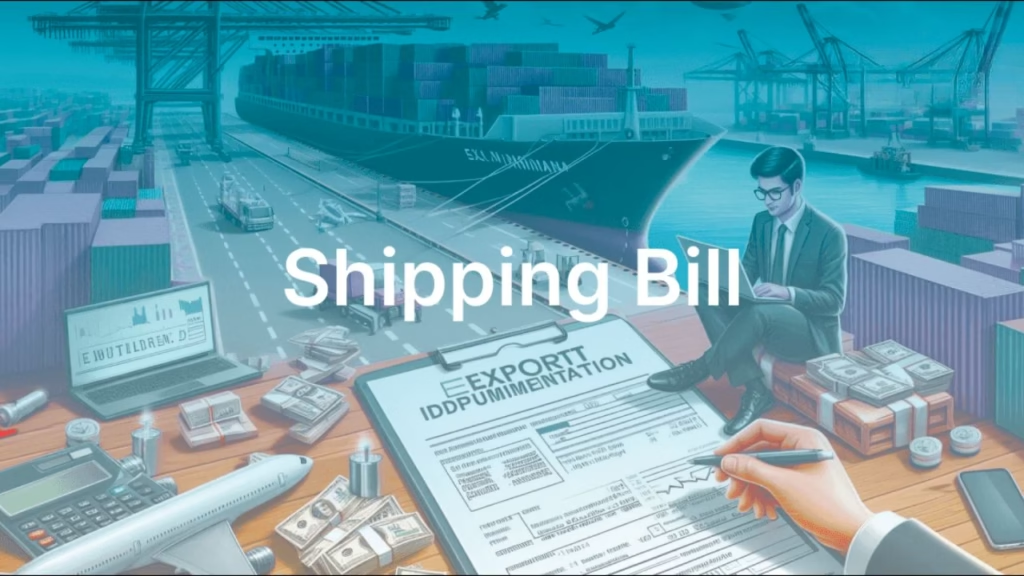
Most blogs stop at “it is required for export.” Here’s what it really does.
Where the S Bill Sits in the Export Flow
Think of the export process as a chain:
- You receive an export order
- You pack the goods
- You file the shipping bill
- Customs assesses it
- LEO is granted
- Goods are loaded
- Carrier files EGM
- Import country files IGM
- Bank matches remittance
- Government processes RoDTEP / Drawback
The s bill is the starting trigger for all of this. Without it, nothing after that works.
The Relationship Between Key Export Records
This is where most exporters fail.
Shipping Bill
Your declaration. Your base record.
EGM (Export General Manifest)
Filed by the carrier. It confirms your cargo actually left India.
No EGM = no incentive, no proof of export.
That’s why:
- egm shipping bill
- egm status matter so much.
IGM (Import General Manifest)
Filed at the destination country. It proves the goods arrived.
Used in:
- igm tracking
- air igm status
Bank Remittance
Your bank matches the inward payment to your shipping bill number.
Mismatch = FEMA problem.
RoDTEP / Drawback
The government links incentive credits directly to:
- Shipping bill number
- EGM status
- DBK enquiry records
No valid chain = no money.
Why Customs Uses it
Customs doesn’t use it for formality. They use it to control three things.
1) Assess duty
HS code + value = duty decision.
Wrong entry = notice.
2) Approve incentives
Only s bills with valid EGM and scheme codes get:
- RoDTEP
- DBK
- EPCG benefits
That’s why exporters keep checking:
- icegate sb status
- sb bill status
- shipping bill tracking status
3) Track export history
Your s bills build your export profile.
They affect:
- DGFT credibility
- Bank risk rating
- Incentive audits
This is your export footprint.
What this really means is:
The s bill is not a form. It is the spine of the Indian export system. Get it right, and everything flows. Get it wrong, and everything breaks.
Who Must File a Shipping Bill?
Short answer: anyone exporting goods from India.
There is no “small exporter” exemption. No “trial shipment” exception.
Exporters
If you are the one selling goods outside India, the responsibility is legally yours. Even if your CHA files it, you are still accountable for every detail inside that s bill.
Two examples:
- You export garments worth ₹50,000. Still mandatory.
- You export machinery worth ₹50 crore. Still mandatory.
Value does not change the rule.
CHA (Customs House Agent)
Most exporters use a CHA. But understand this clearly the CHA files on your behalf. They do not own the liability. If the HS code is wrong, the duty is wrong, or the incentive is mis claimed, Customs will question you, not them.
Courier Exports
Even courier shipments that cross borders need a s bill. The only difference is the format and processing channel. The legal requirement does not change.
All Transport Modes
A shipping bill is required for exports by:
- Air
- Sea
- Road
- Rail
The mode changes the logistics. It does not change Customs law.
When a S Bill Is NOT Required (Rare)
These are exceptions, not loopholes:
- Baggage exports under special rules
- Diplomatic consignments
- Government to government aid shipments
- Certain defense or strategic exports
If you are a regular commercial exporter, assume you always need a shipping bill. Trying to “check if you can skip it” is how penalties start.
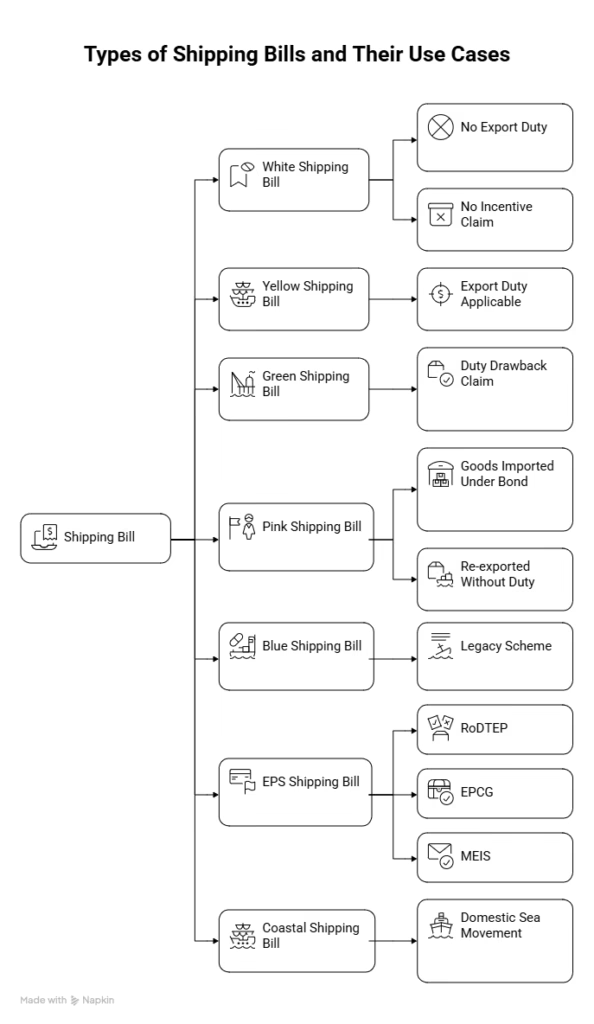
Types of Shipping Bills (With Color Codes & Use Cases)
The color is not decoration. It tells Customs why you are exporting and what you are claiming.
White Shipping Bill – Free Shipping
Used when:
- No export duty applies
- No incentive or drawback is claimed
This is for clean, neutral exports.
Common industries:
- IT hardware
- Handmade goods
- Low margin trading items
If you choose white and later try to claim RoDTEP, you’ve already failed.
Yellow Shipping Bill – Dutiable Goods
Used when export duty is applicable.
Example:
- Certain minerals
- Restricted commodities
This tells Customs “I accept duty assessment on this export.”
Green Shipping Bill – Drawback Claim
Used when you want duty drawback (DBK) on inputs.
This connects directly to:
- dbk enquiry
- drawback enquiry ICEGATE
If your s bill is not green, your DBK claim will not even enter the system.
Pink Shipping Bill – Ex Bond / Duty Free
Used for:
- Goods imported under bond
- Now re-exported without paying duty
This is common in:
- SEZ movements
- Warehousing exports
Blue Shipping Bill – DEPB
The blue shipping bill was used when exporters claimed benefits under the DEPB (Duty Entitlement Passbook) Scheme.
The DEPB scheme is closed now. You cannot use a blue s bill for new exports today.
So why does it still matter?
Because old DEPB s bills are still referenced in:
- Bank export history checks
- DGFT audits
- Customs verification
- Incentive reconciliation
Two examples:
- If you exported in the DEPB era, banks may still ask for those blue s bills during compliance or loan reviews.
- If an old DEPB case is under audit, Customs will refer to the original blue s bill data.
So while you will never file a new blue s bill today, you still need to understand it for records, audits, and legacy disputes.
EPS Shipping Bill – Incentive Schemes
Export promotion s bill is the most commercially important today.
Used for:
- RoDTEP
- EPCG
- MEIS
If your EPS details are wrong, your:
- Icegate sb status
- shipping bill tracking status will show errors and your credit will fail.
Coastal Shipping Bill
Used for domestic sea movement between Indian ports. Not an export.
But still regulated.
Difference:
- Coastal shipping bill = India to India by sea
- Export shipping bill = India to another country
Mixing them up blocks cargo at the port. Choosing the wrong s bill type is like choosing the wrong visa. You might still travel, but you will pay for it later.
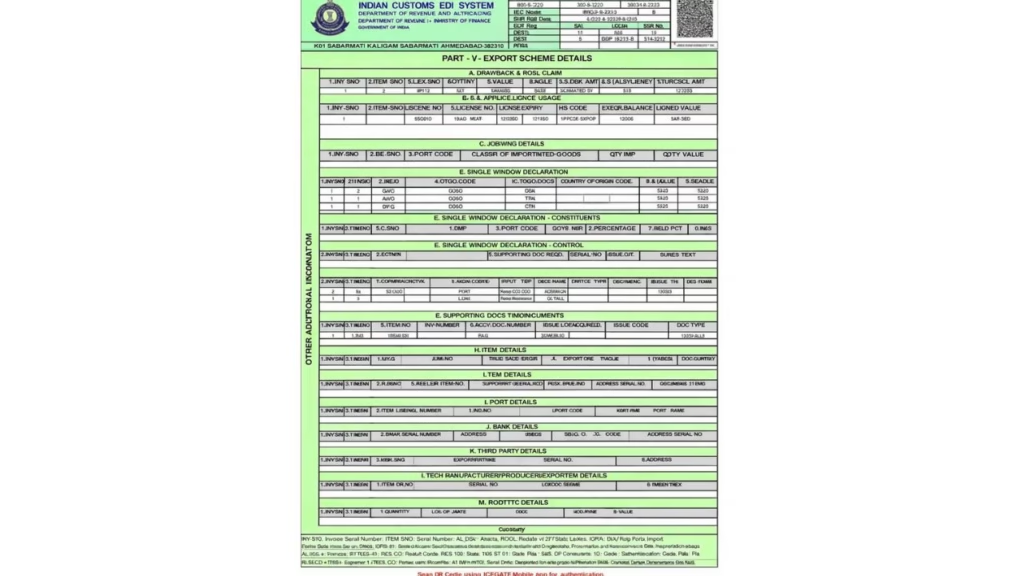
Key Components of a Shipping Bill
A s bill is not “one form.” It is a data file. And every field talks to a different government system. If one part is wrong, something else will fail later.

Exporter & Consignee Details
This section proves who is exporting and who is receiving.
Import Export Code
Your Import Export Code is your identity.
No IEC = no ICEGATE filing.
Two examples:
- Wrong IEC = shipping bill not linked to DGFT
- Old IEC = RoDTEP credit fails
Address
Your registered business address must match DGFT and GST records. Mismatch triggers verification holds.
GST
Used to validate:
- LUT(Letter of Undertaking) eligibility
- Zero rated exports
- Refund claims
If GST and IEC don’t align, the s bill stays “under query.”
Goods Information
This is the most sensitive section.
HS Code
This decides:
- Duty
- Restrictions
- Incentives
Wrong HS = wrong law applied.
Description
Must match:
- Invoice
- Packing list
- HS heading
Generic descriptions like “spare parts” gets flagged.
Quantity
Used to match:
- Packing list
- Container count
- EGM data
FOB Value
This is your declared export value. Banks, Customs, and DGFT all use it.
Undervaluation = notice.
Overvaluation = incentive audit.
Transport Details
This tells Customs how and where the goods move.
Mode
Air, Sea, Road, or Rail. Each has different EGM and IGM systems.
Port of Loading
Where Customs clears your goods.
Port of Discharge
Destination port. Mismatch here causes igm tracking errors later.
Financial Details
This section decides money in or money out.
Currency
Must match your invoice and bank inward remittance.
GST
Used to validate:
- LUT
- Zero tax export
- Refunds
Drawback
Only works with green shipping bill and correct DBK code.
RoDTEP
Only credited if:
- EPS shipping bill
- EGM filed
- Status clean on ICEGATE
Declaration & Signatures
This is your legal oath.
You are declaring that:
- The data is true
- No restricted goods are hidden
- You accept penalties for false declaration
This is not a formality. This is what allows Customs to prosecute if something is wrong.
Required Documents
The s bill is the summary. These documents are the proof.
Commercial Invoice
Shows:
- Buyer
- Value
- Currency
- Terms of sale
Customs cross checks this with your s bill value.
Packing List
Confirms:
- Quantity
- Weight
- Package details
Used during physical inspection.
Import Export Code
Proof that you are legally registered to export.
Export Order / Purchase Order
Shows there is a genuine buyer and transaction.
LUT / Bond
Required for GST free exports. Without it, GST liability is triggered.
QC (Quality Control) Certificates
Mandatory for regulated products like food, chemicals, or pharma.
LC Copy
Used by banks and sometimes by Customs to verify payment security. Most exporters lose incentives not because of schemes, but because of wrong data in these fields.
Step by Step Process to File on ICEGATE
ICEGATE is not a website. It is the customs nervous system. Everything flows through it. Miss one step and your status will freeze.
Register on ICEGATE
You cannot file without registration.
What you need:
- IEC
- PAN
- GST
- Digital signature (DSC)
Once approved, your IEC is mapped to ICEGATE. If this mapping is wrong, your shipping bill will never reflect correctly.
Login Using IEC/CHA
You can:
- File yourself using IEC login
- Or authorize a CHA to file on your behalf
But remember The CHA is just the operator. You remain the legal owner of the data.
Enter Shipping Bill Details
This is where 90% of mistakes happen.
You enter:
- Exporter details
- Consignee details
- HS code
- Value
- Scheme code
- Port
- Mode of transport
Once submitted, every system (DGFT, Bank, Customs) reads from this data.
Upload Documents
Attach:
- Commercial invoice
- Packing list
- LUT/Bond
- Any certificates
If documents don’t match the fields, Customs raises a query.
Checklist Verification
ICEGATE generates a checklist. You must verify every line. If you approve wrong data here, you cannot blame the system later.
Customs Assessment
The evaluator checks:
- HS code
- Value
- Scheme eligibility
They may:
- Approve
- Raise a query
- Send for examination
Until this clears, your shipping bill status stays pending.
Let Export Order (LEO)
This is the real approval.
No LEO = no export. Once LEO is given, Customs has legally cleared your goods.
EGM Filing by Carrier
After departure, the airline or shipping line files EGM. This proves your goods actually left India.
Without EGM:
- RoDTEP fails
- Drawback fails
- Bank matching fails
That’s why exporters obsess over egm shipping bill status.
Download Shipping Bill PDF
Once processed, you can:
- Download from ICEGATE
- Share with bank, buyer, auditor
This PDF is your permanent export proof.
How to Check Shipping Bill Status Online
If you don’t track, you don’t get paid.
ICEGATE Shipping Bill Status
You can check using:
- icegate shipping bill status
- s bill status
- sbill tracking
- shipping bill tracking status
All point to the same ICEGATE tracking screen.
What you’ll see:
- Filed
- Under Assessment
- LEO Granted
- EGM Filed
If any step is missing, your export is incomplete.
Shipping Bill Number
Your shipping bill number is your export identity. Every status check, incentive claim, bank remittance, and compliance verification links back to this one number. If you don’t know where to find it, you lose control over your shipment.
You can locate your shipping bill number in four places:
- ICEGATE dashboard – After filing, it appears in your shipment list and status screen.
- Shipping bill PDF – Printed on the top section of the final approved document.
- CHA checklist – Your customs agent’s verification sheet always contains the generated SB number.
- Invoice reference – Many exporters add the s bill number to their commercial invoice for tracking and audit clarity.
If you cannot find this number, you cannot track your export, your incentives, or your payment status.
This is required for:
- Bank submission
- Incentive claims
- Audit records
Exporters lose more money from not tracking status than from bad buyers.
EGM Status Explained
If your shipping bill is the birth certificate, EGM is the proof of life.
No EGM = no export in the eyes of the government.
What Is EGM?
EGM (Export General Manifest) is a declaration filed by the carrier (airline or shipping line) after your cargo physically leaves India.
It confirms:
- Your container or AWB actually departed
- The shipment details match the shipping bill
- The export is complete in the system
Until EGM is filed, your s bill is only “approved,” not “executed.”
Why EGM Is Mandatory for Incentives
Every incentive engine checks one thing first Has EGM been filed for this shipping bill?
No EGM, then:
- RoDTEP = rejected
- Drawback = not processed
- EPCG = flagged
This is why exporters constantly check:
- egm shipping bill
- egm status
Because the money sits behind this gate.
Two common failures:
- Carrier forgets to file EGM
- EGM filed with wrong shipping bill number
Both block your credits.
How to Check EGM Shipping Bill Status
You can track using ICEGATE by entering your shipping bill number.
You’ll see:
- EGM not filed
- EGM filed
- EGM error
So when you need EGM proof, you must:
- Ask your CHA, or
- Ask the airline / shipping line
They pull it from the carrier system or ICES backend and share it with you. If EGM is not showing after departure, follow up immediately. Waiting weeks is how claims die quietly.
IGM Tracking and Air IGM Status
EGM proves exit. IGM proves arrival.
What Is IGM?
IGM (Import General Manifest) is filed by the carrier at the destination port or airport.
It confirms:
- Goods arrived
- They are linked to the s bill and airway bill / BL
- The import country has accepted the cargo
Difference Between EGM and IGM
| EGM | IGM |
| Filed in India | Filed in destination country |
| Proves export | Proves import |
| Used for incentives | Used for clearance abroad |
| Linked to shipping bill | Linked to BL/AWB |
How to Check IGM
You can track by searching:
- igm tracking
- air igm status
Air shipments update faster. Sea shipments can take days.
If IGM doesn’t appear:
- Buyer cannot clear goods
- Payment may be delayed
Most exporters lose incentives not because they filed wrong, but because they never followed EGM and IGM.
That’s not bad luck. That’s bad control.
DBK Enquiry & Drawback Tracking on ICEGATE
If you export from India and don’t check DBK status, you are leaving money on the table.
What Is DBK?
DBK (Duty Drawback) is a refund of customs and excise duties paid on inputs used to manufacture exported goods.
It exists to make Indian exports competitive. But the refund is not automatic. It is status driven.
Who Can Claim
You can claim DBK if:
- You exported goods under a green shipping bill
- Your product has a notified drawback rate
- Your EGM is filed
- Your s bill is error free
If any one link breaks, the chain stops.
How to Use DBK Enquiry on ICEGATE
You can track your claim using:
- dbk enquiry
- drawback enquiry icegate
What you’ll see:
- Shipping bill number
- EGM reference
- Amount sanctioned
- Amount paid
- Rejection reason (if any)
Two brutal truths:
- If DBK shows “error,” no one will call you.
- If you don’t check, you will never know you were rejected.
ICEGATE SB Status Errors (And What They Actually Mean)
ICEGATE does not explain errors. It just shows statuses. You have to read between the lines.
Here’s what they really mean.
LEO Not Granted
Meaning:
Customs has not legally cleared your goods.
Causes:
- HS code mismatch
- Valuation query
- Missing documents
Until LEO is granted, your export is frozen.
EGM Not Filed
Meaning:
Your cargo left physically, but not digitally.
Causes:
- Carrier delay
- Wrong shipping bill number in EGM
- System mismatch
Result:
- No RoDTEP
- No DBK
- No bank matching
Drawback Rejected
Meaning:
Your DBK claim failed validation.
Causes:
- Wrong scheme code
- No EGM
- Product not eligible
ICEGATE will not fix this. You must.
RoDTEP Not Credited
Meaning:
Your s bill did not pass incentive checks.
Causes:
- EPS code wrong
- EGM missing
- Port mismatch
Your export happened. Your money didn’t. ICEGATE is not broken. It is brutally logical. It only pays when every link is correct.
Common Mistakes Exporters Make
These are not small errors. Each one directly blocks clearance, incentives, or payment.
Wrong HS Code
This is the most dangerous mistake.
Your HS code controls:
- Duty
- Restrictions
- Incentives
Two outcomes:
- You under-classify → penalties and duty demand
- You over-classify → incentive rejection
Customs sees this as mis declaration, not a clerical error.
Incorrect FOB Value
FOB is the base for:
- Duty calculation
- RoDTEP credit
- Bank remittance matching
If your invoice shows one value and your s bill shows another, ICEGATE flags it.
This triggers:
- Audit
- Withheld incentives
- Bank compliance issues
Missed EGM
- You shipped.
- You invoiced.
- You got paid.
But the carrier didn’t file EGM.
Result:
- No RoDTEP
- No DBK
- Export not “completed” in the system
This is the most common silent failure.
Claiming the Wrong Incentive
Choosing EPS, DBK, or RoDTEP without eligibility is not strategy. It’s self sabotage.
Two examples:
- Claiming RoDTEP on ineligible goods → rejected
- Using wrong scheme code → status error forever
ICEGATE does not auto correct. It directly rejects.
Shipping Bill at ICES (Indian Customs EDI System)
Exporters see ICEGATE. Customs sees ICES. They are not the same.
What ICES Is
ICES (Indian Customs EDI System) is the internal system used by Customs officers.
It is where:
- Assessment happens
- Queries are raised
- LEO is granted
ICEGATE is only the window. ICES is the engine.
How ICES Links to ICEGATE
- You file on ICEGATE
- The data flows into ICES
- Customs processes it there
- The result comes back to ICEGATE
If ICES rejects or flags something, ICEGATE only shows the symptom.
Why Errors Happen
Not because the portal is bad.
Because:
- Your data is inconsistent
- Your documents don’t match
- Your codes are wrong
ICES follows strict rules. It does not “assume.” It only validates. Most exporters blame the portal.
The portal is not the problem.The input is.
Billing Address vs Shipping Address (Why Exporters Get This Wrong)
Most exporters treat these as non essential fields. Customs treats them as identity signals.
Billing Address and Shipping Address
- Billing address:
The address linked to the buyer’s payment and legal entity. - Shipping address:
The physical location where the goods are delivered.
They are often different, and that is normal. What is not normal is entering them randomly.
Difference Between Shipping and Billing Address
Two real cases:
- A buyer pays from a head office in Germany, but goods go to a warehouse in Poland.
Billing address = Germany
Shipping address = Poland - A marketplace pays from Singapore, but ships to Dubai.
Billing address = Singapore
Shipping address = UAE
If you enter both as the same, your records lie.
Impact on Customs Clearance
Customs uses these fields to:
- Match commercial contract
- Verify country of destination
- Track trade patterns
Wrong entries can cause:
- Query from Customs
- IGM mismatch
- Bank remittance delay
Why It Is Legally Critical
This is the part no one tells you clearly. The s bill is not only “for customs.” It is for every authority connected to your export.
FEMA Compliance
Banks use the shipping bill number to prove that foreign currency came from a genuine export.
No shipping bill link = FEMA red flag.
Bank Remittance
Your inward payment is matched to:
- Shipping bill number
- FOB value
- Currency
If it doesn’t match, your money can be held.
DGFT Proof
Your export history at DGFT is built only from shipping bills.
No bill = no export record.
Incentive Claims
RoDTEP, DBK, EPCG. All of them read from one source. The shipping bill.
If it is wrong, incomplete, or unmatched, the money does not move. The s bill is not a document.
It is your legal export identity.
Final Thoughts
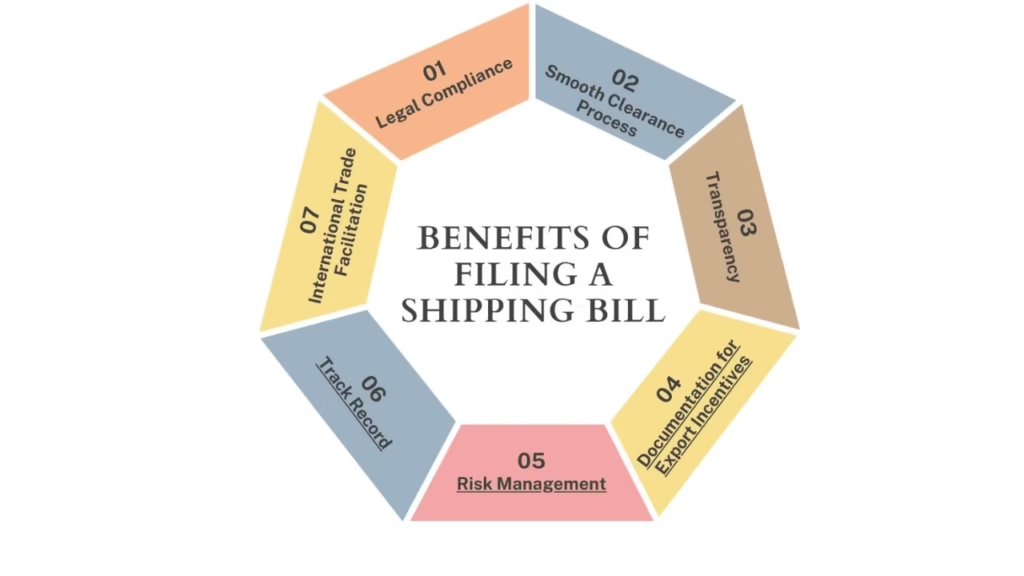
Let’s strip this down to the truth.
The shipping bill is not paperwork.
It is not a form.
It is not a routine task to “get done.”
It is your export identity.
Every authority that touches your shipment reads from this one record:
Customs. Banks. DGFT. Incentive systems. Auditors. If the shipping bill is clean, everything moves.
If it’s wrong, everything stalls.
Two realities most exporters learn the hard way:
- You can ship goods and still not be “exported” in the system.
Without EGM, your shipping bill is incomplete. - You can receive money and still face compliance issues.
If the bank can’t match it to your shipping bill, FEMA risk starts.
What this really means is simple:
Your shipping bill is your export passport. It decides whether you cross borders smoothly or get stopped at every checkpoint.
So stop treating it like admin work. Treat it like what it is the single record that proves you are a real exporter in the eyes of the system.
Frequently Asked Questions
Q1) How long does it take for shipping bill status to update on ICEGATE?
Normally, status updates within 2 to 24 hours at each stage.
If your sb bill status is stuck for more than a day after LEO or departure, it usually means:
EGM is not filed
Or data mismatch exists
Waiting won’t fix it. Follow up with the carrier or CHA immediately.
Q2) Why is my shipping bill showing LEO granted but no incentive credited?
Because LEO is not the finish line.
Incentives only process after:
EGM is filed
s bill egm status is updated
Scheme codes are validated
No EGM = no RoDTEP, no DBK.
Q3) Can I edit a shipping bill after submission?
Yes, before LEO.
After LEO, only limited amendments are allowed, and most incentive-related fields are locked.
Two examples:
You can correct consignee name before LEO
You cannot change scheme code after LEO
Q4) What should I do if my shipping bill is rejected or stuck on ICEGATE?
Don’t wait. Do three things immediately:
Check sbill tracking for the exact status
Ask your CHA for the ICES error code
Correct and resubmit or raise a query response
ICEGATE will not auto-resolve anything.
Q5) Is the shipping bill required for bank remittance and GST refunds?
Yes. Always.
Banks, DGFT, and GST systems all match your export through the s bill number.
No shipping bill = no legal proof of export.
About the Author
Hi, I’m SriHarsha, founder of shxhub.in.
I focus on explaining import export business topics in a practical, beginner friendly way, based on how exports actually work on the real ground especially documentation, quality control, and buyer expectations.


14 thoughts on “Shipping Bill: 11 Critical Facts Every Exporter Must Know Before Filing”