
Introduction
Every exporter knows the uncomfortable arithmetic. You pay your suppliers this week. You pay your workers at the end of the month. You pay the freight forwarder before the container leaves. And your overseas buyer, quite reasonably, pays you 60 or 90 days after the goods land.
That stretch between money going out and money coming in is the cash gap, and it is the reason pre shipment and post shipment finance exist. Pre shipment finance funds the work of making an export order. Post shipment finance releases the cash locked inside the invoice once the goods have sailed. Together they carry an exporter from purchase order to payment without forcing the business to stall between orders.
Most explanations of this topic stop at definitions and a comparison table. This guide does something different. We follow one exporter and one order from the day the purchase order arrives to the day the buyer’s money lands, and we show where cash runs out and which export finance tool fills each gap.
By the end you will understand:
- What pre shipment finance and post shipment finance mean, in plain language
- How packing credit, PCFC, bill discounting, factoring and forfaiting actually work
- The difference between pre shipment and post shipment finance
- A worked example with numbers
- Which documents banks look for, what costs to ask about, and which mistakes to avoid
- A simple framework for choosing the right facility
The explanations use Indian banking terminology, with international trade finance concepts where they help.
Table of Contents
Why Exporters Need Finance: The Cash Gap Explained
Picture the life of a single export order. An exporter receives an order, buys raw materials, manufactures or processes the goods, packs them, hires transport, clears customs, ships them, and then waits for the buyer to pay. At almost every step, money leaves the business long before any comes back.
The export cash cycle, step by step
| Stage | What happens | Cash direction |
| Order received | Buyer confirms the purchase | None yet |
| Procurement | Raw materials or goods bought | Money out |
| Production and packing | Wages, utilities, consumables, packaging | Money out |
| Shipment | Freight, insurance, documentation | Money out |
| Waiting period | Goods in transit, buyer’s credit period | Nothing in |
| Payment | Buyer remits export proceeds | Money in |
The bigger the order, the deeper the hole before the first rupee returns.
Why open account terms widen the gap
Under an open account sale, the exporter ships first and the buyer pays later, commonly 30, 60 or 90 days after an agreed event such as the shipment date or delivery. Buyers like this arrangement because it keeps their own cash free. Competing exporters often have to match it. So the exporter who can afford to wait wins the order, and the exporter who cannot afford to wait loses it.
Export working capital finance exists so that one order’s payment does not have to arrive before the next order can begin.
Two stages, two different funding needs
The funding requirement splits cleanly into two stages:
- Before shipment: you need money to buy inputs, process them and pack them. This is the pre shipment stage.
- After shipment: the goods are gone, the invoice is issued, and you are waiting. This is the post shipment stage.
Each stage has its own products, its own paperwork and its own risks. Keep this two stage picture in mind, because the rest of this guide hangs on it.
The timeline at a glance
Order Buy inputs Make & pack Ship Buyer’s credit period Payment
|———–|————–|————-|—————–|————————|
|<—— PRE-SHIPMENT FINANCE ——>|<——– POST-SHIPMENT FINANCE ————->|
Cash out –> Cash out –> Cash out –> Cash out –> No cash in ……….. Cash IN
What Is Pre-Shipment Finance?
Definition
Pre-shipment finance is credit given to an exporter to fund export related activity before the goods are shipped. In India it is commonly called packing credit or export packing credit.
The name is misleading. Packing credit does not only pay for packing. The Reserve Bank of India’s export credit framework treats it as finance for purchasing, processing, manufacturing and packing goods, and also for eligible working capital expenses of exporters who render services. Think of it as finance for executing the export order, not for putting goods into boxes.
What it can finance
Depending on the transaction and the bank’s sanction, pre shipment finance can support:
- Buying raw materials, components or finished goods for export
- Processing or manufacturing the export product
- Packing and preparing goods for shipment
- Working capital costs of service exports, such as wages, consumables and supplies
The key phrase is export related. It is not unrestricted funding for unrelated spending. Banks sanction it against an export requirement and monitor how the money is used.
What the bank needs as the basis
A bank does not lend against a hope. It normally wants evidence that an export order exists. Acceptable evidence usually includes:
- A confirmed export order or contract
- A letter of credit (LC) issued in the exporter’s favor
- Other evidence of an order that the financing bank accepts
A common misunderstanding is that you need an LC to get packing credit. You do not. A qualifying export order can be enough. The framework also allows a running account facility for eligible exporters, under which the order or LC can be produced later, within a period the bank decides, subject to conditions.
Main forms of pre-shipment finance in India
| Form | What it means |
| Rupee packing credit | Pre shipment export finance denominated in Indian rupees. |
| PCFC (Pre Shipment Credit in Foreign Currency) | Foreign currency finance for eligible export related inputs, both domestic and imported. |
| Running account packing credit | A flexible arrangement for eligible exporters who must arrange inputs or production before individual orders or LCs are lodged, subject to the bank’s conditions. |
Whether you qualify for each, and on what terms, depends on the bank’s assessment and the rules in force at the time.
How pre-shipment finance works, step by step
- The exporter receives an export order or letter of credit.
- The exporter applies to a bank for packing credit.
- The bank assesses the requirement and sanctions a facility.
- Funds are disbursed either in a lump sum or in stages.
- The exporter uses the funds to prepare and ship the goods.
- Export documents are submitted to the bank.
- The packing credit balance is adjusted through the purchase, discounting or negotiation of export bills, or another permitted route.
Staged disbursement is worth noticing. Banks often prefer to release money as the work progresses rather than all at once, which gives them a way to track end use.
The key insight: post-shipment finance can repay packing credit
Here is the point most beginners miss. The exporter does not have to wait for the buyer’s final payment to clear the packing credit. Once the goods ship and the export bill is financed, that post shipment advance can liquidate the pre-shipment facility.
The funding does not stack up. It moves from one stage to the next, like a baton handed over in a relay.

What Is Post-Shipment Finance?
Definition
Post shipment finance is credit provided after goods have been shipped, or services rendered, and before the export proceeds are realized. It bridges the period when the exporter has done the work but not yet been paid.
Say you ship goods today and give the buyer 60 days to pay. Without financing, the invoice amount sits idle for two months. With post shipment finance, you can draw funds against the export bill or receivable almost immediately.
There are several routes. Let us take them one at a time.
Export bills purchased, discounted or negotiated
This is the most common form. The bank gives you money against eligible export documents before the underlying payment arrives. The three terms are used for slightly different situations:
- Purchased: typically used for demand or sight bills, where payment is due when the buyer receives the documents.
- Discounted: typically used for usance bills, where payment is due at a future date. The bank advances the amount now and deducts a discount for the waiting time.
- Negotiated: typically used for documents presented under a letter of credit.
When an LC is involved, compliance with its documentary conditions is everything. A single mismatch between your documents and the LC’s requirements can stall the whole payment.
Advances against bills sent for collection
In a documentary collection, the exporter’s bank forwards shipping documents to the buyer’s bank, which releases them against payment or acceptance. Many exporters assume this also gives them money. It does not.
Collection is a payment handling arrangement, not a financing arrangement, and it is not the same as a bank’s payment undertaking under an LC. If you need cash while the collection is pending, you ask the bank for a separate advance against the collection bill. The RBI framework expressly recognizes this type of post shipment advance.
Advance against duty drawback receivables
In India, eligible exporters may also receive post shipment advances against duty drawback that the government owes them, subject to conditions and supporting evidence. This finances a receivable from the government, not the overseas buyer’s invoice. It is a useful way to unlock a refund that would otherwise take a while to arrive.

Export factoring
Factoring means selling eligible short term export receivables to a specialist (the factor) for immediate cash, at a discount. A factor may bundle several services like finance, collection, receivables bookkeeping and credit protection.
The crucial detail is who bears the risk if the buyer does not pay. That depends on the factoring agreement, so read it. Factoring tends to suit exporters selling on open account to many buyers who want outsourced collections and some protection against non-payment.
Forfaiting
Forfaiting is the sale of medium or long term export receivables to a forfaiter at a discount, without recourse. Without recourse means the forfaiter cannot come back to you if the buyer defaults, which moves the buyer’s payment risk off your books.
It is most useful when buyers need long payment terms, such as capital goods sold with payments stretching across months or years. Factoring and forfaiting belong to the wider family of receivables finance. They are not identical to a conventional bank loan against export bills, so do not describe them as if they were.
How post-shipment finance is repaid
Normally the overseas buyer’s payment is applied to clear the outstanding post shipment finance. The RBI framework also recognizes certain alternative repayment arrangements, subject to conditions and agreement with the bank.
One subtlety deserves attention. Repaying the bank is not the same as realizing export proceeds. If you clear an export credit balance from your own rupee resources, the separate obligation to realize the export proceeds does not automatically disappear. Treat them as two different obligations that happen to touch the same transaction.
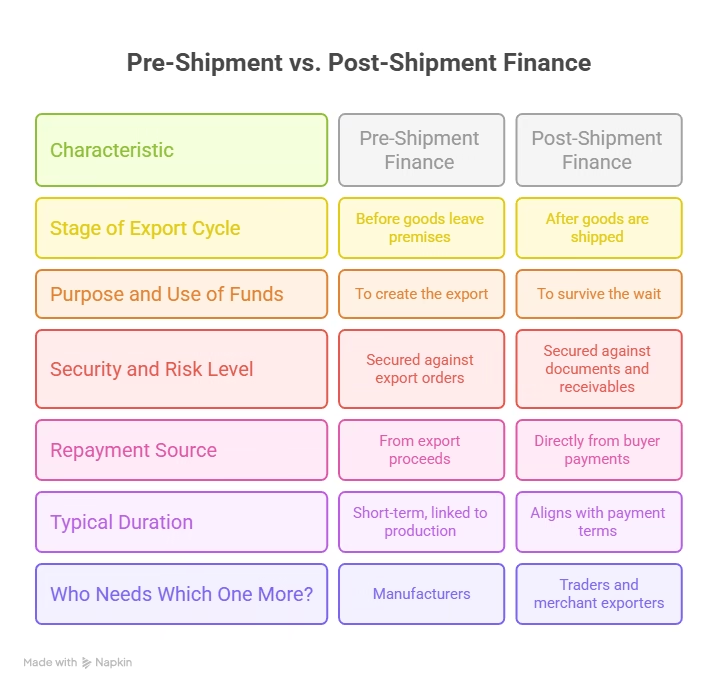
Pre-Shipment vs Post-Shipment Finance: Side by Side
The difference between pre shipment and post shipment finance comes down to timing and purpose.
| Basis | Pre shipment finance | Post shipment finance |
| Timing | Before shipment or before export services are performed | After shipment or service delivery, until proceeds are realised |
| Main purpose | Fund preparation and execution of the export order | Release cash tied up while awaiting payment |
| Stage | Procurement, processing, manufacturing, packing | Export bills and receivables after shipment |
| Usual evidence | Export order, contract, LC or other acceptable proof, running account exceptions exist | Export bills, shipping or service documents, proof of the receivable |
| Common facilities | Rupee packing credit, PCFC | Bills purchased, discounted or negotiated advances against collection bills |
| Normal adjustment | Through financing of export bills, proceeds or another permitted route | Through realisation of export proceeds or another permitted route |
In one line: pre shipment finance helps create the export, post shipment finance helps turn the resulting receivable into usable cash.
Worked Example: Following One ₹20 Lakh Order
The figures below are illustrative only. They are not standard bank terms, and real advance percentages, interest and charges will differ.
An Indian exporter wins an order worth ₹20 lakh. Preparing the goods will cost ₹12 lakh. The overseas buyer will pay 60 days after shipment.
Stage 1: Before shipment
The exporter puts in ₹3 lakh of its own money and obtains ₹9 lakh in packing credit. Together these cover the ₹12 lakh needed to buy materials, manufacture and pack.
Stage 2: After shipment
The goods ship and the exporter submits the required documents. Suppose the bank approves post shipment finance of ₹16 lakh against the export bill. Ignoring interest and charges for simplicity:
- ₹9 lakh of that advance clears the packing credit principal.
- The remaining ₹7 lakh becomes available to the exporter for the next order.
Stage 3: Buyer pays
Sixty days later the buyer pays ₹20 lakh. The bank applies the proceeds to the outstanding post shipment finance and applicable charges, then releases the balance to the exporter.
The flow in one view
Own funds ₹3L ─┐
├─> Goods prepared (₹12L)
Packing credit ₹9L ─┘
│
[ SHIPMENT ]
│
Post shipment advance ₹16L
├─> ₹9L repays packing credit
└─> ₹7L released to exporter
│
[ 60 days later ]
│
Buyer pays ₹20L ─> bank clears ₹16L + charges ─> balance to exporter
Why this is one chain, not two stacked loans
The packing credit does not sit outstanding alongside the post shipment advance. The second replaces the first. This matters because banks guard against double financing, where the same underlying requirement is funded twice. A properly structured facility moves a single exposure from pre shipment to post shipment status.
The takeaway: at no point did the exporter need to find the full ₹12 lakh from its own pocket, and the business had ₹7 lakh free to start the next order weeks before the buyer paid.
Documents Involved at Each Stage
Documentation depends on the lender, the goods or services, the destination market, the payment method and the contract. Treat the lists below as a practical guide, not a universal checklist.
Pre-shipment documents
The core evidence is the export order, contract, letter of credit or other acceptable proof of the order. Beyond that, the bank assesses the proposed export activity and monitors how the advance is used. Qualifying running account facilities are the exception, since individual orders can be lodged later.
Post-shipment documents
Depending on the transaction, you may need:
- Commercial invoice
- Packing list or weight certificate
- Bill of lading or other applicable transport document
- Insurance certificate, where required
- Certificate of origin, where required
- Any additional documents specified by the letter of credit, if the sale is LC backed
Do not tell yourself that every exporter must submit every item above. The required set varies by transaction. What does not vary is the penalty for sloppiness under a letter of credit, discrepancies between your documents and the LC’s terms can delay or jeopardize payment.
What the banker looks for: a quick checklist
- Names and addresses match across invoice, transport document and LC, character for character.
- Amounts and quantities agree across every document.
- Dates are consistent: shipment date within the LC’s shipment window, presentation within the allowed period.
- Goods description mirrors the LC wording rather than a paraphrase.
- Every required document is present, signed where signatures are required, and in the number of originals and copies asked for.
- Insurance and origin documents cover exactly what the LC or contract demands.
Run this check before you submit, not after the bank returns the documents.

Interest, Costs and Tenor: What to Ask Your Bank
There is no single interest rate, funding percentage or repayment period that applies to every pre shipment or post shipment facility. Banks operate within the regulatory framework and judge each case on its own. Packing credit duration, for instance, depends on the time genuinely needed to procure, manufacture, process and ship the goods.
The costs are not all interest
When you compare offers, separate these:
- Interest on a loan or advance
- Discount deducted when a receivable is financed or purchased
- Payment instrument costs, such as LC opening, advising, confirmation or negotiation charges
- Credit insurance premiums, where you insure the buyer’s payment
- Foreign exchange risk management costs, such as hedging or forward cover
A facility that looks cheap on interest can turn expensive once the other items are added.
A note on changing rules
Interest rate systems, foreign currency benchmarks, reporting requirements and policy provisions have changed over the years. The mechanics described in this guide follow the RBI’s export credit framework, but the rates, subsidies, maximum tenors and advance percentages in force today must be confirmed from the RBI’s current directions and your bank. Never assume a figure you read in an old circular or blog still applies.
Questions to ask your bank before you accept
- What is the all in cost, including processing fees, discount and any LC or collection charges?
- What percentage of the order or bill value will you finance?
- What is the maximum period for the facility, and what happens if shipment is delayed?
- How and when will funds be disbursed lump sum or in stages?
- How will the packing credit be liquidated once I ship?
- Is the post shipment finance with or without recourse to me?
- What happens to the advance if the export does not take place?
- Which documents do you need, and in what form?

Benefits and Risks
Benefits
- It helps you execute orders. Pre shipment finance puts money behind purchasing and preparing goods before any payment arrives.
- It smooths cash flow. Post shipment finance means you do not wait for the buyer before you can access cash.
- It supports competitive payment terms. You can offer open account or deferred terms without funding the entire cash cycle yourself.
- It offers flexible risk structures. Letters of credit, factoring, forfaiting and export credit insurance each address different financing and payment risk needs.
Risks and limitations
- Non-performance risk. If the export does not happen, the advance may be treated differently and carry extra costs under the facility terms.
- Buyer and country risk. Shipping does not remove the possibility of late payment, non-payment or restrictions on cross border remittances.
- Documentary risk. Discrepancies can block or delay payment under an LC.
- Foreign exchange risk. Exchange rate movements change the value of foreign currency receipts or obligations.
- Contractual risk allocation. Not every receivables finance arrangement moves the buyer’s credit risk away from you. The agreement must say whether financing is with or without recourse.
The point to remember
Financing gives you liquidity. It does not, by itself, give you payment protection. A standard advance puts cash in your hands sooner. A letter of credit, export credit insurance or a properly structured non-recourse purchase of receivables is what addresses specified payment risks, and each has its own conditions.
Five Common Mistakes Exporters Make
1. Treating packing credit as general purpose funding. It is tied to an export order and monitored for end use.
How to avoid it: keep the funds and records linked to the specific order.
2. Assuming shipment removes buyer non-payment risk. Once goods leave, you are exposed until you are paid.
How to avoid it: choose the payment method and any credit protection before you ship, not after.
3. Ignoring LC document discrepancies. A small mismatch can hold up the entire payment.
How to avoid it: check every document against the LC line by line before presentation.
4. Confusing loan repayment with realization of export proceeds. Clearing the bank advance from your own funds does not automatically settle the obligation to realize the proceeds.
How to avoid it: track both separately and confirm the position with your bank.
5. Not checking recourse terms in factoring. Some arrangements leave the buyer’s credit risk with you.
How to avoid it: ask directly, and make sure the agreement states with or without recourse in plain words.
How to Choose the Right Facility: A Decision Framework
Start with where your order sits in the cash cycle and what worries you most.
| If this is your situation | Then consider |
| You need money to buy materials, produce or pack for a confirmed order | Pre shipment finance (packing credit, or PCFC if you need foreign currency finance) |
| You will not get a firm order or LC first, but you regularly need to prepare inputs | Running account packing credit, if you are eligible |
| You have shipped on open account and the buyer pays in 30 to 90 days | Post shipment bill finance (purchase or discounting) |
| You shipped under an LC and presented documents | Bill negotiation, with strict document checking |
| You sent documents on collection and need cash meanwhile | Advance against the collection bill |
| You want to pass buyer non-payment risk to someone else on short term sales | Export factoring, after checking recourse terms |
| Your buyer needs long payment terms, over months or years | Forfaiting |
| A duty drawback refund is pending | Advance against duty drawback receivable |
Most exporters end up combining two or three of these across a single order, exactly as the worked example showed.
Conclusion
An export order is a promise of money in the future that costs real money today. Pre shipment finance builds the export, it pays for materials, production and packing.
Post shipment finance unlocks the cash, it turns the invoice you are waiting on into funds you can use now. Handled well, the two form a single chain, with the post shipment advance replacing the packing credit rather than piling on top of it.
Before you commit, confirm current rates, tenors, advance percentages and eligibility with your bank and the RBI’s latest directions, because those details change.
If you export regularly, talk to your bank or a trade finance advisor about which combination fits your order sizes and buyer terms, and subscribe for more practical guides on managing export cash flow.

Frequently Asked Questions
Is packing credit only for packing?
No. It can finance purchasing, processing, manufacturing and packing goods before export, and eligible working capital expenses for service exports.
Is a letter of credit mandatory?
No. A qualifying export order or other acceptable evidence can support pre shipment finance. Eligible running account facilities add flexibility, subject to conditions.
Can an exporter use both facilities for one order?
Yes. Pre shipment finance funds the preparation, and post-shipment finance can then repay that advance and cover the wait for payment. The structure must avoid double financing.
Does post-shipment finance guarantee payment from the buyer?
No. A conventional advance provides liquidity, not protection. Letters of credit, export credit insurance or an appropriately structured non-recourse receivables purchase may cover specified risks, each under its own conditions.
Can service exporters get export credit?
Yes. The RBI framework recognizes pre shipment and post shipment credit for eligible service exporters. The distinction is between spending before the service is performed and the receivable after it is rendered, rather than the movement of physical goods.
What is PCFC?
PCFC stands for Pre Shipment Credit in Foreign Currency. It is foreign currency finance for eligible export related inputs, both domestic and imported, offered by banks under the RBI’s export credit framework.
About the Author
Hi, I’m SriHarsha, founder of shxhub.in.
I focus on explaining import export business topics in a practical, beginner friendly way, based on how exports actually work on the real ground especially documentation, quality control, and buyer expectations.



1 thought on “Pre Shipment and Post Shipment Finance: Meaning, Differences & Examples”