


Every time you convert a dollar to a rupee and back to a dollar, you’re paying twice for nothing
Picture this, a textile exporter in Andhra Pradesh ships a container of processed seafood to a buyer in Rotterdam and gets paid USD 20,000. The bank credits the amount, converts it to rupees at its buying rate, and deposits roughly ₹16.6 lakh into the current account.
Three weeks later, the same exporter needs to pay an overseas freight forwarder USD 6,000. The bank sells dollars back at its selling rate usually 0.5% to 1.5% worse than the buying rate it used three weeks earlier.
Nobody explains this on the invoice. It just quietly disappears somewhere between ₹8,000 and ₹25,000 per round trip, depending on the transaction size and the bank’s spread. Multiply that across a year of shipments and incidental foreign payments, and a mid sized exporter can lose lakhs of rupees to conversions that were never actually necessary.
There is a legal, RBI sanctioned way to stop this leak, and most exporters either don’t know it exists or open the account and never use it correctly. It’s called the EEFC account (Exchange Earners’ Foreign Currency Account) and this guide walks through exactly what it is, who can use it, the rules that govern it, the mistakes that get exporters into trouble, and a real step by step process to open one.
This isn’t a rewritten RBI notification. It’s written the way a trade finance consultant would explain it to an exporter sitting across the table with real numbers, a running example, and the parts of the rulebook that actually matter for your day to day decisions.
Table of Contents
What Is an EEFC Account?
EEFC full form Exchange Earners’ Foreign Currency Account.
Strip away the acronym and it’s a simple idea an EEFC account is a bank account that holds foreign currency as foreign currency, instead of forcing every dollar, euro, or pound that comes in to be immediately converted into rupees.
Think of your regular business current account as a rupee wallet. An EEFC account is a second wallet a dollar wallet, a euro wallet, or a pound wallet sitting next to it at the same bank. When a foreign buyer pays you, instead of that money automatically becoming rupees the moment it lands, an eligible portion of it can sit in the EEFC account in its original currency, ready to be used the next time you owe someone money in that same currency.
It is opened with an Authorized Dealer (AD) bank essentially any bank in India licensed by the RBI to deal in foreign exchange and it operates under the framework of the Foreign Exchange Management Act, 1999 (FEMA), along with RBI’s Foreign Currency Accounts regulations and its Master Direction on Deposits and Accounts.
Quick Facts: EEFC Account at a Glance
| Feature | Detail |
| Full form | Exchange Earners’ Foreign Currency Account |
| Account type | Current account (non-interest bearing) |
| Who regulates it | Reserve Bank of India (RBI), operated through AD banks |
| Governing law | FEMA, 1999 + RBI Master Direction on Deposits and Accounts |
| Currencies typically offered | USD, EUR, GBP (subject to the bank’s offering) |
| Interest earned | None |
| Maximum credit allowed | Up to 100% of eligible foreign exchange earnings |
| Conversion deadline | Unused monthly accruals must generally be converted to INR by the end of the following calendar month |
| Who can open it | Resident individuals and businesses earning eligible foreign exchange |
| Who cannot open it | Units located in Special Economic Zones (SEZs) |
Keep this table handy nearly every question an exporter has about EEFC eventually traces back to one of these ten facts.
Why EEFC Exists: The Double Conversion Problem, Explained With Real Numbers
RBI’s own language for why EEFC exists is that it lets foreign exchange earners avoid “the need for conversion of foreign exchange into Rupees and vice versa, thereby saving on conversion costs.” That sentence is technically accurate and completely forgettable. Here’s what it actually means in rupee terms.
Let’s follow a fictional but realistic business through this guide Meridian Exports, a Visakhapatnam based processed seafood exporter that ships to buyers in the US and Europe and occasionally pays overseas logistics agents, certification bodies, and freelance quality inspectors in foreign currency.
Without an EEFC account:
- Meridian receives USD 20,000 from a US buyer. The bank converts it to INR immediately at its buying rate say, ₹83.10/USD crediting ₹16,62,000.
- Three weeks later, Meridian needs to pay a US based cold chain logistics consultant USD 4,000. The bank sells USD at its selling rate say, ₹83.85/USD costing ₹3,35,400.
- Total conversion spread absorbed on this one back and forth roughly ₹3,000, just on the portion that had to be converted twice. Scale this to a business doing 15–20 such round trips a year, and the number quickly climbs into six figures.
With an EEFC account:
- Meridian receives the same USD 20,000. Because it holds a USD EEFC account, it can credit the eligible amount directly into that account without an immediate mandatory conversion.
- When the USD 4,000 payment to the logistics consultant comes due, Meridian pays it directly out of the EEFC balance no second conversion, no second spread.
- Only the remaining accrual that isn’t used for approved purposes or forward contracts eventually needs to be converted to INR, and only by the RBI mandated deadline (more on that below).
With EEFC vs. Without EEFC Side by Side
| Situation | Without EEFC Account | With EEFC Account |
| Export payment received in USD | Automatically converted to INR on receipt | Eligible amount can be credited directly to the USD EEFC account |
| Paying an overseas vendor, freight forwarder, or consultant in USD | Bank sells USD again using INR, at a fresh spread | Paid directly from EEFC balance, subject to FEMA permitted use |
| Exchange rate exposure | Fully converted immediately, no flexibility | Some flexibility to time usage and hedge via forward contracts |
| Conversion cost | Two conversion spreads on the same money | Potentially zero or one spread, depending on usage |
| Best suited for | Exporters with no material foreign currency outgoings | Exporters who regularly pay for freight, certifications, software, marketing, or consultants in foreign currency |
The point isn’t that EEFC eliminates conversion altogether RBI still requires unused monthly accruals to eventually become rupees. The point is that it removes the unnecessary round trip: the one where you convert dollars to rupees only to buy dollars back a few weeks later for a payment you knew was coming.
Who Can Open an EEFC Account? Eligibility Breakdown
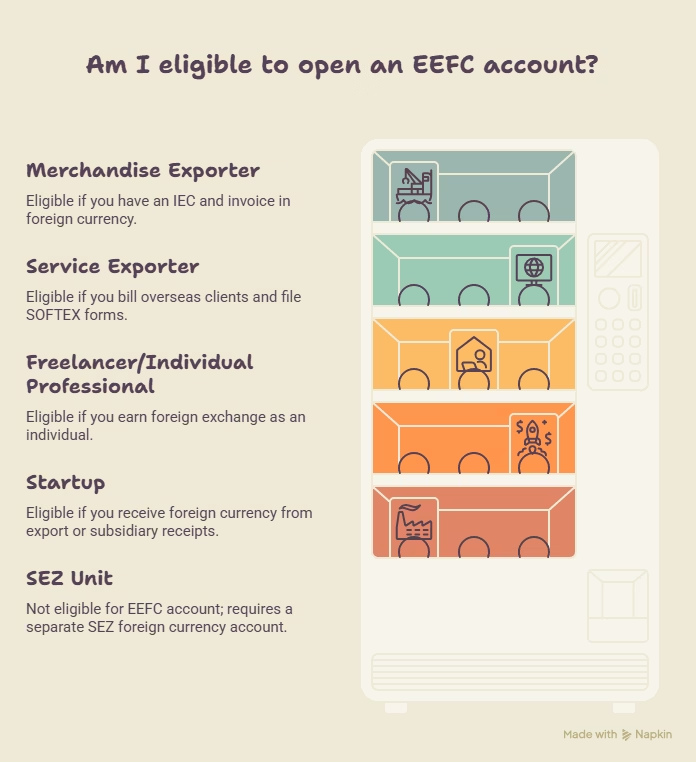
RBI’s language here is broad “all categories of foreign exchange earners” both individuals and companies resident in India, are permitted to open and maintain an EEFC account. In practice, that covers several distinct categories, each with slightly different documentation expectations.
Merchandise Exporters
This is the most common category manufacturers and merchant exporters shipping physical goods overseas and receiving payment in foreign currency through normal banking channels. If you have an Import Export Code (IEC) and regularly invoice buyers in USD, EUR, or GBP, you’re squarely in this bucket.
Service Exporters
Software companies, IT services firms, design studios, digital marketing agencies, and other service exporters who bill overseas clients and file SOFTEX forms (for software/service exports) also qualify. For this group, EEFC is particularly useful because service exporters frequently pay for overseas subcontractors, cloud infrastructure billed in foreign currency, or international marketing platforms exactly the kind of foreign currency outgoing that EEFC is designed to offset.
Freelancers and Individual Professionals
This is the category most people don’t realize applies to them. RBI explicitly permits individual professionals earning eligible foreign exchange consultants, directors receiving foreign directorship fees, lecturers receiving honoraria, and similar professionals to open EEFC accounts. If you’re an independent consultant invoicing a US client in dollars every month, you don’t need to incorporate a company to benefit from an EEFC account you can open one as an individual.
Startups
Eligible Indian startups receiving foreign currency from export activity or specified overseas subsidiary related receipts are also covered under RBI’s Master Direction, reflecting the growing number of India based startups with global customer bases.
Who Cannot Open One: The SEZ Exception
Here’s a detail that a surprising number of articles on this topic simply omit a unit located inside a Special Economic Zone (SEZ) cannot open an EEFC account. Instead, RBI allows SEZ units to maintain a separate, distinct foreign currency account facility with an Authorized Dealer, governed by its own set of conditions.
This matters for accuracy and for planning, if your manufacturing or export unit operates out of an SEZ, don’t assume you’ll be routed into a standard EEFC account when you approach your bank. You’ll need to ask specifically about the SEZ foreign currency account facility instead.
EEFC Account Rules Every Exporter Must Know
This is the section that actually determines whether your EEFC account works for you or becomes a compliance headache. RBI’s Master Direction on Deposits and Accounts (most recently updated in April 2025) lays out the operating rules in detail. Here’s what matters in practice.
1. It’s a Non-Interest Bearing Current Account
An EEFC account earns zero interest, by design. RBI structured it this way specifically to prevent it from being used as a forex investment or parking vehicle it’s meant to be a transactional cash management tool, not a savings instrument. If your goal is to earn a return on foreign currency holdings, an EEFC account is the wrong tool you’d be looking at a different regulatory framework entirely (and likely outside the scope of what’s available to a resident business).
Banks are also barred from extending fund based or non-fund based credit facilities against EEFC balances. You cannot use your EEFC balance as collateral for a loan or overdraft.
2. The 100% Credit Rule
Eligible account holders can credit up to 100% of their eligible foreign exchange earnings into the EEFC account. This was a significant liberalization from earlier eras when only a partial percentage of export earnings could be retained in foreign currency today, in principle, the entire eligible receipt can stay in dollars, euros, or pounds if the exporter wants it to.

But “100% eligible” doesn’t mean “100% indefinitely.” That’s where the next rule comes in and it’s the one exporters most often get wrong.
3. The Monthly Conversion Deadline Explained With a Timeline
This is the rule that catches people off guard. RBI requires that the total accruals during a calendar month be converted into INR on or before the last day of the following calendar month after netting off:
- Amounts already used for approved purposes, and
- Amounts covered under permitted forward contracts.
In other words, EEFC is not a place to indefinitely warehouse foreign currency waiting for a better exchange rate. It’s a rolling one month utilization window.
Here’s the timeline in practice, using Meridian Exports:
| Event | Date | Action Required |
| Meridian receives USD 15,000 from a buyer | 8 April | Credited to EEFC account |
| Meridian pays USD 5,000 to an overseas logistics vendor | 22 April | Deducted from EEFC balance approved use |
| Meridian enters a forward contract covering USD 4,000 of the remaining balance | 25 April | Earmarked, excluded from the conversion requirement |
| Remaining unutilized balance (USD 6,000) | — | Must be converted to INR by this deadline → |
| Deadline to convert the remaining USD 6,000 to INR | 31 May | Mandatory, unless used or hedged before this date |
The mistake exporters commonly make is treating the EEFC account like a savings account leaving a consolidated dollar balance sitting there for two, three, or four months hoping the exchange rate improves. That’s not how the rule is designed to work, and banks are expected to track accrual by accrual, month by month compliance.
Practical takeaway, if you’re not going to use a specific month’s foreign currency inflow for a foreign payment or a forward contract within roughly 30–60 days, plan for it to be converted to rupees. Don’t rely on the EEFC account as a long term forex hedge against rupee depreciation.
4. Permitted Credits What Can Actually Go Into the Account
RBI allows several categories of foreign exchange inflows into an EEFC account, including:
- Foreign exchange earnings received through normal banking channels (excluding foreign currency loans, foreign investment receipts, and money received to meet a specific personal obligation)
- Advance remittances received from overseas buyers against future export of goods or services
- Receipts under eligible counter trade arrangements
- Professional receipts, consultancy fees, director’s fees, lecture fees, honoraria, and similar earnings for individual professionals
- Re-credit of foreign currency that was earlier withdrawn from the EEFC account but not used
- Repayment by an overseas buyer of trade related loans or advances the exporter had extended out of EEFC funds
- Eligible foreign currency receipts by qualifying Indian startups from export or overseas subsidiary related sales
- Reimbursements received in foreign exchange through international credit cards, where applicable
5. Permitted Debits What You Can Actually Pay For
On the payment side, EEFC balances can be used for:
- Payments outside India for permissible current account or capital account transactions under FEMA
- Payment in foreign currency for goods purchased from a 100% Export Oriented Unit (EOU), or a unit in an Export Processing Zone (EPZ), Software Technology Park (STP), or Electronic Hardware Technology Park (EHTP)
- Payment of customs duty as permitted under the applicable foreign trade policy
- Trade related loans or advances extended to overseas importer customers, subject to FEMA compliance
- Foreign currency payments made to an Indian resident for the supply of goods or services, including airfare and hotel expenditure
- Repayment of packing credit (whether availed in INR or foreign currency), but only to the extent that the underlying exports have actually taken place
6. INR Withdrawal Is a One Way Street
You can withdraw funds from your EEFC account and convert them into INR at any time. But once that money becomes rupees, it cannot be converted back into foreign currency and re-credited to the EEFC account.
This is a subtle but important rule, don’t withdraw more than you need to rupees “just in case,” assuming you can reverse the decision later if a foreign payment comes up unexpectedly. Once it’s INR, it stays INR (within the EEFC framework) unless you go through a fresh conversion at the prevailing market rate like any other transaction.
7. Export Documentation Obligations Don’t Disappear
Opening an EEFC account does not reduce or replace your standard FEMA and export documentation responsibilities. You’re still required to realize and repatriate export proceeds through proper banking channels within the RBI prescribed timeline, and to maintain shipping bills, invoices, e-BRC filings, AD bank reporting, and (for service exporters) SOFTEX documentation exactly as before.
EEFC changes how the money is held and used after it arrives it doesn’t change the rules about whether and when it must arrive.
EEFC Account vs. Current Account vs. RFC Account — Which One Do You Need?
Exporters often confuse EEFC with other foreign currency adjacent facilities. Here’s how they stack up:
| Feature | EEFC Account | Regular INR Current Account | RFC Account (Resident Foreign Currency) | SEZ Foreign Currency Account |
| Currency held | Foreign currency (USD/EUR/GBP etc.) | Indian Rupees only | Foreign currency | Foreign currency |
| Who it’s for | Resident exporters/professionals earning forex | Any resident business | Returning NRIs bringing foreign assets back to India | Units operating inside an SEZ |
| Purpose | Manage export earnings vs. foreign currency outgoings | Day to day rupee transactions | Hold foreign assets earned while abroad, post return | Manage forex earnings of SEZ based export units |
| Interest | None | May earn nominal interest (bank dependent) | Typically interest bearing | Governed by SEZ specific rules |
| Conversion deadline | Monthly accruals must generally convert to INR by end of the following month | Not applicable | No comparable RBI deadline | Governed separately |
| Eligible for exporters covered in this guide | Yes | Yes (as the linked rupee account) | No (different resident category) | No SEZ units use this instead of EEFC |
If you’re a non-SEZ exporter or a professional earning foreign fees, EEFC is almost certainly the right tool. If your unit sits inside an SEZ, ask your bank about the dedicated SEZ foreign currency account instead not EEFC.
EEFC in Action: What the Savings Actually Look Like at Different Transaction Sizes
Let’s extend the Meridian Exports scenario into a broader comparison, because the benefit of EEFC scales with transaction size and frequency, not just with one big export order.
Assume a combined round trip conversion cost (buy spread + sell spread) of approximately 0.8%–1.2% of the transaction value a reasonable estimate for typical AD bank forex margins on current account transactions, though actual spreads vary by bank, currency, and relationship.
| Transaction Size (Foreign Currency In + Out) | Estimated Cost Without EEFC (Double Conversion) | Estimated Cost With EEFC (Single/No Conversion) | Approximate Savings |
| USD 5,000 | ₹3,300 – ₹5,000 | ₹0 – ₹2,000 (if fully utilized within EEFC) | ₹1,500 – ₹3,500 |
| USD 20,000 | ₹13,000 – ₹20,000 | ₹0 – ₹8,000 | ₹6,000 – ₹14,000 |
| USD 50,000 | ₹33,000 – ₹50,000 | ₹0 – ₹20,000 | ₹16,000 – ₹33,000 |
(These are illustrative estimates based on typical spread ranges, not guaranteed figures actual costs depend on your bank’s forex margins, the currency pair, and how much of the balance is genuinely used for foreign payments versus eventually converted to INR anyway.)
The real world lesson EEFC delivers the biggest benefit to exporters who have recurring, predictable foreign currency expenses logistics agents, overseas certification bodies, international marketing spends, software subscriptions billed in USD, or payments to overseas subcontractors.
If your business only ever receives foreign currency and never pays any out, the benefit shrinks to whatever hedging flexibility the account offers before the monthly conversion deadline kicks in.
How to Open an EEFC Account: Step by Step Process
The exact onboarding flow varies slightly bank to bank, but the overall path is consistent across AD Category-I banks. Here’s how to approach it.
Step 1: Identify the right bank desk. Don’t walk into a generic branch EEFC accounts are handled by the forex, trade finance, or international banking desk. If you already maintain your business current account with a particular bank, start there it simplifies linking the two accounts later.
Step 2: Request the EEFC account opening form and FEMA declaration. The bank will provide an account opening form specific to EEFC, along with a FEMA compliance declaration you’ll need to sign, confirming the nature of your foreign exchange earnings.
Step 3: Complete KYC and business verification. Standard KYC applies PAN, identity and address proof, and business verification documents appropriate to your entity type (proprietorship, partnership, LLP, or company).
Step 4: Submit evidence of your export or foreign exchange earning activity. This is where the bank confirms you actually qualify as an eligible foreign exchange earner through your IEC registration, past export invoices, service contracts, or professional fee agreements, depending on your category.
Step 5: Choose your currency. Select the foreign currency (USD, EUR, GBP, or another freely convertible currency the bank offers) that matches your actual trade pattern. If you invoice in multiple currencies, ask whether the bank allows multiple EEFC sub accounts or a single multi currency facility.
Step 6: Link the EEFC account to your INR current account. This linkage is what allows conversions, bank charges, and INR side operational transactions to flow smoothly between the two accounts.

Step 7: Confirm the bank’s operational procedures. Before you start routing real transactions through it, get clarity from the bank on how they credit incoming export receipts, how they track your monthly accrual to conversion timeline, how forward contracts against EEFC balances are booked, and what reporting you’ll receive to track compliance with the monthly conversion rule.
Documents Commonly Requested
Requirements vary by bank, but exporters should generally be ready with:
- PAN card and identity/address proof
- Existing business current account details
- GST registration certificate, where applicable
- Import Export Code (IEC), for merchandise exporters
- Incorporation documents, partnership deed, LLP agreement, or proprietorship proof, as applicable
- Export invoices, purchase orders, shipping bills, or overseas contracts
- SOFTEX related documentation, for software/service exporters
- FEMA declaration forms and any bank specific formats
Treat this as a starting checklist, not a final one confirm the exact list with your chosen AD bank before your first appointment, since minimum balance requirements, permitted currencies, account fees, and digital banking features differ from bank to bank.

Key Benefits of an EEFC Account for Exporters
Pulling the threads together, here’s what an EEFC account actually does for your business:
- Cuts unnecessary conversion costs by letting you match foreign currency income against foreign currency expenses without two separate conversion spreads.
- Simplifies foreign payment logistics for recurring foreign currency vendors freight forwarders, certification agencies, international marketing platforms, and overseas subcontractors.
- Offers limited hedging flexibility EEFC balances can be covered against exchange rate risk through forward contracts, with sold forward balances remaining earmarked for delivery (contracts can typically be rolled over).
- Extends beyond goods exporters individual consultants, freelancers, directors, and lecturers earning eligible foreign fees can use the same facility, not just registered exporting companies.
- Supports trade specific payments that would otherwise require a fresh forex purchase every time customs duty, EOU/STP/EHTP purchases, and packing credit repayment tied to actual exports.
EEFC Account Limitations Exporters Often Overlook
No article on EEFC is complete without being equally clear about what it won’t do for you.
- No interest income. If your goal is yield on idle foreign currency, this isn’t the account for that.
- Not a long term forex holding vehicle. The monthly conversion deadline means you can’t sit on dollars indefinitely waiting for a favorable rupee movement.
- No borrowing against the balance. Banks are barred from offering credit facilities secured against EEFC funds.
- Only eligible receipts qualify. Foreign currency loans, foreign investment inflows, and money received to meet a specific personal obligation don’t count as eligible EEFC credits depositing the wrong kind of receipt can create a compliance problem.
- SEZ units are excluded and must use the separate SEZ foreign currency account facility instead.
- The bank scrutinizes every transaction. Don’t assume every foreign currency receipt or outgoing payment automatically qualifies for EEFC treatment the AD bank checks the nature of each credit and debit against FEMA permitted categories.
Tax and GST Obligations Still Apply
An EEFC account changes how you hold and use eligible foreign currency it does not change your income tax, GST, customs duty, or export incentive compliance obligations in any way. Income is still income, regardless of which currency wallet it briefly sits in.
Treat EEFC as a cash management and cost reduction tool, not a tax planning device, and continue routing transaction specific questions to your chartered accountant or trade finance advisor.
The Bottom Line
An EEFC account isn’t a loophole, an investment product, or a way to speculate on the rupee it’s a straightforward cash management tool that solves one specific, common problem exporters converting the same money twice for no reason other than banking convention.
Used correctly crediting eligible receipts, spending directly against genuine foreign currency obligations, and respecting the monthly conversion deadline it can meaningfully reduce the invisible cost of doing international business. Used carelessly, treating it like a long term forex savings account, it creates compliance friction with your AD bank instead of savings.
If you regularly receive foreign currency payments and also regularly owe money in the same currencies to freight forwarders, overseas vendors, certification bodies, or subcontractors it’s worth a conversation with your bank’s trade finance desk this quarter, not eventually.
This article is for general educational purposes only. EEFC account operations are governed by FEMA, RBI’s directions to Authorized Dealer banks, each bank’s internal procedures, and the specific facts of every transaction. Exporters should confirm current requirements with their Authorized Dealer bank and consult a qualified chartered accountant or trade finance professional before making decisions based on this information.
EEFC Account FAQs
What is the full form of EEFC account?
EEFC stands for Exchange Earners’ Foreign Currency Account a foreign-currency current account maintained by eligible resident foreign-exchange earners with an Authorised Dealer bank in India.
Is an EEFC account interest-free?
Yes. RBI mandates that EEFC accounts be maintained as non-interest-bearing current accounts. You will not earn any interest on the foreign-currency balance held in the account.
Can freelancers or independent consultants open an EEFC account?
Yes. Individual professionals earning eligible foreign exchange — including consultants, company directors receiving foreign directorship fees, and lecturers receiving honoraria — are specifically permitted to open EEFC accounts, not just registered export businesses.
Can a unit located in an SEZ open an EEFC account?
No. Units operating inside a Special Economic Zone are not eligible for a standard EEFC account. They must instead use the separate foreign-currency account facility RBI makes available specifically for SEZ units.
What happens if I don’t convert my EEFC balance within the required timeline?
RBI requires unutilized monthly accruals (after approved use and forward-contract earmarking) to be converted into INR by the end of the calendar month following the month in which they were earned. Failing to do so is a compliance lapse your AD bank is expected to flag and correct; it isn’t simply a discretionary choice you can indefinitely postpone.
Can I take a loan against my EEFC account balance?
No. RBI explicitly prohibits AD banks from extending fund-based or non-fund-based credit facilities against EEFC account balances.
Is opening an EEFC account mandatory for exporters?
No. It’s optional. Exporters with minimal or no foreign-currency outgoings may find limited benefit in maintaining one, since the primary advantage is avoiding double conversion when you both receive and pay in foreign currency.
Can I hold more than one currency in an EEFC account?
Typically yes, though this depends on your bank’s specific offering. Many AD banks allow exporters to maintain separate EEFC sub-accounts for different currencies — for example, a USD EEFC account alongside a EUR EEFC account — which is useful if you invoice buyers across multiple regions. Ask your bank whether it offers a single multi-currency facility or separate accounts per currency, since operational procedures and charges can differ between the two structures.
What happens to an EEFC account if my export business closes or I stop earning foreign exchange?
If you no longer have eligible foreign-exchange earnings, any remaining EEFC balance still has to be dealt with in line with RBI’s rules — used for a permitted purpose, covered by a forward contract, or converted into INR within the applicable timeline. It isn’t a dormant account you can simply leave untouched indefinitely; check with your AD bank on the correct closure or conversion process if your business circumstances change.
Can startups open an EEFC account?
Yes. Eligible Indian startups receiving qualifying foreign-currency receipts from export or overseas-subsidiary-related sales activity are covered under RBI’s framework for EEFC eligibility.
About the Author
Hi, I’m SriHarsha, founder of shxhub.in.
I focus on explaining import export business topics in a practical, beginner friendly way, based on how exports actually work on the real ground especially documentation, quality control, and buyer expectations.





3 thoughts on “EEFC Account in Export: Meaning, Rules, Eligibility & How to Open”