
Customs clearance in India is the legal process of getting your imported goods and exporting goods approved by customs authorities so they can enter and leave the country.
Here’s the thing. This isn’t just paperwork. It’s the difference between your cargo moving in 3 days or sitting at the port for weeks while you loose money on demurrage, storage, and penalties.
If your documents are wrong, your duty is miscalculated, or your product classification is off, customs will hold your shipment. No negotiation. No excuses. And every extra day costs you.
In a clean, compliant case, the customs clearance process in India usually takes 2–4 days. That’s when your paperwork is accurate, your duties are paid on time, and your shipment falls into a low risk category.
The entire system today runs digitally through ICEGATE under the Central Board of Indirect Taxes and Customs (CBIC). For imports, you file the Bill of Entry, pay customs duty, and receive Out of Charge (OOC) electronically.
For exports, you file a Shipping Bill, submit documents like the Bill of Lading or Airway Bill, complete customs assessment, and receive the Let Export Order (LEO) for shipment.
In this guide, you’ll get:
- The exact step by step import customs clearance process in India
- The documents you must submit
- How customs duty in India is calculated and paid
- The common mistakes that delay clearance
- When you should hire a customs broker vs handle it yourself
By the end, you’ll understand how the ICEGATE customs process works from arrival to final release, and what you need to do to avoid delays, penalties, and unnecessary costs.
Table of Contents
What Is Customs Clearance in India?
Customs clearance in India is the legal process of getting goods approved by customs authorities for both import into and export out of the country, involving documentation, assessment, and compliance checks before release.
Let’s break it down properly.
Who handles it
- The process is governed by the Central Board of Indirect Taxes and Customs (CBIC)
- All filings, duty payments, and approvals move through the ICEGATE digital system
- Customs officers review, assess, and release shipments based on risk and compliance
When it applies
- Every commercial import into India and export out of India
- Applies across sea shipments, air cargo, and land border movements in both directions
- Covers both full container loads, air consignments, courier shipments, and bulk cargo
Two quick examples so it’s clear:
- Import example: You bring machinery from Germany by sea → import customs clearance at port before delivery
- Export example: You ship garments from India to the US by air → export customs clearance before the goods are allowed to leave the country
Where it happens
- Seaports (like Nhava Sheva, Chennai, Mundra)
- Airports (Delhi, Mumbai, Hyderabad, etc.)
- Inland Container Depots (ICDs) and Container Freight Stations (CFS)
No clearance means your goods don’t move. Simple as that.

Prerequisites Before You Can Clear Goods in India
Before your shipment even reaches India, a few non-negotiable setups must be in place. Skip these and your cargo will sit stuck at the port.
Importer Exporter Code (IEC)
Who needs it
- Any business importing goods into India for commercial purposes
- Even a small e-commerce importer bringing stock from abroad needs it
Who doesn’t
- Individuals importing for personal use
- Government departments and certain notified entities
No IEC means you legally cannot import and export. There’s no workaround.
ICEGATE Registration
Why it’s mandatory
ICEGATE is the digital backbone of the entire customs clearance process in India. Without it, you cannot interact with customs systems.
What it enables
- Filing your Bill of Entry
- Uploading documents through e-Sanchit
- Paying customs duty online
- Tracking clearance status in real time
If your ICEGATE account isn’t active and linked correctly, your shipment will not move forward.
Role of Customs Broker (CHA)
When you need one
- You’re new to imports and don’t understand classification, valuation, or compliance
- Your shipment is high value or falls under regulated categories (electronics, food, chemicals, etc.)
What they actually do
- File the Bill of Entry on your behalf
- Classify your product using correct HSN codes
- Calculate duties correctly
- Coordinate with customs officers during inspection or queries
- Get your shipment cleared faster with fewer mistakes
Can you do it yourself? Yes.
Should you do it yourself without experience? Usually a bad idea.
Import General Manifest (IGM)
Filed by carrier
The shipping line or airline files the IGM when your cargo arrives in India.
Why it matters
Your shipment legally does not exist in the customs system until it appears in the IGM.
- No IGM = no Bill of Entry filing = no customs clearance.
This is the starting trigger of the entire import customs clearance process in India.
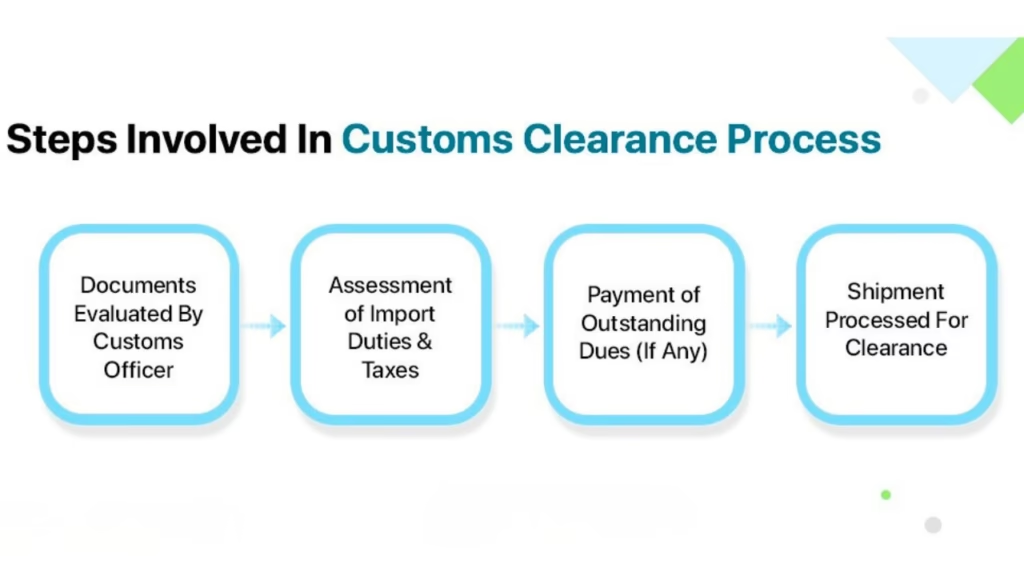
Step by Step Customs Clearance Process in India
This is the actual import customs clearance process in India step by step. No theory. This is exactly how your shipment moves from arrival to release.
Step 1 — Filing the Bill of Entry (BoE)
This is the core document in the entire customs clearance process in India.
Timeline for filing
- Filed before arrival or within 1 day of arrival (excluding holidays)
- Delay here immediately slows everything down
Data required
- Correct HSN code
- Accurate product description
- Declared value (invoice + freight + insurance)
- Country of origin
- Quantity and unit details
If your HSN or value is wrong, customs will stop your file. No debate.
e-Sanchit document upload
All supporting documents are uploaded digitally through e-Sanchit on ICEGATE:
- invoice
- packing list
- bill of lading
- licenses
No physical paperwork anymore. Everything is digital and traceable.
Step 2 — Self Assessment and RMS Processing
Once BoE is filed, you declare your own classification, valuation, and duty. That’s self assessment. Then the system’s Risk Management System (RMS) decides how your shipment will be handled.
RMS risk channels
- Green Channel
No checks. Direct clearance after duty payment. - Yellow Channel
Only document verification. No physical inspection. - Red Channel
Full physical examination of goods by customs officers.
Your history, product type, value, and compliance record decide your risk level.
Step 3 — Duty Calculation and Payment
Once assessed, you must pay applicable customs duty in India before release.
Main duty components
- Basic Customs Duty (BCD)
Based on HSN classification - IGST (Integrated GST)
Charged on import value + duty - Social Welfare Surcharge (SWS)
Additional percentage on BCD
How payment is made
- Paid electronically through ICEGATE
- Using Electronic Cash Ledger
- Linked to your IEC
No payment = no clearance. Your cargo will sit there.
Step 4 — Examination and Verification
If your shipment is flagged (Yellow or Red channel), customs will verify details.
Physical inspection cases
- High risk goods
- First time importers
- Value or classification mismatch
Faceless Assessment:
Handled by National Assessment Centers (NACs) to ensure uniform decision making across India.
Sampling:
For regulated goods (food, pharma, chemicals), samples may be taken for testing. If your documents don’t match your goods, expect delays and penalties.
Step 5 — Out of Charge (OOC) and Goods Release
Once everything is cleared, customs issues Out of Charge (OOC).
What OOC means:
It’s the final clearance approval from customs that allows your goods to leave the customs area.
Electronic release:
- Issued digitally through ICEGATE
- No physical stamp required
Handover to importer After OOC:
- Cargo moves to transporter
- Delivered to your warehouse or factory
This is the final stage of the import customs clearance process in India.
Step 6 — Post Clearance Compliance
Most people think clearance ends at OOC. It doesn’t.
Audits:
Customs can audit your past imports for valuation, classification, or misuse of exemptions.
Bonds / exemptions:
If you claimed any duty benefits, you may need to submit bonds or follow conditions.
Duty disputes:
If customs later finds misdeclaration, you may face:
- differential duty demand
- interest
- penalties
So accuracy upfront matters.
Step by Step Export Customs Clearance Process in India
Export clearance is similar to import, but uses different documents and approvals.
Step 1 — Filing the Shipping Bill
Instead of Bill of Entry, exporters file a Shipping Bill through ICEGATE.
It includes:
- product description
- HSN code
- FOB value
- export scheme (if any like RoDTEP)
Step 2 — Document Submission
Documents uploaded via e-Sanchit include:

- commercial invoice
- packing list
- export license (if required)
- purchase order
- Bill of Lading / Airway Bill
Step 3 — Assessment and Examination
Customs verifies:
- product classification
- export incentives eligibility
- compliance with export restrictions
Some shipments are inspected physically.
Step 4 — Let Export Order (LEO)
After verification, customs issues LEO (Let Export Order). This is the export equivalent of Out of Charge (OOC). Without LEO, goods cannot be loaded onto the vessel or aircraft.
Step 5 — Loading and Departure
Once LEO is granted:
- cargo is handed to shipping line/airline
- loaded onto vessel/aircraft
- export is completed
Step 6 — Post Export Benefits
After export, you may claim:
- RoDTEP benefits
- Duty drawback
- GST refunds
Key Documents Required for Import Customs Clearance in India
Below is the standard import documentation for customs clearance in India. Missing even one critical document can stop your shipment.
| Document | Purpose | Mandatory / Conditional |
| Bill of Entry | Official declaration of imported goods for customs clearance | Mandatory |
| Commercial Invoice | Shows value, description, and transaction details | Mandatory |
| Packing List | Details quantity, weight, and packaging of goods | Mandatory |
| Bill of Lading / Airway Bill | Proof of transport and shipment ownership | Mandatory |
| Certificate of Origin | Required to claim preferential duty benefits under trade agreements | Conditional |
| Insurance Certificate | Proof of insurance coverage for goods in transit | Conditional |
| Import License / IEC | Legal authorization to import goods into India | Mandatory |
| GATT / DGFT Declaration | Declaration of value and compliance under import rules | Mandatory |
Important note:
Depending on your product category, additional regulatory approvals may be required:
- BIS certification for electronics and certain industrial goods
- FSSAI license for food imports
- Drug Controller approval for pharmaceuticals
- Plant quarantine or animal quarantine certificates for agricultural goods
If you ignore product specific compliance, customs will hold your shipment even if everything else is correct.
Additional Documents for Export Customs Clearance
| Document | Purpose |
|---|---|
| Shipping Bill | Export declaration filed with customs |
| Commercial Invoice | Export value declaration |
| Packing List | Shipment details |
| Bill of Lading / Airway Bill | Transport proof |
| Export License (if required) | Compliance for restricted goods |
| LUT/Bond (for GST) | For export without IGST payment |
Customs Duties and Charges You Must Pay
If you don’t understand how customs duty in India is calculated, you’ll either underpay and get penalized or overpay and kill your margins. There’s no middle ground.
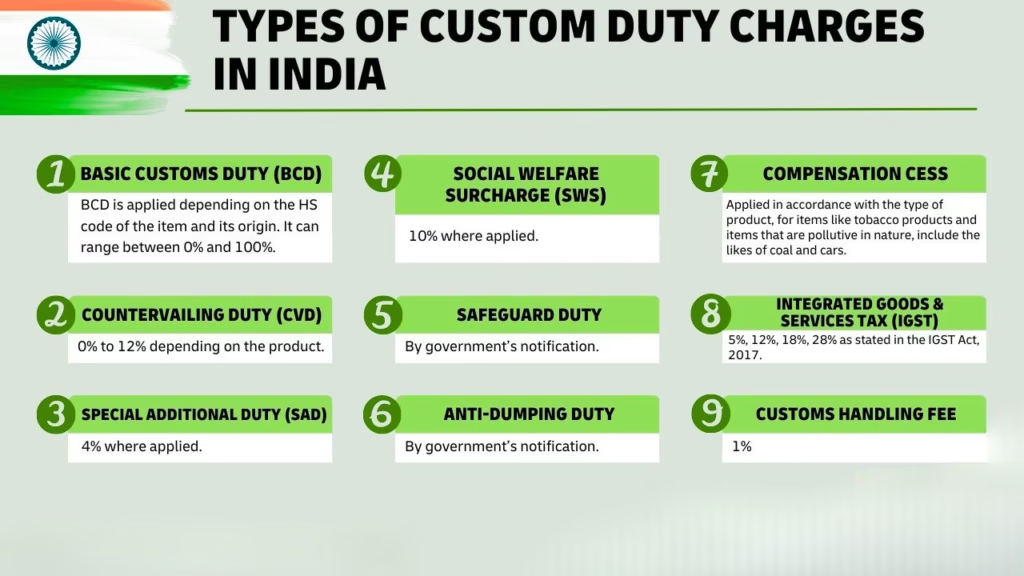
Breakdown of taxes
Every import typically attracts three main charges:
- Basic Customs Duty (BCD)
This is the base tax applied on your product based on its HSN code. Rates vary widely depending on the product category. - Integrated GST (IGST)
Charged on the total assessable value after adding BCD and other charges. This is similar to GST you pay on domestic purchases. - Social Welfare Surcharge (SWS)
A percentage applied on the BCD amount.
Depending on your goods, there may also be:
- Anti dumping duty
- Safeguard duty
- Compensation cess
Ignore these at your own risk. They can drastically change your landed cost.
How duty is calculated
Customs doesn’t calculate duty on just your invoice value. They use CIF value, which includes:
Cost of goods + Insurance + Freight total becomes your assessable value.
Then duties are applied step by step:
- BCD applied on CIF value
- SWS applied on BCD
- IGST applied on (CIF + BCD + SWS)
Two quick examples so you don’t get this wrong:
Example 1:
- Product value: ₹5,00,000
- Freight + insurance: ₹50,000
- CIF value = ₹5,50,000
- BCD @10% = ₹55,000
- SWS @10% of BCD = ₹5,500
- IGST @18% on total = applied on ₹6,10,500
Example 2:
- Product value: ₹2,00,000
- Freight + insurance: ₹20,000
- CIF value = ₹2,20,000
- BCD @20% = ₹44,000
- SWS @10% = ₹4,400
- IGST @18% applied on ₹2,68,400
That’s how your real landed cost builds up.
Role of HSN classification
Your HSN code decides your duty rate. Get it wrong and everything collapses.
Two real scenarios:
Example 1:
You import LED lights and classify them under a general electrical category at 10% duty instead of the correct 20%.
Customs catches it → reassessment + penalty + interest.
Example 2:
You import food supplements but classify them as general food items to avoid stricter checks.
Customs flags it → lab testing + FSSAI compliance + shipment delay + storage cost.
HSN classification is not a guess. It must be correct and defensible.
Penalties for wrong declaration
Customs doesn’t treat mistakes kindly, especially if they affect revenue.
You can face:
- Duty re-assessment
- Interest on unpaid duty
- Monetary penalties
- Confiscation in serious cases
Two common costly mistakes:
Example 1: undervaluing goods to reduce duty
Result → differential duty demand + penalty + future shipments flagged as high risk
Example 2: misdeclaring quantity or description
Result → physical inspection + delay + possible seizure
If you’re not 100% sure, fix it before filing the Bill of Entry. After filing, you’re already in the system.
How Long Does Customs Clearance Take in India?
In a normal, compliant case, the customs clearance process in India takes around 2–4 days from the time your goods arrive and your documents are filed correctly. But that timeline only holds if you do things right.
What actually affects clearance speed
1. RMS Channel Allocation
- Green channel → fastest, often same day clearance after duty payment
- Yellow channel → document verification delays by 1–2 days
- Red channel → physical inspection, can take several days depending on queue
2. Documentation accuracy
Two situations:
- Correct HSN, value, invoice, and licenses → smooth clearance
- Missing invoice or wrong classification → query raised → delay until corrected
3. Port congestion
Major ports like Nhava Sheva or Chennai get overloaded.
Example:
- Peak import season → containers waiting in queue → even cleared cargo waits for handling
- Strikes or system issues → backlog builds instantly
4. Compliance issues
If your product requires regulatory approval:
- Electronics without BIS → shipment held
- Food items without FSSAI clearance → lab testing delay
Both cases can push clearance from 3 days to 10+ days easily. Customs clearance in India is fast only when your paperwork, classification, and compliance are clean. One mistake and your cargo stops moving.
Common Mistakes That Delay Customs Clearance
Most delays aren’t caused by customs. They’re caused by importers interfering with basic compliance. Here are the common issues that get shipments stuck.
1. Wrong HSN classification
Verify the code before filing. Customs does not accept incorrect classification.
- Example 1: You classify kitchen appliances under a general electrical category at 10% instead of the correct 20% rate. Customs reclassifies it → reassessment + penalty + delay.
- Example 2: You import chemicals and use a generic code instead of the specific hazardous classification. Shipment gets flagged for inspection and testing → clearance delayed by days.
2. Undervaluation of goods
Trying to save duty by declaring a lower value is one of the fastest ways to get flagged.
- Example 1: Invoice shows $8,000 but market value is clearly $15,000. Customs rejects declared value → revaluation + duty demand + interest.
- Example 2: You split invoice values across multiple shipments to reduce duty impact. RMS flags pattern → future shipments automatically pushed to Red channel.
3. Missing or incomplete documents
If even one required document is missing or inconsistent, your file doesn’t move.
- Example 1: Packing list doesn’t match invoice quantities → customs raises query → clearance paused.
- Example 2: Certificate of Origin missing for preferential duty claim → benefits denied + reassessment.
4. Not registering on ICEGATE properly
You can’t run a digital clearance system without a working account.
- Example 1: IEC not linked to ICEGATE → Bill of Entry can’t be filed → shipment sits idle.
- Example 2: Digital signature not active → duty payment fails → delay even after assessment is complete.
5. Incorrect invoice data
Your commercial invoice is the foundation of your clearance. If it’s wrong, everything else collapses.
- Example 1: Description says “electronic items” instead of detailed product name → customs demands clarification → file held.
- Example 2: Currency conversion mismatch between invoice and declared value → system flags discrepancy → reassessment.
If you want fast clearance, the rule is simple accurate classification, clean documents, honest valuation, and proper registration. Anything else slows you down.
Should You Hire a Customs Broker or Do It Yourself?
This is where most new importers and exporters make bad decisions. They either try to save money and screw up compliance, or they blindly outsource without understanding what’s happening.
Let’s be clear about when each option makes sense.
When DIY Works
Handling customs clearance yourself can work, but only under limited conditions.
Case 1: Small shipments
- Low value goods
- Limited duty impact
- Minimal regulatory requirements
Example: importing small batches of clothing accessories or non-regulated consumer items.
Case 2: You already have experience
- You understand HSN classification
- You know ICEGATE filing
- You’ve handled clearance before
Example: A repeat importer who ships the same product every month, using the same documentation and the same duty rates each time.
If you don’t meet both conditions, DIY becomes risky.
When You Should Hire a Customs Broker (CHA)
A licensed customs broker isn’t a luxury. In many cases, they’re damage control.
Case 1: High value cargo
- Large duty exposure
- Any mistake becomes expensive
Example: importing machinery worth ₹50 lakh. One classification error can cost lakhs in extra duty and penalties.
Case 2: Complex goods
- Technical products
- Multiple components
- Multiple HSN classifications
Example: electronics with embedded software, chemicals with composition based classification.
Case 3: Regulated categories
- Food (FSSAI)
- Electronics (BIS)
- Pharma or medical goods
Example: importing packaged food without correct FSSAI documentation → shipment held until compliance is proven.
A good customs broker reduces risk, speeds up clearance, and handles queries you don’t even know how to answer.
Cost of Customs Clearance Services in India
Let’s talk numbers.
Typical fee range
- Small shipments: ₹3,000 to ₹8,000
- Medium shipments: ₹8,000 to ₹15,000
- Complex or high value cargo: ₹15,000 to ₹25,000+ depending on documentation and handling
Extra costs may include:
- inspection handling
- document preparation
- port handling coordination
What you’re paying for
You’re not just paying someone to “file a form.” You’re paying for:
- Correct HSN classification
- Accurate duty calculation
- Document verification
- Handling customs queries
- Faster clearance and reduced risk
Two quick realities:
Example 1: You try to save ₹5,000 by skipping a broker, misclassify goods, and end up paying ₹60,000 extra duty + penalty.
Example 2: Broker charges ₹10,000 but gets your shipment cleared in 2 days instead of 8 days, saving you storage and demurrage charges.
So the real question isn’t “Can you afford a customs broker?”
It’s “Can you afford the cost of mistakes if you don’t use one?”
How ICEGATE Simplifies Customs Clearance
ICEGATE is the backbone of the entire customs clearance process in India. If you’re still thinking in terms of physical files and manual approvals, you’re already behind.
Here’s what ICEGATE actually does for you.
e-filing
You file your Bill of Entry and upload all supporting documents digitally through ICEGATE using the e-Sanchit system.
Two situations:
- Example 1: You upload invoice, packing list, and bill of lading correctly in one go → system accepts → file moves directly to assessment.
- Example 2: You upload incomplete documents or wrong file tags → system flags it → customs raises a query → delay starts immediately.
There’s no paper submission fallback anymore. If it’s not uploaded properly, it doesn’t exist.
Duty payment
All customs duty payments in India are made electronically through ICEGATE.
You can:
- calculate payable duty
- pay via net banking or authorized banks
- track payment status instantly
Two situations:
- Example 1: You pay duty immediately after assessment → system updates → your shipment moves to next stage without delay.
- Example 2: Payment fails or is delayed → even if everything else is approved, your goods won’t be released.
No payment confirmation = no clearance.
Tracking status
ICEGATE gives you real time tracking of your shipment’s customs status.
You can check:
- Bill of Entry status
- duty payment confirmation
- RMS channel allocation
- Out of Charge release
Two situations:
- Example 1: You monitor status daily and respond to queries quickly → faster clearance.
- Example 2: You ignore system alerts → miss a query from customs → shipment sits idle for days.
Visibility is there. Whether you use it properly is up to you.
Faceless assessment
ICEGATE supports faceless assessment, where your shipment is assessed by National Assessment Centers instead of local officers.
What this does:
- removes local bias
- standardizes classification and valuation decisions
- improves consistency across ports
Two situations:
- Example 1: Correct documentation and classification → faceless system clears without unnecessary queries.
- Example 2: Incorrect valuation → central assessment flags discrepancy → reassessment and delay.
Faceless doesn’t mean gentle. It means consistent and rule based.
Official Government Resources for Customs Clearance
If you’re serious about imports, you should know where the official information comes from. These are the core resources you should rely on, not random blogs.
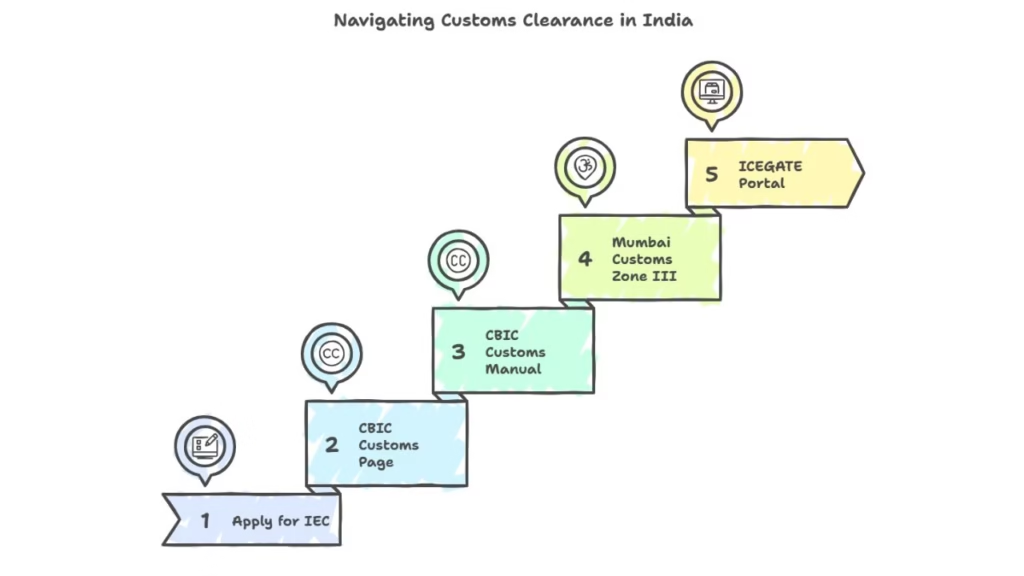
CBIC Customs Procedure Page
This is the official government framework for customs rules, procedures, notifications, and circulars issued by the Central Board of Indirect Taxes and Customs.
Use it when you want:
- official duty structures
- compliance rules
- latest regulatory updates
ICEGATE Portal
This is where the actual customs clearance process in India happens.
You use ICEGATE for:
- filing Bill of Entry
- uploading documents
- paying customs duty
- tracking shipment clearance
If you import regularly, you’ll be logging in here almost every time.
DGFT IEC Application Portal
Managed by the Directorate General of Foreign Trade.
You use this portal to:
- apply for your Importer Exporter Code (IEC)
- modify IEC details
- manage import export authorizations
No IEC, no imports. This is your starting point.
CBIC Customs Manual
This is the detailed operational manual for customs officers and procedures.
Use it to understand:
- classification principles
- valuation rules
- audit procedures
- legal provisions under customs law
If you want to go deep and avoid compliance mistakes, this document is worth reading.
Mumbai Customs Zone III Procedure Page
One of the most practical and detailed procedural guides available from Indian customs authorities.
It gives you:
- step by step import clearance flow
- documentation requirements
- assessment and examination procedures
Even if your shipment is not in Mumbai, the process described here applies broadly across India. If you rely on these official sources and keep your documentation clean, the customs clearance process becomes predictable instead of stressful.
Quick Summary of the Customs Clearance Process
Here’s the entire customs clearance process in India, stripped down to the essentials:
Import Flow
- IEC
- ICEGATE
- Bill of Entry
- Duty payment
- RMS
- OOC
Export Flow
- IEC
- Shipping Bill
- document upload
- customs assessment
- LEO
- shipment departure
Final Thoughts
Here’s the blunt reality. Customs clearance is not complicated, but it is unforgiving.
Accuracy and compliance decide everything.
Two simple truths:
- Example 1: correct HSN, clean documents, proper valuation → clearance in 2–3 days, no issues.
- Example 2: wrong classification, missing certificate, undervaluation → shipment held, duty reassessed, penalties added, delays pile up.
There’s no shortcut around compliance. Every mistake costs time and money.
If you want smooth imports and exports:
- get your documentation right the first time
- classify your goods correctly
- pay duties accurately
- and don’t ignore regulatory requirements
FAQs
How much does customs clearance cost in India?
No fixed cost. It depends on shipment value and product type. You’ll pay customs duty + CHA fee (₹3k–₹25k) + port charges.
Do exports require customs clearance in India?
Yes. All exports require filing a Shipping Bill, customs verification, and receiving Let Export Order (LEO) before goods leave the country.
Can I clear goods without a customs broker?
Yes, legally. But only safe if you understand HSN, ICEGATE, and compliance. For high-value or regulated goods, DIY usually leads to delays and penalties.
What happens if my shipment is held by customs?
It means something is wrong HSN, value, documents, or license. You must fix the issue, or it goes to inspection, penalties, and extra charges.
How to check customs clearance status online?
Use ICEGATE. Track BoE status, duty payment, RMS channel, and OOC. If you respond quickly to queries, clearance moves fast.
About the Author
Hi, I’m SriHarsha, founder of shxhub.in.
I focus on explaining import export business topics in a practical, beginner friendly way, based on how exports actually work on the real ground especially documentation, quality control, and buyer expectations.


2 thoughts on “Customs Clearance in India: Step by Step Process to Avoid Delays and Penalties”