

Export shipments don’t move on trust. They move on documents. Miss one document and your cargo can sit at the port for days while customs asks questions.
Among all export documents, the commercial invoice for export is the one every party depends on. Customs officers read it to assess duties. Banks verify it before releasing payments. Buyers check it to confirm what they’re receiving and how much they owe.
In simple terms, the commercial invoice acts as three things at once. It’s proof that a sale happened, a bill requesting payment, and a declaration that explains the shipment to customs authorities. That’s why even a small mistake in this document can delay clearance or trigger disputes.
Understanding the export invoice meaning early saves you from those problems. Once you know what information belongs in the invoice and why it matters, preparing export documentation becomes far easier.
In this guide, we’ll walk through:
- what a commercial invoice in export actually is
- why this international trade invoice is critical for customs and payments
- how to prepare a commercial invoice correctly
- what details must always be included to avoid delays
By the end, you’ll understand exactly how this single document supports the entire export transaction.
Table of Contents
What Is a Commercial Invoice in Export?
A commercial invoice in export is a legal document issued by the exporter to the overseas buyer that records the details of an international sale. It lists the products sold, their value, quantity, shipping terms, and other essential information related to the transaction.
Think of it as the official record of the deal between exporter and importer. Once goods are ready to be shipped, the exporter prepares this invoice and sends it along with the shipment documents.
The commercial invoice meaning becomes clearer when you look at who uses it. The importer uses it to verify the purchase. The bank checks it during payment processing. Customs authorities rely on it to determine duties and ensure the shipment complies with trade regulations.
A typical export commercial invoice definition includes details such as:
- exporter and importer information
- description of goods
- quantity and value of products
- currency used for the transaction
- shipping terms and destination
Because it contains these details, customs officials treat the commercial invoice as the primary invoice for international shipping. They use it to identify the shipment, calculate taxes, and confirm that the declared goods match the cargo being exported.
In practice, the commercial invoice plays three major roles in international trade.
1. Proof of Sale
The invoice confirms that a transaction took place between the exporter and the buyer. It records the agreed price, quantity, and terms of the sale.
Example:
An Indian textile exporter selling cotton fabric to a buyer in Italy issues a commercial invoice showing the product description, quantity, and total value of the shipment.
2. Payment Document
Banks and buyers rely on the commercial invoice to process payments under methods like Letter of Credit, Telegraphic Transfer, or Documentary Collection.
Example:
If a buyer is paying through a bank under a Letter of Credit, the bank verifies the invoice details before releasing payment to the exporter.
3. Customs Declaration
Customs authorities use the commercial invoice to evaluate the shipment and calculate duties or taxes in the importing country.
Example:
When electronics are exported from India to Germany, customs officials examine the invoice to check the product value, HS code, and country of origin before clearing the shipment.
Because of these roles, the commercial invoice becomes the central document that connects exporters, buyers, banks, freight companies, and customs authorities in the international shipping process.
Why a Commercial Invoice Is Important in International Trade
In exports, paperwork is not a formality. It’s the system that keeps global trade running. Among all export documents, the commercial invoice sits at the center because every party involved in the shipment relies on it.
Customs officials check it before clearing goods. Banks review it before processing payments. Importers verify it to confirm the details of the purchase.
This is why the importance of commercial invoice goes far beyond simple billing. It supports customs clearance, payment verification, and legal documentation of the transaction.
Let’s break down the three main reasons it matters.
1. Customs Clearance
The first place a commercial invoice gets examined is at customs.
When goods arrive at a port, customs officers use the invoice to understand exactly what is entering or leaving the country. They verify several critical details before allowing the shipment to move forward.
These include:
- Value of goods – to determine the declared export value
- Product classification – checked using HS codes
- Duties and taxes – calculated by the importing country based on product category
If the information on the invoice is unclear or incorrect, customs may hold the shipment for inspection.
Example:
- An exporter shipping spices from India to the UK lists the wrong HS code on the invoice. Customs cannot classify the goods correctly, so the shipment is delayed until the document is corrected.
- A machinery exporter declares a lower product value than the purchase contract. Customs flags the discrepancy and requests additional documentation before clearing the shipment.
Accuracy in export documentation is critical.
2. Payment Processing
The commercial invoice also plays a major role in how exporters get paid.
Banks use the invoice as a reference document when verifying export transactions. If the details don’t match other documents like the packing list or bill of lading, the bank may reject the payment request.
Banks commonly review commercial invoices during:
- Letter of Credit (LC) transactions
- Documentary collection methods like DP or DA
- Telegraphic transfer (TT) payments
Example:
- An exporter shipping garments under a Letter of Credit submits documents to the bank. The bank compares the commercial invoice with the LC terms before releasing funds.
- In a documentary collection transaction, the buyer’s bank releases documents only after confirming that the invoice matches the shipment details. Because of this, exporters must ensure every detail in the invoice matches other export documents.
3. Legal Proof of Export Transaction
The commercial invoice also serves as a permanent record of the transaction.
It provides legal proof that a sale occurred between the exporter and importer. Businesses use this document for accounting, taxation, and regulatory compliance.
It supports:
- financial records of the sale
- tax reporting for export transactions
- trade compliance with international regulations
Example:
- An exporter filing GST returns in India may refer to commercial invoices as proof of zero rated export supplies.
- During an audit, a company may present export invoices to show the value of goods shipped to overseas buyers.
Because of this role, the commercial invoice becomes a key part of meeting export documentation requirements and maintaining accurate business records.
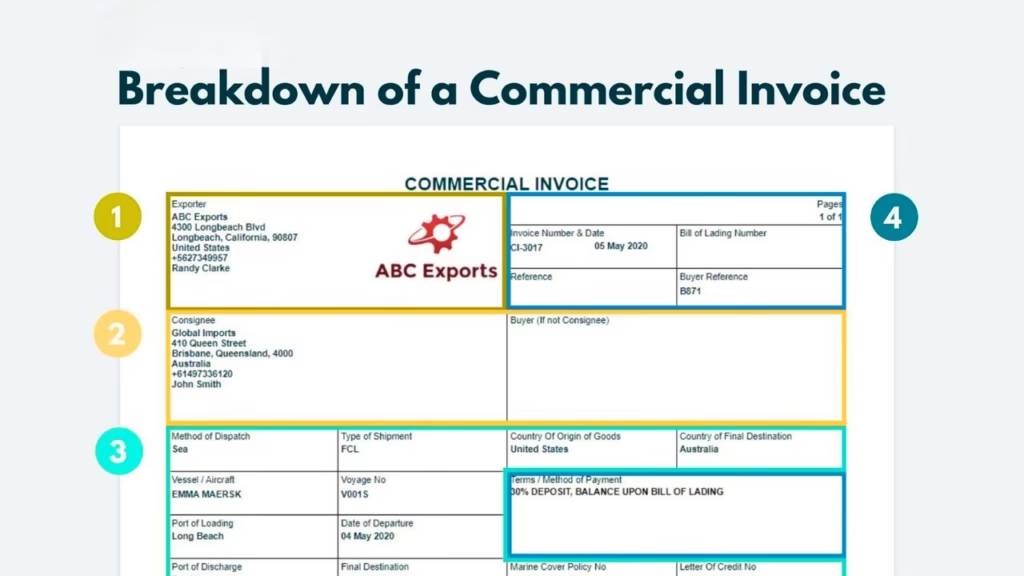
Key Components of a Commercial Invoice for Export
A commercial invoice is only useful if it contains complete and accurate information. Missing details can delay customs clearance, create payment issues, or cause disputes between buyers and sellers.
A proper commercial invoice format follows a structured layout so that customs officials, banks, and logistics providers can easily read the shipment details.
Here are the essential fields included in a standard export invoice format.
Exporter Details
The invoice must clearly identify the business that is exporting the goods.
Typical details include:
- company name
- registered business address
- GST number (for identification in India)
- Import Export Code (IEC) issued by DGFT
Example:
- Exporter: Green Harvest Exports Pvt. Ltd.
Address: Andhra Pradesh, India
IEC: 0489032145
GSTIN: 32ABCDE1234F1Z5
- Exporter: Oceanic Marine Products
Address: Visakhapatnam, India
IEC: 0997654321
These details help customs authorities identify the exporting entity.
Buyer Details
The importer’s information must also appear on the invoice.
This normally includes:
- importer name
- buyer’s address
- tax identification number or registration number
Example:
- Buyer: Al Noor Foods Trading LLC
Address: Dubai, UAE
Tax ID: 100345678900003
- Buyer: Global Grain Traders
Address: Rotterdam, Netherlands
VAT Number: NL123456789B01
Correct buyer details ensure the shipment is linked to the correct importer during customs clearance.
Invoice Information
Every export invoice must have a unique reference number so the transaction can be tracked.
Key details include:
- invoice number
- invoice date
- purchase order reference
Example:
- Invoice Number: EXP/045/2025
Invoice Date: 14 March 2025
PO Number: PO-78921
- Invoice Number: INV-AGRO-2025-112
Invoice Date: 02 April 2025
These numbers help banks and buyers match the invoice with contracts and shipment documents.
Product Description
This section explains exactly what is being exported. Clear descriptions prevent customs confusion and classification errors.
A proper description includes:
- product name
- HS code
- quantity
- weight
- packaging type
Example:
- Product: Basmati Rice 1121
HS Code: 10063010
Quantity: 500 bags
Weight: 25 kg each
Packaging: Polypropylene bags
- Product: Cotton T-Shirts
HS Code: 61091000
Quantity: 2,000 pieces
Packaging: Cartons
Accurate product descriptions are one of the most important parts of the information required in commercial invoice.

Pricing Details
The commercial invoice must clearly state how much the buyer is paying.
Include:
- unit price
- total price
- currency used
Example:
- Unit Price: USD 42 per bag
Total Value: USD 21,000
- Unit Price: EUR 6.50 per piece
Total Value: EUR 13,000
Export transactions are usually billed in freely convertible currencies such as USD, EUR, GBP, or JPY.
Shipping Information
Logistics details help everyone involved in the shipment understand how the goods are moving.
Typical fields include:
- port of loading
- port of discharge
- mode of transport
- bill of lading reference
Example:
- Port of Loading: Visakhapatnam Port, India
Port of Discharge: Hamburg Port, Germany
Mode: Sea Freight
- Port of Loading: Mumbai Airport
Port of Discharge: Dubai Airport
Mode: Air Freight
These details ensure the invoice matches the shipment documents.
Incoterms
Incoterms define the responsibilities of the buyer and seller in international trade.
Common examples include:
- FOB (Free on Board)
- CIF (Cost, Insurance and Freight)
- EXW (Ex Works)
- DDP (Delivered Duty Paid)
Example:
- Incoterm: FOB Chennai
- Incoterm: CIF Rotterdam
Using the correct Incoterm clarifies who pays for shipping, insurance, and other logistics costs.
Declaration and Signature
A commercial invoice usually ends with a declaration confirming that the information provided is accurate.
This statement often includes confirmation of the goods’ origin.
Example declaration:
- “We hereby certify that the information provided in this invoice is true and correct and that the goods are of Indian origin.”
- “We declare that the above details accurately represent the contents and value of the shipment.”
The exporter then adds:
- authorized signature
- name and designation
- company seal
This final step officially validates the commercial invoice for international trade.
Commercial Invoice Format for Export (Example)
A commercial invoice doesn’t need complicated formatting, but the structure must be clear and organized. Customs officers, banks, freight forwarders, and buyers all read the same document, so the layout should make the shipment details easy to understand at a glance.
Most exporters follow a standard commercial invoice template that separates seller information, buyer details, goods description, pricing, and shipping information. This structure ensures that every important detail is visible and consistent with the rest of the export documents.
A typical sample export commercial invoice contains the following sections.
| Field | Description |
| Exporter Details | Name, address, IEC number, GSTIN |
| Buyer Details | Importer name, address, tax identification number |
| Goods Description | Product name, specifications, packaging |
| HS Code | Harmonized System code used for customs classification |
| Quantity | Number of units, cartons, bags, or pieces |
| Unit Price | Price per unit of product |
| Shipping Information | Port of loading, port of discharge, mode of transport |
| Declaration | Statement confirming accuracy and origin of goods |
This layout helps customs officers quickly verify product details and shipment value before approving clearance.
Simple Example for Understanding
Below is a simplified example so you can see how a commercial invoice may look in practice.
Exporter: Sunrise Exports, India
Address: Visakhapatnam, Andhra Pradesh
IEC: 0489032145
Buyer: Al Noor Foods Trading LLC
Address: Dubai, UAE
Product: Basmati Rice 1121
HS Code: 10063010
Quantity: 400 bags
Unit Price: USD 43
Total Value: USD 17,200
Port of Loading: Chennai Port
Port of Discharge: Jebel Ali Port
Mode of Shipment: Sea Freight
Declaration:
“We certify that the above information is true and correct and that the goods are of Indian origin.”
Authorized Signature
Company Seal
In real export documentation, this structure may appear in a slightly more detailed format, but the core fields remain the same. Using a consistent commercial invoice template helps exporters avoid mistakes and maintain professional documentation.
Proforma Invoice vs Commercial Invoice
Many beginners confuse proforma invoice with commercial invoice because both look similar. But in international trade, they serve completely different purposes.
Understanding the proforma invoice vs commercial invoice distinction helps exporters avoid confusion during negotiations, shipment preparation, and payment processing.
Let’s break it down.
What Is a Proforma Invoice?
A proforma invoice is issued before goods are shipped. It is not a request for payment but a preliminary document used during the negotiation stage of a transaction.
Exporters usually send a proforma invoice to the buyer after discussing product details and pricing. It confirms the agreed terms of the deal and allows the buyer to review the order before placing a formal purchase order.
A proforma invoice is mainly used to:
- quote the price of goods
- confirm the order details
- outline trade terms such as quantity, payment method, and Incoterms
Example:
- A coffee exporter sends a proforma invoice to a buyer in Germany showing 5,000 kg of Arabica beans priced at USD 6 per kg under FOB terms.
- A textile manufacturer shares a proforma invoice with a retailer in Canada listing product specifications, estimated shipment date, and payment terms before the order is finalized.
Because it is only a quotation document, the proforma invoice does not create a legal obligation for payment.
What Is a Commercial Invoice?
A commercial invoice is issued after the shipment is ready or dispatched. Unlike a proforma invoice, this document represents the final transaction between the exporter and the buyer.
It confirms the exact goods shipped, their value, and the agreed payment terms. Customs authorities and banks rely on the commercial invoice when processing international shipments.
The commercial invoice is used to:
- request payment from the buyer
- confirm the final sale transaction
- provide customs with shipment details
Example:
- A spice exporter sends a commercial invoice after shipping turmeric powder to a buyer in Malaysia. The invoice shows the exact quantity shipped and the final payment value.
- A machinery exporter issues a commercial invoice once equipment is loaded onto a vessel, allowing the buyer’s bank to process payment under a Letter of Credit.
Key Differences
Here’s a quick comparison to highlight the difference between proforma and commercial invoice.
| Feature | Proforma Invoice | Commercial Invoice |
| Purpose | Quotation | Final bill |
| Timing | Before shipment | After shipment |
| Legal status | Not binding | Legal document |
In simple terms, the proforma invoice helps finalize the deal, while the commercial invoice officially records the completed export transaction.
Commercial Invoice Requirements for Export from India
Export documentation in India follows rules defined by the Directorate General of Foreign Trade (DGFT) and customs authorities. Among these documents, the commercial invoice plays a central role because it explains the entire export transaction.
A properly prepared commercial invoice for export from India must contain accurate shipment details and comply with regulatory requirements. Customs officers rely on this document to verify the exporter, classify the goods, and confirm the declared value before clearing the shipment.
Indian exporters typically prepare the commercial invoice along with several other export documents in India that move together through the shipping and customs process.
DGFT Documentation Requirements
The DGFT specifies a basic set of documents that support export transactions. The commercial invoice is one of the mandatory documents used to verify the sale and shipment details.
Customs authorities check the invoice to confirm:
- exporter identity
- product classification
- shipment value
- destination of goods
Example:
- An exporter shipping engineering components from Pune to Germany must submit a commercial invoice showing product description, value, and buyer details when filing the shipping bill.
- A seafood exporter sending frozen shrimp from Kochi to Japan attaches the commercial invoice with the export declaration submitted through customs.
IEC Number
Every exporter in India must hold an Import Export Code (IEC) issued by the DGFT. This number identifies the exporting business during customs clearance.
The IEC usually appears in the exporter details section of the commercial invoice.
Example:
- Exporter: Coastal Marine Exports
IEC: 0314056789
- Exporter: Sunrise Agro Exports
IEC: 0998765432
Without an IEC number, businesses cannot legally export goods from India.
GST Details
Even though exports are treated as zero rated supplies under GST, the exporter’s GST identification number is usually included in the invoice for identification purposes.
This helps authorities track export transactions and verify tax compliance.
Example:
- Exporter GSTIN: 29ABCDE1234F1Z5
- Exporter GSTIN: 37AAACB1234D1ZP
Including GST details ensures consistency between financial records and export documentation.
English Language Requirement
Export documentation in India is generally prepared in English so that customs officials, banks, and foreign buyers can easily understand the information.
Example:
- An exporter shipping handicrafts to France prepares the commercial invoice in English so that both Indian customs and the importer can verify the shipment details.
- A pharmaceutical exporter sending medicines to Brazil uses English for the invoice even though the buyer’s local language is Portuguese.
Using a widely understood language helps reduce misunderstandings during customs inspections.

Documents Used Along With the Commercial Invoice
The commercial invoice rarely travels alone. It is normally submitted with several other export documents that support the shipment.
These include:
- Packing List – provides detailed packaging and weight information
- Shipping Bill – the official export declaration filed with Indian customs
- Bill of Lading – the transport document issued by the carrier
Example:
- A rice exporter sends a shipment from Chennai to Dubai with three key documents attached commercial invoice, packing list, and bill of lading.
- A machinery exporter files a shipping bill through customs along with the commercial invoice and packing list before the cargo is loaded on the vessel.
Together, these documents give customs authorities a complete picture of the export transaction.

Common Mistakes Exporters Make in Commercial Invoices
Most export documentation problems start with small mistakes in the commercial invoice. Even a minor error can delay customs clearance or create confusion between the buyer, bank, and logistics provider.
Many of these commercial invoice errors happen because exporters rush through documentation or copy information incorrectly from other documents.
Understanding these export documentation mistakes can help you avoid costly delays.
Incorrect HS Code
The HS code is used worldwide to classify goods in international trade. Customs authorities rely on this code to determine the correct duty and product category.
If the HS code is incorrect, customs may stop the shipment until the classification is verified.
Example:
- An exporter shipping herbal extracts mistakenly lists the HS code for essential oils. Customs cannot match the product description with the classification, which delays clearance.
- A textile exporter enters the HS code for synthetic fabric instead of cotton fabric. The incorrect classification triggers additional customs checks.
Because HS codes directly affect duty calculations, accuracy is critical.
Incoterm Mismatch
Incoterms define who is responsible for shipping costs, insurance, and risk during transportation. When the Incoterm on the commercial invoice does not match the contract or other documents, banks or buyers may reject the paperwork.
Example:
- The sales contract mentions FOB Mumbai, but the commercial invoice shows CIF Rotterdam. The mismatch raises questions about who is responsible for freight and insurance.
- The packing list states EXW Delhi, while the commercial invoice lists FOB Chennai. Customs or banks may request clarification before processing documents.
Keeping the same Incoterm across all export documents prevents confusion.
Incorrect Currency
International trade payments must usually be made in freely convertible currencies such as USD, EUR, GBP, or JPY. Using the wrong currency on the invoice can create issues during payment processing.
Example:
- An exporter mistakenly issues an invoice in Indian Rupees instead of USD for a shipment to Canada. The buyer requests a revised invoice before processing payment.
- A supplier quotes the product price in EUR in the purchase contract but lists USD in the commercial invoice, creating confusion during bank verification.
Consistency in currency ensures smooth payment processing.
Mismatch with Packing List
The packing list and commercial invoice must always match. If quantities, weights, or packaging details differ, customs officials may suspect documentation errors.
Example:
- The commercial invoice states 500 cartons, but the packing list shows 480 cartons. Customs holds the shipment until the discrepancy is explained.
- The invoice lists 10,000 pieces, while the packing list records 9,800 pieces, triggering a document correction request.
Matching the details across all export documents is one of the simplest ways to prevent delays and disputes.
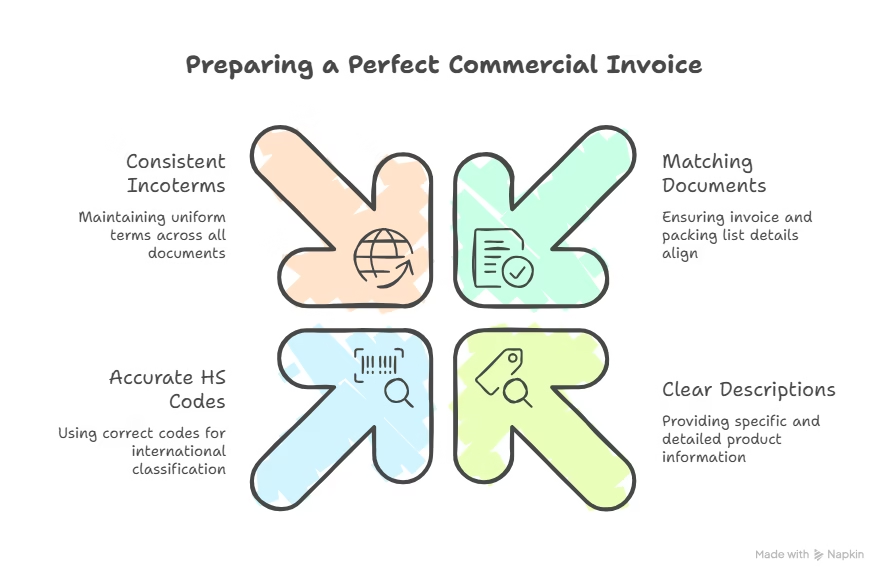
Tips to Prepare a Perfect Commercial Invoice
Preparing a commercial invoice is not complicated, but it requires attention to detail. Small errors in documentation are one of the most common reasons shipments get delayed or questioned by customs authorities.
If you understand how to prepare a commercial invoice correctly, most export documentation problems can be avoided. The goal is simple make the document clear, accurate, and consistent with the rest of your shipment paperwork.
Here are some practical export invoice tips that experienced exporters follow.
Always Match the Invoice With the Packing List
Your commercial invoice and packing list must tell the same story. Quantities, packaging details, and weight should match across both documents.
Example:
- If the invoice states 200 cartons of garments, the packing list must also show 200 cartons, not 198 or 205.
- If the invoice mentions 50 bags × 25 kg each, the packing list should reflect the same packaging details and total weight.
Even a small mismatch can trigger customs questions or document corrections.
Use Clear Product Descriptions
Customs officers rely on the product description to understand what is being shipped. Vague or incomplete descriptions often lead to inspection or classification issues.
Example:
- Instead of writing “Textile products”, write “100% cotton men’s t-shirts”.
- Instead of “Food items”, write “Basmati Rice 1121 – 50 kg bags”.
The clearer the description, the easier it is for customs and buyers to verify the shipment.
Keep HS Codes Accurate
The HS code determines how goods are classified in international trade. Incorrect codes can lead to incorrect duty calculations or customs delays.
Example:
- A spice exporter shipping turmeric powder should use the HS code for turmeric, not the general category for spices.
- A footwear exporter should use the specific HS code for leather shoes rather than a broader footwear category.
Always double check HS codes before issuing the invoice.
Maintain Consistent Incoterms
Incoterms define the responsibilities of buyers and sellers in international trade. The Incoterm used in the commercial invoice should match the sales contract and other shipment documents.
Example:
- If the contract states FOB Chennai, the commercial invoice should also mention FOB Chennai, not CIF or EXW.
- If the purchase agreement uses CIF Hamburg, the same term must appear on the invoice and shipping documents.
Using Incoterms consistent helps avoid disputes and ensures everyone understands who handles freight, insurance, and delivery responsibilities.
Conclusion
At first glance, a commercial invoice may look like a simple billing document. In reality, it carries much more responsibility.
This document connects every part of the export process. Customs officers use it to verify goods and calculate duties. Banks rely on it when processing payments. Buyers refer to it to confirm the details of the transaction.
In other words, the commercial invoice becomes the foundation of the entire export transaction.
When exporters learn to prepare this document correctly, several things improve immediately. Shipments clear customs faster, documentation remains organized, and buyers see a professional and reliable supplier.
For anyone entering international trade, mastering the commercial invoice is one of the most practical steps toward building a smooth and dependable export process.
Frequently Asked Questions
1. Is a commercial invoice mandatory for exports?
Yes. A commercial invoice is one of the essential documents required for export shipments. Customs authorities use it to verify the value, classification, and destination of the goods before allowing them to leave or enter a country.
Example:
If an exporter ships 500 cartons of garments from India to the UK, customs officers review the commercial invoice to confirm the declared value and HS code before clearing the cargo.
Without this document, the shipment cannot legally proceed through customs.
2. Who prepares the commercial invoice?
The exporter or seller prepares the commercial invoice. Since the exporter knows the product details, pricing, and shipment terms, they are responsible for issuing the invoice to the buyer.
Example:
A rice exporter in Andhra Pradesh prepares the commercial invoice after confirming the order from a buyer in Dubai.
Although freight forwarders or documentation agents may help format the document, the exporter remains responsible for the accuracy of the information.
3. Can a commercial invoice be used for customs declaration?
Yes. In many cases, the commercial invoice acts as the primary reference document for customs authorities.
Customs officers rely on it to understand what goods are being shipped, the declared value of the cargo, the HS code used for classification, the country of origin.
Example:
When spices are exported from Kochi to Germany, customs officials use the commercial invoice to verify the shipment value and product category.
Because of this role, the invoice must contain clear and accurate shipment information.
4. What currency should be used in export invoices?
Export invoices are typically issued in freely convertible international currencies. The most commonly used ones include USD (US Dollar), EUR (Euro), GBP (British Pound), JPY (Japanese Yen), AUD or CAD.
Example:
An exporter selling tea to the United States may issue the commercial invoice in USD.
Using widely accepted currencies ensures that banks and buyers can process international payments without complications.
5. Can a Commercial Invoice Be Revised or Edited After Issuing?
Yes, a commercial invoice can be revised if mistakes are found, but the corrected version must be shared with the buyer, freight forwarder, and bank if payment documents are involved.
Example:
An exporter writes 450 cartons instead of 500 cartons on the invoice. A revised invoice is issued with the correct quantity.
Example:
The wrong HS code is listed for a product. The exporter sends a corrected commercial invoice with the proper classification.
However, changes should be avoided once documents are submitted to banks, especially in Letter of Credit transactions, because even small errors can cause payment delays.
About the Author
Hi, I’m SriHarsha, founder of shxhub.in.
I focus on explaining import export business topics in a practical, beginner friendly way, based on how exports actually work on the real ground especially documentation, quality control, and buyer expectations.




7 thoughts on “What Is a Commercial Invoice for Export? Format, Example & Complete Guide”