
The container arrived on time. The buyer was ready. The payment was sitting in escrow, waiting to move. Everything was perfect except for one thing.
The Bill of Lading had the wrong consignee name.
Three words. That’s all it took to freeze an entire shipment. The cargo sat at the port for eleven days. Demurrage charges stacked up. The buyer grew impatient. The exporter panicked. And the freight forwarder? Scrambling to fix a mistake that should have been caught in thirty seconds.
This isn’t a horror story pulled from a textbook. This happens every single week, at ports across the world Mumbai, Shanghai, Rotterdam, Dubai. Experienced exporters, seasoned freight teams, and established trade lanes, all brought to a grinding halt by one document that most beginners treat as an afterthought.
That document is the Bill of Lading.
And if you’re in export, international trade, or shipping in any capacity understanding it isn’t optional. It’s survival.
The Bill of Lading isn’t just another form in your documentation stack. It controls who owns the cargo. It determines when payment moves. It decides who has the legal right to walk into a port and take delivery of the goods. Get it right, and your trade runs clean. Get it wrong, and you’re looking at delays, disputes, financial losses, and in the worst cases, legal action.
This guide breaks it all down the meaning, the types, the mistakes, the mechanics, and the practical knowledge that separates exporters who operate with confidence from those who learn the hard way.
By the end of this guide, you’ll never underestimate this document again.
Table of Contents
WHAT IS A BILL OF LADING?
Let’s start with the cleanest definition possible, no jargon, no complexity:
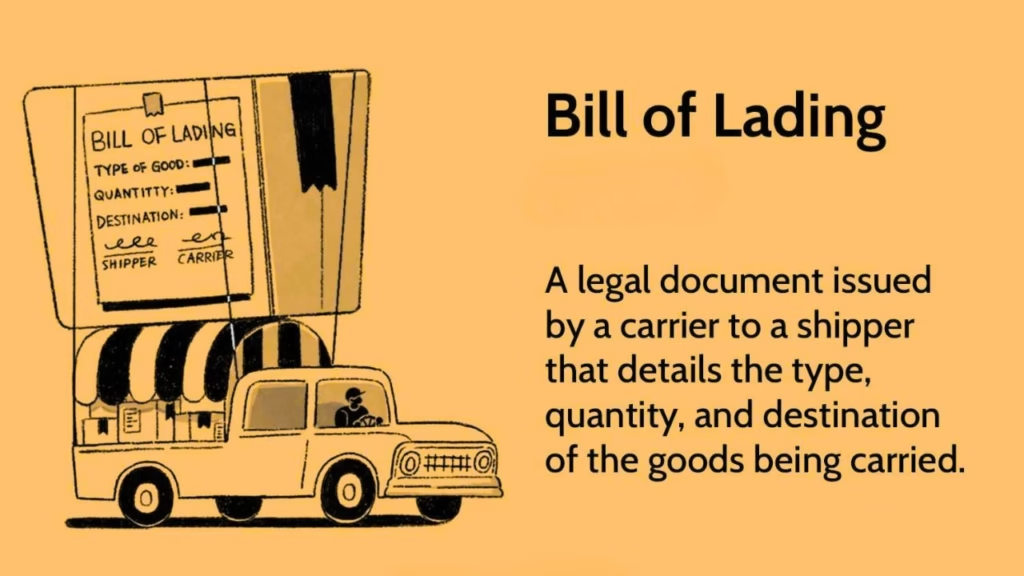
A Bill of Lading is a legal document issued by a carrier that proves your goods were handed over for shipment, sets out the terms of their transport, and in many cases, determines who has the right to claim them at the destination.
That’s it. Three functions, one document.
It’s known in the industry by two abbreviations B/L and BOL and you’ll see both used interchangeably across shipping lines, freight portals, and trade finance documents. Same document, same weight, same consequences if mishandled.
Now, let’s break those three functions down, because each one carries serious implications.
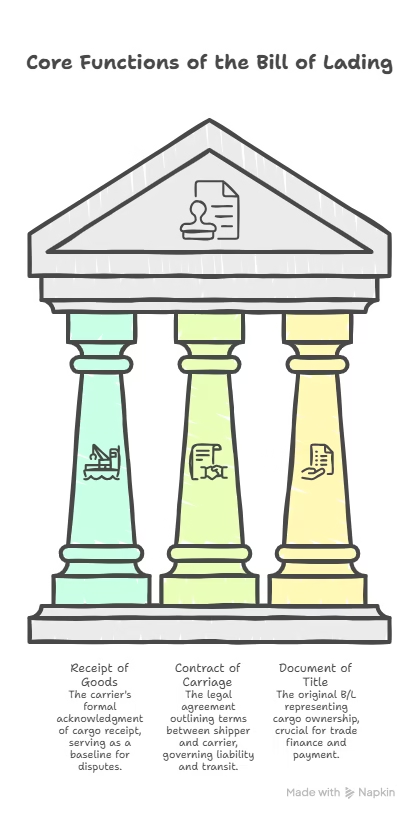
First — it’s a receipt. When your cargo is handed to the carrier and loaded (or accepted for loading), the Bill of Lading is the carrier’s acknowledgment that they’ve received the goods in the stated condition and quantity. Think of it as the carrier signing off: “Yes, we have your shipment. Here’s what we received.”
Second — it’s a contract. The Bill of Lading is evidence of the contract of carriage between the shipper and the carrier. It outlines where the cargo is going, under what terms, and who is responsible for what during transit. If something goes wrong mid voyage, this document is what courts and arbitrators will look at first.
Third — and most powerfully it’s a document of title. In many transactions, whoever holds the original Bill of Lading holds the right to claim the cargo. This is what makes the B/L unlike almost any other shipping document. It doesn’t just describe the shipment. It can represent it, legally and financially.
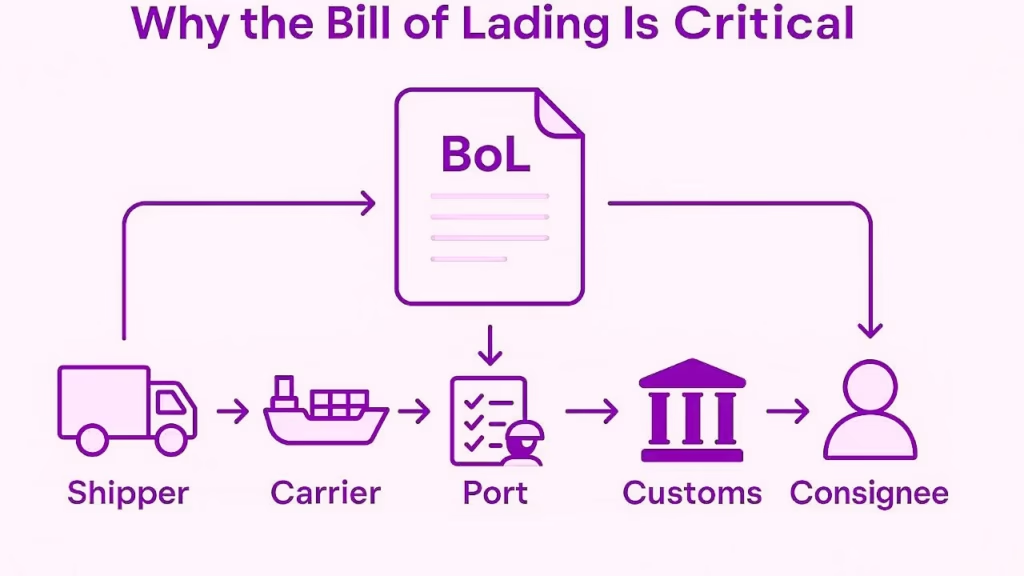
Three parties sit at the center of every Bill of Lading the shipper (the exporter sending the goods), the carrier (the shipping line or vessel operator transporting them), and the consignee (the buyer or receiver at the destination).
As one trade finance principle puts it cleanly “The Bill of Lading is the document that proves a shipment exists, shows who is involved, and sets out how the goods will be delivered.”
Under International trade law, the Bill of Lading carries enforceable legal weight. Disputes over cargo damage, loss, or non-delivery are routinely settled based on what the Bill of Lading states making accuracy not just good practice, but a legal necessity.
WHO ISSUES THE BILL OF LADING?
The short answer the carrier. But in real world shipping, it’s rarely that simple.
The Bill of Lading is issued by whoever is responsible for the physical transportation of your cargo. In most ocean freight scenarios, that means one of three parties:
The Shipping Line is the most common issuer. Global giants like Maersk, MSC, CMA CGM, Hapag-Lloyd, and Evergreen issue Bills of Lading directly when an exporter books cargo with them. This is called a Master Bill of Lading (MBL) the top level document that governs the entire shipment at the carrier level.
The Freight Forwarder issues a House Bill of Lading (HBL) when an exporter books through them rather than directly with the shipping line. The forwarder consolidates cargo, manages the booking, and issues their own Bill of Lading to the exporter. Behind the scenes, the shipping line issues an MBL to the forwarder making the forwarder the shipper on that document.
The Vessel Operator, in charter or specialized cargo situations, may also issue the Bill of Lading directly though this is less common in standard container trade.
Here’s where it gets critical the document you receive depends entirely on how you booked your shipment.
Book directly with Maersk? You get a Master Bill of Lading. Book through a freight forwarder? You get a House Bill of Lading and the MBL exists between your forwarder and the shipping line, often invisible to you.
This distinction isn’t just administrative. It has real consequences in Letter of Credit transactions, where banks frequently require a Master Bill of Lading and will reject a House Bill of Lading outright. It affects payment timelines, document submission, and cargo release at destination.
We’ll go deep on HBL vs MBL in the types section but remember this as the foundation who issues the Bill of Lading determines what type you hold, and what type you hold determines what you can do with it.
THREE CORE FUNCTIONS OF THE BILL OF LADING
Most exporters know the Bill of Lading matters. Far fewer understand why and that gap is exactly where costly mistakes are made. The Bill of Lading isn’t a single purpose document. It carries three distinct functions, each with its own legal and commercial weight.
Receipt of Goods
The first function is the most straightforward the Bill of Lading is the carrier’s formal acknowledgment that your cargo has been received.
When your container is gated into the port and accepted by the carrier, the Bill of Lading is issued as confirmation here are the goods, here is their stated condition, here is the quantity we received. If the cargo shows up damaged, short shipped, or misrepresented, this receipt becomes the baseline for any dispute or insurance claim.
A clean Bill of Lading one issued without any notations about damaged or suspect packaging is worth protecting. A claused B/L, carrying remarks like “packaging damaged on receipt,” immediately signals a problem and can complicate both payment and insurance claims downstream.
Contract of Carriage
The second function gives the Bill of Lading its legal backbone. As a contract of carriage, it sets out the agreed terms between the shipper and the carrier where the cargo is going, the freight rates and payment terms, the liability limits, and what happens if something goes wrong in transit.
This is the document courts look at when cargo is lost, delayed, or damaged at sea. International conventions like the Hague Visby Rules and the Rotterdam Rules govern carrier liability under the Bill of Lading and carriers have successfully limited their exposure to claims precisely because the B/L terms permitted it.
The lesson: the Bill of Lading isn’t just a receipt you file away. It is a binding legal agreement, and its terms matter from the moment it’s issued.
Document of Title
This is where the Bill of Lading becomes unlike almost any other document in international trade and where most beginners have the weakest understanding.
As a document of title, the original Bill of Lading legally represents the cargo itself. Whoever holds a valid original has the right to claim the goods at the destination port. Transfer the original Bill of Lading to your buyer by endorsement, in the case of a negotiable B/L and you are effectively transferring ownership of the cargo.
This function is the engine of trade finance. Banks issue Letters of Credit against it. Payment is released when the correct Bill of Lading is presented. Importers cannot clear cargo without it. And exporters who courier the original B/L before receiving payment have, in practical terms, handed over their goods for free with no legal leverage left.
The rule is absolute: in original B/L transactions, no document, no cargo.
If the goods delivered at the destination don’t match what the Bill of Lading describes wrong quantity, wrong condition, wrong specification the carrier is exposed to liability under international shipping law. The Bill of Lading is the benchmark against which delivery is measured.
Get all three functions working in your favor, and the Bill of Lading becomes your most powerful tool in international trade. Mishandle any one of them, and it becomes your most expensive mistake.
HOW THE BILL OF LADING WORKS (STEP BY STEP)
Understanding what a Bill of Lading is gets you halfway there. Understanding how it moves through a real export shipment is what separates confident exporters from the ones caught off guard at the worst possible moment.
Here’s exactly how it works from factory floor to final delivery.
Step 1 — Packing and Documentation Complete
The shipment begins on land. Goods are packed, weighed, and measured. The commercial invoice, packing list, and any certificates required for the destination country are prepared. These documents feed directly into the Bill of Lading every figure must match, precisely.
Step 2 — Customs Clearance
The exporter files the shipping bill with customs. Once the goods are examined and cleared for export, the shipment is legally authorized to leave the country. No Bill of Lading can be issued against cargo that hasn’t cleared customs.
Step 3 — Container Stuffed and Sealed
Cargo is loaded into the container. The container is sealed, assigned a unique container number and seal number both of which will appear on the Bill of Lading.
Step 4 — Gate In at Port
The container enters the port terminal and is officially handed over to the carrier’s custody. This moment matters it’s when the carrier takes physical responsibility for the cargo.
Step 5 — Vessel Departure
The container is loaded onto the vessel. Once the ship sails, the carrier begins preparing the Bill of Lading based on the shipping instructions provided by the exporter or freight forwarder.
Step 6 — Carrier Prepares the Bill of Lading Draft
The shipping line generates a draft Bill of Lading and sends it to the exporter or forwarder for review. Every field consignee name, port details, cargo description, freight terms is populated based on the booking instructions. The exporter should cross check every minute detail.
Step 7 — Exporter Reviews and Approves the Draft
This is where most exporters lose money. A wrong consignee name, a mismatched cargo description, or an incorrect freight term on the Bill of Lading can trigger bank rejection, customs delays, and demurrage charges that run into thousands. Read every field. Cross-check against your invoice and packing list. Never approve a draft under time pressure without a line-by-line check.
Take a real example: an exporter ships basmati rice from Chennai to Dubai under a Letter of Credit. The LC specifies “Freight Prepaid” but the Bill of Lading draft comes back showing “Freight Collect.” The exporter, rushing to meet the vessel cut-off, approves it without reading.
The bank in Dubai rejects the documents. Payment is held. Demurrage begins ticking at the Dubai port. What should have been a clean transaction turns into a three week crisis over two words.
Step 8 — Original B/L or Telex Release Issued
Once approved, the carrier issues either the original Bill of Lading typically in three original copies or processes a Telex Release if the exporter has surrendered the originals at origin. The type issued depends on the agreed payment terms and the buyer’s requirements.
Step 9 — B/L Used for Payment and Cargo Clearance
The exporter presents the B/L to the bank for payment under LC, or couriers the originals directly to the buyer for prepaid shipments. At the destination, the buyer surrenders the original B/L to the shipping agent and takes delivery of the cargo.
The document that started as a draft on a screen has now moved money, transferred ownership, and released a shipment. That is the full journey of a Bill of Lading and every step of it matters.
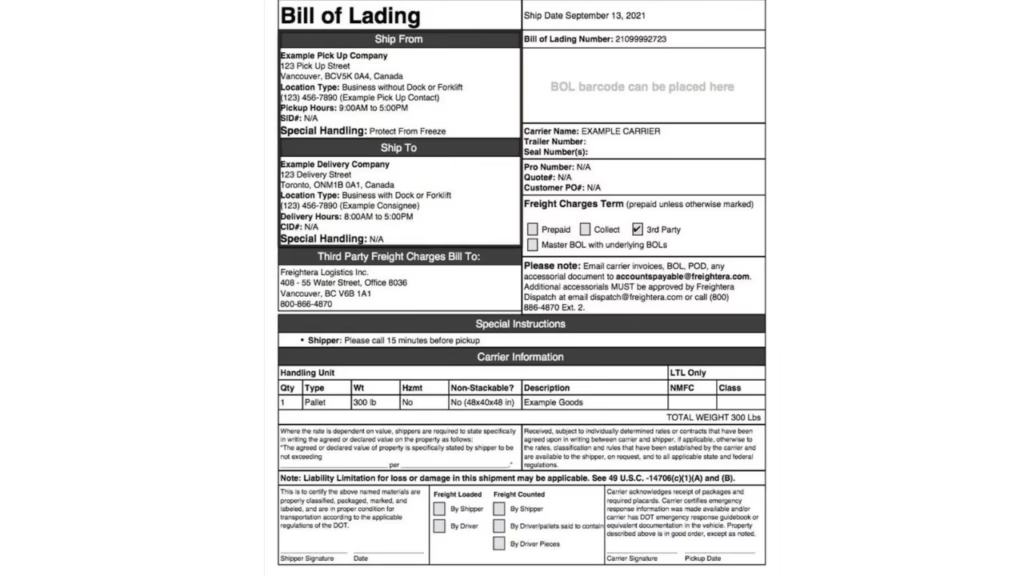
WHAT DOES A BILL OF LADING INCLUDE?
A Bill of Lading carries more information than most exporters pause to read carefully which is precisely why errors slip through. Here is every field you will find on a standard B/L format, and why each one matters.
☐ Shipper Name and Address– The exporter’s full legal name and address. This must match your commercial invoice exactly any variation can trigger a bank discrepancy in LC transactions.
☐ Consignee Name and Address– The buyer or receiving party at the destination. In negotiable B/Ls, this may read “To Order” or “To Order of [Bank Name]” critical in trade finance scenarios.
☐ Notify Party– The party the carrier notifies upon cargo arrival usually the importer or their customs agent. Often confused with the consignee, but legally distinct.
☐ Carrier and Vessel Details– The name of the shipping line and the vessel carrying the cargo. Relevant for tracking, insurance, and destination port coordination.
☐ Voyage Number- The specific voyage identifier for the vessel. Banks and customs authorities use this to verify the shipment timeline against LC expiry dates.
☐ Port of Loading and Port of Discharge- Where the cargo departs and where it arrives. These must match the LC terms and the commercial invoice precisely no substitutions, no abbreviations that create ambiguity.
☐ Container Number and Seal Number– The unique identifiers for the physical container. Used for tracking and verified at destination before cargo release.
☐ Cargo Description, Quantity, Weight, and Volume– The description of goods, number of packages, gross weight, and measurement. Unclear or mismatched descriptions are a leading cause of customs holds and insurance disputes.
☐ Freight Payment Terms– Either Freight Prepaid (exporter has paid the freight) or Freight Collect (importer pays at destination). Banks under LC transactions are particularly sensitive to this field a mismatch here is an automatic discrepancy.
☐ Bill of Lading Number– The unique reference number assigned by the carrier. Used for tracking, bank submission, and cargo release at destination.
☐ On-Board Date / Issue Date– The date the cargo was loaded onto the vessel. This date is scrutinized against LC expiry and latest shipment dates. A single day’s error here has caused countless payment rejections.
☐ Special Instructions– Any additional requirements temperature control, hazardous cargo markings, or handling notes specified by the exporter.
One field. One mismatch. That’s all it takes. A consignee name that drops a comma, a port name shortened differently from the LC, a weight figure that doesn’t align with the packing list any of these can result in bank rejection, customs delay, or cargo being held at the destination port.
Check every field against every document before approving the draft. Every single time.
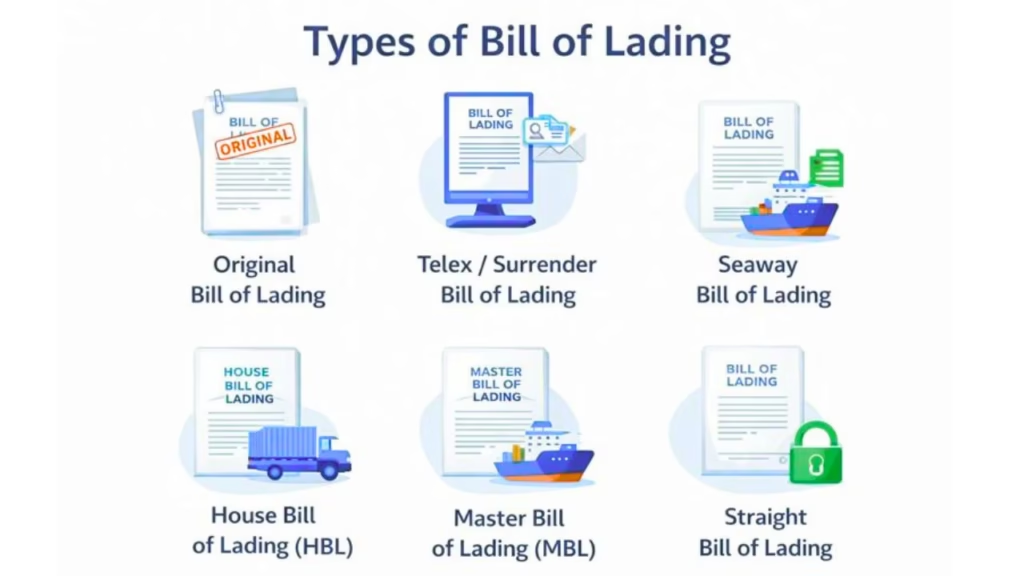
TYPES OF BILL OF LADING (DEEP DIVE)
Not all Bills of Lading are built the same. The type you use determines who can claim your cargo, how payment flows, and whether your bank will accept the documents at all. Choosing the wrong type isn’t a technicality it’s a financial risk. Here is every type you need to know, broken down without the jargon.

Original Bill of Lading (Negotiable)
This is the heavyweight. The original Bill of Lading is the most powerful version of the document negotiable, legally transferable, and the only type that functions as a full document of title.
Standard practice is to issue three original copies, all carrying equal legal weight. The importer must surrender at least one original to the shipping agent at the destination port before cargo is released. No original, no delivery that’s not a suggestion, it’s maritime law.
The negotiable nature of the original B/L means it can be transferred between parties by endorsement making it a live instrument in trade finance, Letters of Credit, and ownership transfers during transit.
The hard rule every exporter must tattoo into their process never courier original Bills of Lading before confirmed payment. Verbal promises, long relationships, and good faith mean nothing once that document leaves your hands. Exporters who have broken this rule have handed over cargo with zero legal recourse to recover it.
Telex Release / Surrender Bill of Lading
The Telex Release also called a Surrender B/L was built for speed and trust. Here’s how it works the exporter surrenders all original B/L copies to the carrier at the origin port. The carrier then sends an electronic instruction (historically via telex, now digitally) to their destination agent, authorizing cargo release without any original document being presented.
The importer walks in, identifies themselves, and collects the cargo. Clean, fast, paperless.
When is it safe? When you have received 100% advance payment before the vessel sails. When your buyer is long established and the relationship is ironclad. When speed of delivery is a commercial priority and payment risk is zero.
When is it a trap? On credit terms. On open account transactions. With new buyers. With buyers in markets where dispute resolution is slow or unreliable. Once you surrender those originals, you have no document to hold over the transaction. If payment doesn’t arrive, your cargo is already accessible at the other end and you have nothing left to negotiate with.
Telex Release is a tool, not a default. Use it deliberately, not out of convenience.
Seaway Bill of Lading
The Seaway Bill is non-negotiable by design. It is a pure transport document it records the shipment details and evidences the contract of carriage, but it does not function as a document of title and cannot be transferred between parties.
At the destination, the named consignee simply identifies themselves and takes delivery. No original document required.
Here’s the confusion most beginners carry a Seaway Bill and a Telex Release look similar in practice both allow cargo release without originals. But they are legally distinct. A Telex Release starts life as a negotiable original B/L that is subsequently surrendered.
A Seaway Bill was never negotiable to begin with. The legal foundation is entirely different, and that difference matters in disputes, insurance claims, and financing arrangements.
Use the Seaway Bill between established, trusted counterparties where speed matters and trade finance is not involved.
House Bill of Lading (HBL)
When you book your shipment through a freight forwarder rather than directly with a shipping line, the document you receive is a House Bill of Lading issued by the forwarder under their own name and terms.
HBLs are common in LCL (Less than Container Load) shipments, where multiple exporters share a single container. The forwarder consolidates the cargo, issues individual HBLs to each exporter, and holds the Master B/L from the shipping line as the overarching document.
For routine shipments between trusted parties, an HBL works perfectly well. But in Letter of Credit transactions, the House B/L regularly causes problems because banks scrutinize who issued the document, and a forwarder issued B/L may not meet the LC’s specific requirements.
Know what you’re holding before you submit it to a bank.
Master Bill of Lading (MBL)
The Master Bill of Lading is issued by the shipping line itself like Maersk, MSC, CMA CGM, Hapag-Lloyd, and their peers. In a freight forwarder scenario, the MBL names the forwarder as the shipper and the forwarder’s overseas agent as the consignee. The exporter doesn’t appear on it at all.
The MBL governs the relationship between the freight forwarder and the shipping line. It is the top level document in the entire shipment chain.
Banks love the MBL. In LC transactions, most banks specifically require a Master B/L because it comes directly from a recognized carrier and carries unambiguous legal standing. A House B/L, by contrast, is only as strong as the forwarder who issued it and banks are not in the business of evaluating freight forwarder credibility.
If your payment terms involve a bank or LC, confirm early whether an MBL is required. Discovering this after the vessel has sailed is a problem with no clean solution.
Straight Bill of Lading
The Straight B/L is non-negotiable and names a specific consignee directly. It cannot be transferred, endorsed, or used as a financial instrument. Only the named party can collect the cargo end of story.
This makes it clean and straightforward for the right situations prepaid shipments, intra company transfers, shipments to fully trusted buyers where no financing is involved and ownership transfer during transit is irrelevant.
What it is not suitable for is any transaction where the B/L might need to change hands, where a bank needs to hold title as security, or where the cargo might be sold while still at sea. In those cases, a negotiable original B/L is the only appropriate choice.
Bearer Bill of Lading
The Bearer B/L operates on a simple and radical principle whoever physically holds the document owns the cargo. No endorsement required. No named consignee to verify. Possession equals title.
In theory, this makes it maximally flexible. In practice, it makes it maximally dangerous. A lost or stolen Bearer B/L is an open invitation for cargo theft there is no mechanism to verify legitimate ownership, and the carrier is legally obligated to release goods to whoever presents the original.
For this reason, Bearer Bills of Lading are rarely used in modern international trade. The risk reward calculation simply doesn’t work in an era of high value containerized cargo and sophisticated fraud. Most shipping lines actively discourage their use, and many trade finance institutions won’t touch transactions backed by a Bearer B/L.
It exists, you should know what it is but in practical export operations, you are unlikely to encounter it, and even less likely to want to use it.
Negotiable vs Non-Negotiable: At a Glance
| B/L Type | Negotiable | Original Required | Used In | Document of Title |
| Original B/L | Yes | Yes | LC, trade finance, standard export | Yes |
| Telex Release | No (surrendered) | No | Advance payment, trusted buyers | No |
| Seaway Bill | No | No | Trusted trade, no financing | No |
| House B/L | Depends | Depends | LCL, forwarder shipments | Depends |
| Master B/L | Yes | Yes | LC transactions, bank submissions | Yes |
| Straight B/L | No | Sometimes | Prepaid, intra-company | No |
| Bearer B/L | Yes | Yes | Rare, high-risk only | Yes |
BILL OF LADING VS. SEA WAYBILL
They cover the same shipment. They travel the same route. But they are not the same document and confusing the two can derail a transaction before it even reaches the destination port.
The Core Difference
| Feature | Bill of Lading | Sea Waybill |
| Document of title | Yes | No |
| Negotiable / transferable | Yes (if original) | No |
| Original required for delivery | Yes | No |
| Used in LC transactions | Yes | Rarely accepted |
| Can be sold/endorsed in transit | Yes | No |
| Speed of cargo release | Slower (original needed) | Faster (no original needed) |
| Risk if document lost | High | Low |
| Best for | Trade finance, new buyers | Trusted parties, intra-company |
When to Use Which
The Bill of Lading is the right choice when trade finance is involved, when you are dealing with a new buyer whose payment behaviour is unproven, when your LC specifically requires it, or when the cargo may change hands during transit.
The Sea Waybill works well between established trading partners subsidiaries of the same company, repeat buyers on open account terms, or any scenario where speed of release is the priority and title transfer is irrelevant.
Why Waybills Don’t Work in LC Transactions
A Letter of Credit is a bank’s promise to pay contingent on specific documents being presented. Banks require a document of title because it gives them security over the cargo if the transaction goes wrong. A Sea Waybill offers no such security. It cannot be held as collateral. It cannot be transferred. It gives the bank nothing to stand behind.
Present a Sea Waybill against an LC that calls for a Bill of Lading, and the bank will reject your documents without hesitation.
The Real World Cost of Getting It Wrong
An exporter ships machinery from Germany to Nigeria on a Sea Waybill fast, convenient, no courier delays. The buyer relationship is six months old, not six years. Payment doesn’t arrive. The cargo has already been released at Lagos port because the buyer is the named consignee and no original was needed. The exporter has no document to block delivery with. The goods are gone.
The choice between a B/L and a Sea Waybill is not an administrative preference. It is a risk management decision. Make it consciously, every single time.
BILL OF LADING VS. PACKING SLIP
They both describe your shipment. They both travel with your cargo. And they are nothing alike in terms of legal standing, purpose, or consequence.
This is one of the most common points of confusion for exporters who are new to documentation and clearing it up early saves real headaches later.
Side by Side
| Feature | Bill of Lading | Packing Slip |
| Issued by | Carrier / Shipping Line / Forwarder | Exporter / Seller |
| Legal standing | Legally binding document | Informational only |
| Document of title | Yes | No |
| Used by customs | Primary reference | Supporting reference |
| Used by banks | Essential for LC | Not accepted as substitute |
| Controls cargo release | Yes | No |
| Transferable | Yes (if negotiable) | No |
| Purpose | Proof of shipment, contract, title | Shows what’s inside the box |
The Message Is Simple
The packing slip tells everyone what is in the shipment. The Bill of Lading tells the world who owns it, who is responsible for it, and who can legally claim it.
Customs authorities cross reference the packing slip against the B/L but it is the B/L that carries legal authority. Banks under LC transactions will not accept a packing slip as a substitute for any B/L field or function. It doesn’t matter how detailed or accurate your packing slip is. Without a clean, compliant Bill of Lading, your payment doesn’t move and your cargo doesn’t clear.
The beginner mistake is assuming that because the packing slip has all the cargo details, the B/L is just a formality. It is the opposite. The B/L is the document that makes everything else work the packing slip is the note inside the box.
PACKING SLIP VS PACKING LIST — ARE THEY THE SAME THING?
Here is a question that trips up more exporters than it should are a packing slip and a packing list the same document?
The short answer is almost, but not quite.
The Packing List is a formal shipping document prepared by the exporter that details every item in the shipment product descriptions, quantities, weights, dimensions, and package counts across the entire consignment. It travels with the cargo, gets submitted to customs, and is cross referenced by banks in LC transactions alongside the commercial invoice and Bill of Lading.
The Packing Slip is an informal document typically placed inside or attached to an individual package or box that describes the contents of that specific package only. It is primarily informational, intended to help the receiver verify what arrived in each unit, and carries no formal role in customs clearance or trade finance documentation.
BILL OF LADING IN LC (LETTER OF CREDIT) TRANSACTIONS
If there is one arena where the Bill of Lading is treated with absolute seriousness, it is inside a Letter of Credit transaction. Banks do not deal in goodwill, context, or reasonable interpretation. They deal in documents and the B/L is the document they scrutinize hardest.
Understanding why banks are this rigorous, and what they look for, is the difference between getting paid on time and spending three weeks chasing a discrepancy that should never have existed.
Why Banks Scrutinize the B/L So Heavily
A Letter of Credit is a bank’s conditional payment guarantee. The bank promises to pay the exporter but only when a precise set of documents is presented, exactly as the LC specifies. The B/L sits at the center of this because it is the document that proves the goods were shipped, confirms the terms of transport, and critically gives the bank security over the cargo as collateral if the transaction fails.
The bank isn’t being difficult. It is protecting its position in a financial instrument worth potentially millions of dollars. One ambiguous line on a B/L is enough to blow that security apart.
What Banks Check — Field by Field
Consignee name — Must match the LC instruction exactly. If the LC says “To Order of Standard Chartered Bank,” and your B/L shows the buyer’s name directly, that’s a discrepancy. No exceptions, no explanations accepted.
Ports of loading and discharge — Must correspond precisely to what the LC states. A port abbreviation, an alternate port name, or a transshipment clause the LC doesn’t permit will trigger rejection.
On-board notation — Banks require confirmation that cargo was actually loaded onto the vessel not just received by the carrier. The B/L must carry an on-board notation with a specific date. A “received for shipment” B/L without an on-board stamp is not acceptable under most LCs.
Shipment date — The on-board date must fall within the LC’s latest shipment date. A single day beyond that boundary and the document is non-compliant regardless of why the vessel sailed late.
Unauthorized clauses — Any notation on the B/L that wasn’t anticipated by the LC damage remarks, carrier disclaimers, unusual conditions can constitute a discrepancy that banks won’t overlook.
MBL vs HBL in LC Transactions
Banks want a Master Bill of Lading issued directly by the shipping line. A House B/L, issued by a freight forwarder, introduces a layer of intermediary that banks are not comfortable with because the forwarder is not a regulated carrier, and the HBL’s legal standing is dependent on the forwarder’s own terms and credibility.
Some LCs explicitly state “forwarder B/L not acceptable.” Even when they don’t, submitting an HBL against an LC that expects an MBL is a gamble that frequently doesn’t pay off. Confirm with your bank and buyer before the vessel sails not after.
Freight Prepaid vs Freight Collect
This two word field triggers more LC rejections than most exporters expect. If your LC specifies Freight Prepaid meaning the exporter has paid the ocean freight and your B/L shows Freight Collect, the bank will reject your documents outright. The reverse is equally problematic.
The freight terms on your B/L must mirror your LC terms with precision. Confirm this with your freight forwarder when reviewing the draft. It is a thirty second check that prevents a three week delay.
The Real Consequence of a B/L Discrepancy Under LC
A discrepancy doesn’t just mean the bank asks a question. It means your payment is held. The bank notifies the importer’s bank, which notifies the importer, who now has the option to accept or reject the discrepant documents. If the importer is under financial pressure, in a dispute with you, or simply slow to respond your payment waits.
Meanwhile, your cargo has arrived at the destination port. Demurrage begins. Storage charges accumulate. And you are negotiating a document fix across time zones while the clock runs.
The B/L in an LC transaction is not a document to rush, delegate blindly, or approve without reading. It is the fulcrum of the entire payment mechanism and it deserves the attention that role demands.
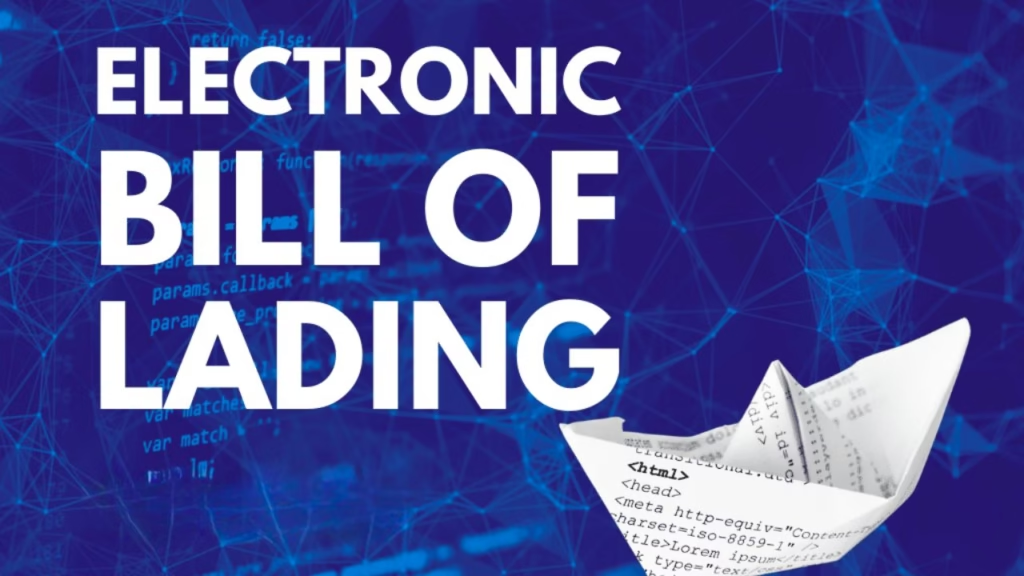
ELECTRONIC BILL OF LADING (eBL)
The paper Bill of Lading has dominated international trade for centuries. It has also caused missed payments, delayed shipments, and full blown cargo crises simply because a courier was late, a document was lost in transit, or an original took two weeks to cross an ocean that the ship crossed in ten days.
The Electronic Bill of Lading exists to fix exactly that.
What It Is and How It Works
An Electronic Bill of Lading (eBL) is a digital version of the traditional B/L carrying the same legal functions of receipt, contract of carriage, and document of title, but issued, transferred, and surrendered entirely through a secure digital platform.
Instead of printing three originals and couriering them across continents, the carrier issues the B/L digitally. The exporter receives it on a platform, transfers it to the buyer or bank electronically, and the receiving party surrenders it digitally to claim cargo. The entire ownership chain is tracked, timestamped, and tamper proof.
The Benefits Are Significant
Speed — An eBL reaches the buyer in minutes, not days. In fast moving trade lanes where cargo arrives before paper documents, this alone eliminates demurrage risk.
Security — Digital platforms use encryption and blockchain based verification to prevent fraud, duplication, and unauthorized transfers risks that physical originals carry inherently.
No courier risk — Lost originals, delayed couriers, and damaged documents disappear as operational problems entirely.
Who Is Leading the Charge
Several platforms and industry initiatives are driving eBL adoption globally:
- WAVE — A blockchain based eBL platform focused on decentralized title transfer
- BOLERO — One of the oldest and most established digital trade document platforms
- essDOCS — Widely used across bulk cargo and tanker trades
- CargoX — A blockchain document transfer platform gaining traction in emerging markets
- DCSA (Digital Container Shipping Association) — An industry body working to standardize eBL formats across major shipping lines including Maersk, MSC, and CMA CGM
The Reality Check
For all its promise, eBL adoption is not yet universal and that gap matters enormously in practice.
Many ports, banks, and customs authorities in developing trade lanes across Africa, South Asia, and parts of Southeast Asia still operate on physical originals. Regulatory frameworks in several jurisdictions haven’t fully caught up with digital title transfer. Some banks simply won’t accept an eBL under LC transactions until their internal systems and legal teams are aligned.
The result: an exporter enthusiastically using an eBL platform may still be asked by their buyer’s bank for a physical original creating exactly the friction the eBL was meant to eliminate.

Where It’s Headed
The direction is clear, even if the pace is uneven. Industry bodies are pushing for full eBL interoperability by the late 2020s. Major shipping lines have committed to eBL targets. Legislative changes in the UK, Singapore, and several other jurisdictions have given electronic trade documents the same legal standing as paper originals.
The Electronic Bill of Lading is not a future concept. It is a present reality growing, maturing, and steadily making the physical original look like the relic it eventually will be. The exporters and freight teams building eBL capability now are the ones who will operate fastest, cheapest, and most securely in the trade environment of the next decade.
BILL OF LADING TRACKING
Once your cargo is on the water, the Bill of Lading number becomes your most important tracking tool. Knowing how to use it and where keeps you ahead of delays, port congestion, and buyer pressure instead of scrambling to catch up.
How B/L Number Tracking Works
Every Bill of Lading carries a unique reference number assigned by the carrier. This number is tied to your specific shipment in the shipping line’s system vessel, voyage, container, route, and estimated arrival are all accessible through it.
To track, you simply enter the B/L number into the relevant portal and the system returns the current status of your shipment in real time.
Where to Track
Shipping line portals are the most direct and reliable source:
- Maersk — maersk.com — track by B/L number or container number
- MSC — msc.com — real-time vessel and container tracking
- CMA CGM — cma-cgm.com — full shipment tracking with milestone updates
- PIL (Pacific International Lines) — pilship.com — PIL container tracking by B/L
- Grimaldi Lines — grimaldi-lines.com — Grimaldi tracking by B/L number for RoRo and container cargo
- Hapag-Lloyd — hapag-lloyd.com — detailed tracking with port event history
Freight forwarder portals offer consolidated tracking across multiple carriers particularly useful when your shipment involves transshipment or multimodal legs that span different shipping lines.
Third party tracking aggregators like Searates, 17TRACK, and GoComet pull data from multiple carriers into a single dashboard useful for exporters managing high shipment volumes across different lines.
Container Number as Backup
If your B/L number isn’t returning results common in the early days before the B/L is fully registered in the system your container number works as an equally reliable alternate tracking reference on most shipping line portals.
Why Tracking Matters Beyond Curiosity
Proactive tracking is not just about knowing where your shipment is. It is about managing what happens when things go wrong and in international shipping, things go wrong regularly.
Port congestion at destination, vessel schedule changes, transshipment delays, and customs holds all show up in tracking data before they show up as problems. An exporter who spots a three day delay in Singapore before the buyer asks about it is in a fundamentally different position than one who finds out when the buyer sends an angry message.
Track consistently. Update your buyer proactively. Use the data don’t just collect it.
COMMON BILL OF LADING MISTAKES EXPORTERS MAKE
Experience is a brutal teacher in export documentation. The mistakes below have collectively cost exporters millions in delayed payments, demurrage charges, and lost cargo. Read them not as cautionary tales read them as a checklist of what never to do.
1. Sending Original Bill of Lading Before Receiving Payment
The single most financially devastating mistake in export trade. Once the original B/L leaves your hands, your leverage leaves with it. The buyer can collect cargo without paying and you are left chasing money across jurisdictions with no document to back your claim. No relationship, no track record, and no verbal assurance is worth more than a confirmed payment before originals are released.
2. Skipping the Draft Verification Step
The Bill of Lading draft is your last clean opportunity to catch errors before they become expensive problems. Exporters who approve drafts without reading them rushing to meet cut-off deadlines or trusting that the forwarder got it right regularly discover mistakes after the B/L is issued. Corrections post-issuance are slow, costly, and sometimes impossible before the vessel arrives.
3. Wrong Consignee Name on Bill of Lading
A missing comma. A shortened company name. A trading name instead of the registered legal entity. Any variation from the exact consignee name specified in the LC or sales contract creates a discrepancy. Banks reject documents over this routinely and at major destination ports, cargo sits uncollected while paperwork is corrected.
4. Mismatch Between B/L, Invoice, and Packing List
These three documents must tell exactly the same story same cargo description, same quantities, same weights, same port details. A figure that differs between the invoice and the Bill of Lading is a discrepancy. A cargo description worded differently across documents raises flags with both banks and customs. Consistency across the entire document set is non-negotiable.
5. Choosing Telex Release on Credit Terms
Telex Release is a tool designed for transactions where payment risk is zero. Using it on open account or credit terms because it’s faster or the buyer requested it removes every piece of financial leverage you hold. Once originals are surrendered and the telex is sent, the buyer can collect cargo regardless of whether payment arrives. This mistake is irreversible.
6. Confusing HBL with MBL in LC Submissions
A House Bill of Lading submitted against an LC that requires a Master Bill of Lading will be rejected. Full stop. Many exporters don’t discover this distinction until they’re sitting across from a bank officer explaining why their payment can’t be processed. Know which type your LC requires before your freight forwarder makes the booking because changing it after the vessel sails is not a straightforward process.
7. Ignoring Freight Terms — Prepaid vs Collect
Freight Prepaid and Freight Collect are not interchangeable labels. They define who has paid the ocean freight and carry direct implications for LC compliance. If your LC mandates Freight Prepaid and your Bill of Lading shows Freight Collect, the bank will reject your documents without hesitation and the correction process will cost you time, money, and potentially the LC’s validity window.
8. Overlooking the On-Board Notation Date
Banks under LC transactions require an on-board date the specific date the cargo was loaded onto the vessel. This date must fall within the LC’s latest shipment date. An on-board date that is even one day beyond that boundary renders your documents non-compliant. Exporters who don’t check this field during draft review discover the problem only when the bank rejects their submission.
9. Not Understanding Negotiable vs Non-Negotiable B/L Types
Using a Straight B/L when a negotiable original is required, or issuing a Seaway Bill when the LC demands a document of title these are not minor missteps. They are fundamental document failures that can prevent cargo release, block payment, and create legal disputes that take months to untangle. Know your Bill of Lading types before you choose, not after you’ve shipped.
10. Trusting Verbal Promises Over Documented Terms
“Don’t worry, payment is coming.” “We’ve worked together for years.” “Just send the originals and we’ll sort the rest.” These phrases have preceded some of the worst cargo losses in export trade history. Documents govern outcomes. Relationships are valuable but they are not legally enforceable. Every agreement that matters must be reflected in writing before cargo moves.
A note on Indian ports: At major terminals including Mumbai (JNPT) and Chennai, document discrepancies are among the leading causes of demurrage and cargo holds. Port processing is rigorous, customs cross referencing is thorough, and even minor Bill of Lading errors can trigger delays that stack up charges fast.
Exporters operating out of Indian ports need a zero tolerance approach to Bill of Lading accuracy not because the system is unforgiving, but because the costs of getting it wrong at these volumes are simply too high to absorb.
PRACTICAL TIPS FOR EXPORTERS
Knowing the mistakes is half the battle. Building the habits that prevent them is the other half. These are the practical disciplines that experienced exporters embed into every shipment not occasionally, but every single time.
▸ Always Request the B/L Draft Before Final Issuance
This is non-negotiable. Before the carrier or forwarder issues the final Bill of Lading, you must receive and review the draft. No exceptions, no time pressure shortcuts. The draft is your last clean window to catch errors before they become discrepancies and discrepancies become delays.
▸ Cross-Check Every Field Against Your Invoice and Packing List
Don’t read the draft in isolation. Open your commercial invoice and packing list side by side and verify every field consignee name, cargo description, weight, port details, freight terms, on-board date. These three documents must align precisely. If they don’t, fix it before the Bill of Lading is issued.
▸ Know Your Payment Terms Before Selecting Your B/L Type
Your payment terms determine your Bill of Lading type not the other way around. LC transaction? Confirm MBL requirement with your bank before booking. Advance payment confirmed? Telex Release may be appropriate. Open account with trusted buyer? Seaway Bill might work. Make this decision deliberately, at the start of the shipment process not as an afterthought.
▸ Build a B/L Verification Checklist
Create a simple, field-by-field checklist that your team runs through every time a Bill of Lading draft is received. Shipper details, consignee name, notify party, ports, vessel, voyage number, container number, cargo description, weight, freight terms, on-board date, special instructions every field gets a tick. A checklist takes three minutes and eliminates the category of mistakes that comes from assumption and rushing.
▸ Coordinate With Your Freight Forwarder Early — Not After the Vessel Sails
Your forwarder needs correct shipping instructions before the cut-off not scrambled corrections after departure. Share your LC requirements, consignee details, and freight term instructions at the booking stage. A forwarder working with complete, accurate information from the start produces clean Bill of Ladings. A forwarder filling in gaps under deadline pressure produces discrepancies.
▸ Never Courier Original B/Ls Without Confirmed Payment or a Bank Guarantee
State this as a company policy, not a case by case judgment call. Original Bill of Ladings are released against confirmed payment, an operative LC, or a formal bank guarantee nothing else. No exceptions for long standing relationships, urgent buyer requests, or verbal commitments. The policy exists precisely for the moments when pressure is highest.
▸ Use eBL Where Infrastructure Allows
If your shipping line, your buyer’s bank, and the destination port all support electronic Bills of Lading, use them. The speed, security, and elimination of courier risk are genuine operational advantages. Check compatibility before the shipment not every trade lane is eBL ready yet but where the infrastructure exists, the digital route is almost always the smarter one.
The underlying principle across all of these tips is the same in export trade, documents decide outcomes. The exporter who treats documentation as seriously as the commercial relationship will always operate with more control, more confidence, and significantly fewer expensive surprises.
FINAL THOUGHTS
Most exporters come to understand the Bill of Lading the hard way through a delayed payment, a rejected document, or a cargo dispute that could have been avoided with thirty seconds of careful reading. This guide exists so you don’t have to learn it that way.
Here is the reframe that matters most the Bill of Lading is not a document. It is a control mechanism.
It controls whether your cargo moves. It controls whether your payment releases. It controls who holds legal title to goods worth thousands sometimes millions of dollars while they sit on a vessel somewhere between continents.
Every field on that document, every word, every date, every freight term is a lever. Get them right, and the entire trade transaction flows cleanly. Get one wrong, and that lever works against you.
The exporters who operate with real confidence in international trade are not the ones who have never faced a B/L problem. They are the ones who understand the document deeply enough to prevent problems before they start and to move fast and decisively when something does go wrong.
That understanding is now yours.
Use it on every shipment. Build it into your team’s process. Treat every B/L draft with the seriousness the document deserves because in export trade, documents don’t just describe the deal. They are the deal.
FREQUENTLY ASKED QUESTIONS
Q1. What is a Bill of Lading in simple terms?
A Bill of Lading is a legal document issued by a carrier that serves three purposes: a receipt confirming goods were received, a contract setting out transport terms, and a document of title giving the holder the legal right to claim cargo at destination. It controls your shipment, your payment, and your legal ownership all in one document.
Q2. Who issues the Bill of Lading?
The Bill of Lading is issued by whoever is responsible for transporting the goods typically the shipping line (Maersk, MSC, CMA CGM) in the form of a Master B/L, or a freight forwarder in the form of a House B/L. The type you receive depends entirely on how your shipment was booked.
Q3. What is the difference between a House B/L and a Master B/L?
A Master B/L is issued directly by the shipping line and is the top-level transport document. A House B/L is issued by a freight forwarder to the exporter. In LC transactions, banks typically require a Master B/L submitting a House B/L where an MBL is specified will result in document rejection and payment delays.
Q4. What is a negotiable Bill of Lading?
A negotiable Bill of Lading can be transferred between parties by endorsement, meaning cargo ownership can change hands while goods are still at sea. Whoever holds a valid original has the legal right to claim the cargo. Non-negotiable types like a Straight B/L or Seaway Bill name a fixed consignee and cannot be transferred or used in trade finance.
Q5. What happens if the Bill of Lading has an error?
An error caught during draft review can be corrected before issuance the ideal outcome. Discovered after issuance, it requires a carrier amendment that costs time and money. Found at the bank or destination port, it triggers LC rejection, payment delays, customs holds, and demurrage charges that can run for days or weeks.
Q6. What is an Electronic Bill of Lading?
An Electronic Bill of Lading (eBL) carries the same legal functions as a paper B/L receipt, contract, and title but is issued and transferred digitally through platforms like WAVE, BOLERO, and essDOCS. It eliminates courier delays and document loss risk, though many ports and banks in developing trade lanes still require physical originals.
Q7. How many original Bills of Lading are issued?
Typically three originals are issued, all carrying equal legal weight. The importer must present at least one original to claim cargo at destination. Losing track of originals or releasing them before payment is confirmed is one of the most financially damaging mistakes an exporter can make.
About the Author
Hi, I’m SriHarsha, founder of shxhub.in.
I focus on explaining import export business topics in a practical, beginner friendly way, based on how exports actually work on the real ground especially documentation, quality control, and buyer expectations.


7 thoughts on “Bill of Lading Explained: What Every Exporter Must Know Before Their Next Shipment”