

Introduction
Every year, new exporters make the same expensive mistake. They spot a product that looks hot online, order stock, and only then discover that the supplier cannot hit the volumes, the destination country has rules they never checked, or the shipping bill swallows the margin. If you are wondering how to choose the right product to export, the honest answer is that popularity is the least useful signal you can follow.
The right choice is not simply a popular product. It is a viable combination of product, destination, buyer, price, and delivery capability. Miss any one of those and an attractive idea turns into unsold inventory, a rejected shipment, or a sale that loses money after every cost is counted.
This guide walks you through a practical process built for people who want to start an export business without gambling their savings. Along the way you will get:
- A 5 part filter (Product, Market, Buyer, Price, Delivery) that every candidate must pass
- A ten step selection process you can follow in order
- A worked landed cost example with numbers
- A weighted scorecard you can copy and reuse
- A red flag list that tells you when to walk away
- A 30 day validation plan that turns the decision into action
The examples lean on India, because the legal checks (ITC(HS) codes, DGFT policy, APEDA notifications) are specific to Indian exporters. The decision logic, however, applies to any country.
The 10 steps in one line each
- Start with what you can supply reliably.
- Choose the product and the market together.
- Verify demand with trade data, not trends.
- Study the competition and define your edge.
- Check legal eligibility before you buy stock.
- Confirm your supply chain is export ready.
- Assess logistics and product adaptation.
- Calculate profitability and funding needs.
- Examine tariff advantages for your exact route.
- Validate with real buyers before scaling.
Table of Contents
Why Most First Time Exporters Pick the Wrong Product
Before the method, it helps to understand the traps. Almost every failed first export traces back to one of four mistakes.
The popularity trap. A product that is everywhere on social media or in “top export products” lists feels like proven demand. It is not. Buzz tells you what people are talking about, import statistics tell you what buyers in a specific country actually purchase, year after year. Those two things often diverge.
Product first, buyer later. Many beginners pick a product they like, then go hunting for any overseas buyer. This reverses the logic. A product can be attractive in one country and unsuitable in another, because demand, competition, duties, regulations, and distribution channels all vary by destination. Choosing a product without a market is only half a decision.
Compliance as an afterthought. Some exporters buy stock and then ask whether it can legally leave India or enter the buyer’s country. Those are two separate permissions, and discovering a restriction after you have paid a supplier is the most avoidable form of loss in exporting.
Judging profit at the supplier’s gate. A product can look wonderfully profitable at the factory and become uncompetitive once packaging, freight, insurance, duties, partner margins, and payment delays are added. Profit has to be judged at the buyer’s door, not yours.
A popular product is not the same as an exportable one.
The rest of this guide is designed to keep you out of all four traps.
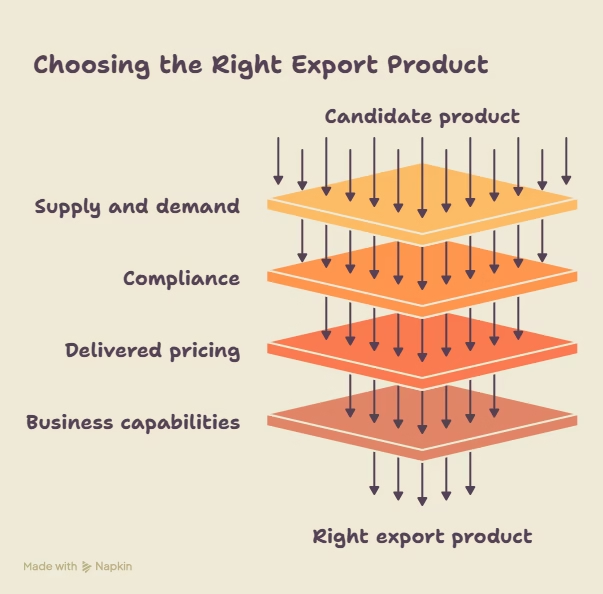
The 5 Part Export Product Filter
Throughout this guide we use one simple test. Every candidate must pass five checks, and passing four out of five is not enough.
| Part | The question it answers | Evidence you need |
| Product | Can I supply this, at consistent quality, in the quantities buyers want? | Specifications, supplier capacity, sample quality |
| Market | Does a specific country consistently import it, and can I legally sell there? | Multi year trade data, import rules, tariffs |
| Buyer | Who exactly would purchase from me, and why would they switch to a new supplier? | Buyer conversations, competitor research |
| Price | After every cost I bear, is the delivered price competitive and still profitable? | Landed cost worksheet, competitor price points |
| Delivery | Can I get it there intact, on time, with the documents and certifications required? | Logistics quotes, lead times, compliance checklist |
Think of the filter as five locks on one door. A product with huge demand (Market) that you cannot supply consistently (Product) fails. A product you can supply easily but that loses money once freight is added (Price) fails. A product with great margins but a regulation you cannot meet (Delivery) fails.
This is why the filter is more useful than a ranking of “best products to export” Rankings describe the market at large. The filter tells you whether a product works for your business, in one destination, for one type of buyer. Each of the ten steps below strengthens one or more of the five checks, and we will point out which.
Step 1: Start With What You Can Supply Reliably
Filter check: Product
Before you search for “high demand export products,” look inward. The best product on paper is worthless if you cannot source or manufacture it consistently. Product knowledge, dependable suppliers, and the ability to maintain quality are your real starting assets.
The supply self audit
Build an initial shortlist by answering these questions honestly:
- Do you understand the product’s specifications, quality grades, and common defects?
- Can you source it in the quantities overseas buyers typically order?
- Can your suppliers meet agreed delivery schedules?
- Can you hold quality steady across repeat orders, not just the first sample?
- Would the product need modification for overseas customers?
- Can you afford the sourcing, preparation, and delivery process before the buyer pays?
If you answer “not sure” to more than two of these, you have not yet found a product. You have found a category.
Narrow the category into a precise product
“Textiles” is not a product. It is an industry. A useful export candidate specifies the material, quality, packaging, and intended customer. Compare these two definitions:
- Too broad: “Cotton garments.”
- Precise: “Organic cotton baby rompers, 0–12 months, individually poly bagged with English and German care labels, for small European online retailers.”
The second version can be researched. You can look up its classification code, find importers, price it, and check the safety and labelling rules that apply. The first cannot.
Mini exercise: write a one line product definition
Complete this sentence before moving on:
I will supply [product, material/grade], packed as [packaging], in orders of about [quantity], for [type of buyer].
If you cannot fill every blank, spend more time on this step. Every later step, from trade data to costing, depends on this definition being specific.
Step 2: Choose the Product and Market Together
Filter checks: Product and Market
A product can be a winner in one country and a dud in another. Import demand, competition, duties, regulations, distribution channels, and the need for adaptation all change by destination. So evaluate pairs such as “Product A for Market X,” rather than choosing a product first and looking for any buyer afterwards.
Shortlist three to five markets, then test one
For an initial comparison, shortlist three to five potential markets. This range is manageable for a small business, and the International Trade Administration suggests testing one market before expanding to others. Resist the temptation to launch in ten countries at once, each additional market multiplies your compliance, pricing, and logistics work.
Compare each destination using the same grid:
| Factor | What to investigate |
| Demand | Does the country consistently import this product? |
| Trend | Are imports rising, falling, or swinging from year to year? |
| Competition | Which countries and suppliers already serve this market? |
| Market access | What tariffs, restrictions, standards, and certifications apply? |
| Delivered price | Can your offer compete after shipping and other costs? |
| Distribution | Which importers, wholesalers, or retailers buy this product? |
| Adaptation | Must the product, packaging, labels, or instructions change? |
Score each factor roughly from 1 to 5 for every market. The pattern that emerges is usually more revealing than any single number.
Large established market vs. smaller growing market
One decision you will face early is whether to aim at a big, established importer or a smaller, faster growing one.
| Large established market | Smaller growing market | |
| Upside | Deep, proven demand, many buyers clear import channels | Less crowded buyers may be open to new suppliers |
| Downside | Heavy competition entrenched suppliers, often stricter standards | Demand may be thin or unstable, fewer reliable buyers, payment risk can be harder to judge |
| Best for | Exporters with consistent quality and a clear differentiator | Exporters with flexible volumes and patience |
| Watch out for | Assuming size equals opportunity for a newcomer | Mistaking a short term surge for a trend |
Neither is automatically better. A large market is only an opportunity indicator, not proof that a new exporter can win orders. A small market can be perfectly suited to a business whose supply network is modest.
Step 3: Verify Demand With Trade Data
Filter check: Market
This is the step that separates a decision from a hunch. Use import and export statistics to establish whether a country actually buys your product. Trade data is far stronger evidence of international demand than a product’s popularity online.
Using ITC Trade Map
The International Trade Centre’s Trade Map provides indicators on international demand, export performance, alternative markets, and competing suppliers. Here is a practical way to use it:
- Find your product classification code (see Step 5). Trade data is organized by HS code, so a precise product definition from Step 1 pays off here.
- Look up imports by destination. Check which countries import the product and in what values and quantities, where quantities are available.
- Compare several years, not one. A single year can mislead. Look for sustained demand rather than a spike.
- See who supplies each market. The list of main supplying countries tells you who your competitors are and how concentrated the supply is.
- Check your home country’s existing exports. If India already exports the product to a market, that is a signal that routes, buyers, and rules exist.
- Compare large and small markets side by side, as discussed in Step 2.
Value versus quantity
Rising import value does not by itself mean more units are being bought. Prices may have risen while volumes fell, or currency movements may have inflated the figure. Whenever quantity data is available, compare it with value. If value climbs while quantity stays flat, buyers may simply be paying more, which could be good for your margin or a sign of supply shortage rather than growing demand.
Export Potential Map
ITC’s Export Potential Map adds another angle by evaluating export performance, target market demand, market access conditions, and bilateral linkages. Use it to find opportunities worth investigating. Treat its output as a prompt for research, not as a sales forecast. An estimate of potential does not guarantee orders.
Reading the data without fooling yourself
- One year spikes: A single strong year can come from a one off contract, a shortage, or a policy change. Look for a pattern across several years.
- Concentrated demand: If one or two buyers account for most of a country’s imports, your realistic addressable market may be much smaller than the headline number.
- Over reading estimates: Potential based tools indicate where to look. They do not tell you that an order is waiting.
- Big market, bigger rivals: Large import volumes usually mean established suppliers. Demand is not the same as demand for you.
Record keeping tip: For every figure you collect, write down the product classification, destination, reporting period, and data source. This habit makes your analysis repeatable, makes it easy to update later, and protects you from quoting numbers you cannot trace.

Statistics tell you the market is active. They do not tell you whether your specific offer meets buyer needs. That comes in Step 10.
Step 4: Analyse Competition and Find Your Edge
Filter checks: Buyer and Price
Demand matters, but buyers also need a reason to choose you. Research who already supplies the market, which specifications they sell, how they position themselves, and what they charge. The aim is not to find a market with no competitors. It is to identify an advantage you can deliver consistently.
Potential differentiators
Investigate whether you can credibly offer any of the following:
- More consistent quality across batches
- A specification or variant that buyers need and existing suppliers do not offer
- Suitable packaging or private label options for smaller retailers
- Reliable supply and delivery, which many importers value above a slightly lower price
- A competitive delivered price, not just a competitive factory price
- Adaptation to local preferences, such as pack size, flavour profile, size range, or labelling language
Be honest about which of these you can sustain. An edge you can deliver once is a promotion. An edge you can deliver every month is a business.
Why low competition can be a warning sign
It is tempting to read an empty field as a golden opportunity. Sometimes it is. Often it means demand is weak, market access conditions are difficult, or earlier suppliers tried and left. Never evaluate competition alone. Read it alongside demand, regulations, and landed cost. If you find low competition, your next question should be “why?”
The positioning template
Finish this sentence with something specific and verifiable:
Buyers should choose me because ___.
“Good quality” does not qualify, every supplier says it. “We pack in 250 gram retail pouches with Spanish labelling and can ship monthly in 1,000 unit lots” does.
If you cannot complete the sentence convincingly, either refine the product or the target buyer, or move on to the next candidate.
Step 5: Check Legal Eligibility Early
Filter check: Delivery
Before you spend heavily on inventory, confirm that the product can legally leave your country and legally enter the destination. These are separate checks. Permission to export does not establish that the product can be imported, and the reverse is also true.
Check 1: Can it leave India?
Start by identifying the correct ITC(HS) classification for your product. The HS code is the international system for classifying traded goods, and the ITC(HS) version used in India extends it to eight digits.
Once you have the code, check the DGFT (Directorate General of Foreign Trade) export policy for that code and any conditions attached. DGFT offers a searchable policy facility for eight digit ITC (Indian Trade Classification) HS codes and also covers SCOMET (Special Chemicals, Organisms, Materials, Equipment and Technologies) items, the list of dual use and sensitive goods that need special authorization to export.
You do not need an HS code to brainstorm, but you do need one before you can research trade data properly or confirm eligibility. Treat classification as a step you finish early, and double check it, because a wrong code can send you to the wrong policy entry and the wrong tariff.
Check 2: Can it enter the destination?
For each shortlisted market, investigate:
- Product restrictions and import authorizations
- Applicable duties and taxes
- Required standards, testing, and certifications
- Packaging and labelling requirements
- Product modifications needed to comply
Agricultural and processed foods
Food products need extra care. Do not assume that all food items follow the same process. APEDA’s (Agricultural and Processed Food Products Export Development Authority) notification page is a useful way to track relevant Indian export policy notices for agricultural and processed food products. Destination country food rules, however, still need their own verification. A product can be perfectly legal to export from India and still be refused at a foreign border for labelling or ingredient reasons.
Treat compliance as a screening condition, not a later problem.
If a candidate fails a legal check, it is out. Do not plan to solve the issue after the first order arrives.
A practical habit: keep a one page compliance sheet per product market pair, with the HS code, the policy source you checked, the date you checked it, and any certificates required. Rules change, and a dated record tells you when to re-verify.
Step 6: Confirm Supply Reliability
Filter check: Product and Delivery
An export opportunity is only useful if you can fulfil it. A steady supply chain is essential to serving overseas demand reliably, so test it before you promise anything to a buyer.
A low cost supplier is not the same as an export ready supply chain. The cheapest quote often hides small capacity, loose quality control, or no tolerance for repeat orders. An export ready supplier can commit to volumes, hold a specification, and recover gracefully when something goes wrong.
Questions to ask every supplier
- What is your available capacity, and what are realistic lead times?
- What are your minimum order quantities?
- Which specifications and quality checks will you agree to in writing?
- Can you handle export grade packaging?
- Can you handle repeat orders at the same quality?
- How will shortages, delays, or defective goods be addressed, and who bears the cost?
The last question matters most. Every supply chain has bad days. What counts is whether the supplier has a process for them.
Supplier comparison template
Compare at least two or three suppliers side by side before committing:
| Criterion | Supplier A | Supplier B | Supplier C |
| Unit price | |||
| Minimum order quantity | |||
| Monthly capacity | |||
| Lead time (days) | |||
| Quality checks offered | |||
| Export packaging capability | |||
| Policy on defects and delays | |||
| Sample quality (1–5) | |||
| Overall reliability (1–5) |
If the cheapest supplier is the weakest on reliability, the cheap price is not really cheap. It is a risk you have decided not to price.
Step 7: Assess Logistics and Adaptation
Filter checks: Price and Delivery
A product can look profitable at the supplier’s location and become uncompetitive once it reaches the overseas customer. Evaluate shipping, packaging, handling, adaptation, and after sales needs before you commit.
Products that lose profit in transit
Ask whether the product is:
- Expensive to transport relative to its selling price. Bulky, low value goods can see freight eat most of the margin.
- Fragile or perishable. Breakage, spoilage, or temperature requirements add cost and risk.
- Dependent on specialized handling. Special storage or equipment narrows your options and raises prices.
- Difficult to package for international shipment. Poor packaging means damage claims.
- Likely to need installation, training, warranties, or local servicing. These obligations can quietly become your largest cost.
No category is universally “easy to export.” Even products that are simple to move can face demanding destination requirements.
Budget for adaptation
Exporters often need to modify products for regulations, climate, buyer preferences, shipping needs, or engineering standards. That might mean different voltage or plug types, new label languages, altered formulations, sturdier packaging, or different size ranges.
Adaptation costs money and time, and the expected market opportunity must justify it. If you need heavy adaptation to chase an uncertain market, the product probably fails the Price check.
Step 8: Calculate Profitability and Funding Needs
Filter check: Price
This step answers the question that matters most, after every cost you bear, does the sale still make money? Compare the achievable selling price with all costs under the proposed transaction.
The cost categories
| Cost category | What to estimate |
| Product | Procurement or manufacturing cost |
| Export preparation | Packaging, labelling, adaptation, testing, certification where required |
| Origin movement | Transport and handling before international shipment |
| International delivery | Freight and insurance, depending on the transaction |
| Destination costs | Duties, taxes, handling, onward delivery |
| Selling channel | Agent, distributor, or other partner margins |
| Service obligations | Installation, warranty, or support where relevant |
Delivery terms decide who pays
Which costs belong to you depends on the agreed delivery terms (the Incoterms in your contract). Under some terms the buyer pays international freight and destination costs, under others you do. So do not automatically charge every category to the exporter. Equally, do not forget that your buyer compares your delivered price with competitors’, so even costs you do not pay still shape whether the buyer says yes.
Worked example: landed cost sheet (illustrative)
The figures below are invented to show the method. They are not market quotations and do not describe any real product. Imagine you quote ₹1,000 per unit for a packaged product, with you bearing costs up to delivery to the buyer’s port.
| Cost item (per unit) | Amount (₹) | Notes |
| Product procurement | 560 | Supplier price at agreed specification |
| Export packaging, labelling, testing | 60 | Retail packs plus destination language labels |
| Inland transport and handling | 25 | Factory to port |
| Export clearance and documentation | 15 | Agent and paperwork fees |
| International freight and insurance | 95 | Share of container cost |
| Agent commission | 50 | Five percent of the selling price |
| Claims and defects reserve | 15 | Allowance for damage or rejection |
| Cost of funding until payment | 30 | Interest on cash tied up |
| Total cost you bear | 850 | |
| Selling price | 1,000 | |
| Contribution | 150 | 15% of revenue |
The remaining ₹150, or 15% of revenue, is a contribution, not net profit. Business overheads such as salaries, rent, software, and travel still have to come out of it, and other costs may remain. Many beginners stop here and celebrate a margin that disappears once the running costs of the business are counted.
Now look from the buyer’s side. If destination duties, taxes, and onward delivery add, say, ₹140 per unit, the buyer’s landed cost is about ₹1,140. A competitor already in the market must beat that figure for you to win. If their landed cost is lower and you cannot reduce yours, the product fails the Price check no matter how appealing the contribution looks.

Cash flow timing
Profit and cash are different things. Ask:
- How much money must I commit before the buyer pays?
- How long will that cash be tied up, from supplier payment to collection?
- Can the business fund that gap, and what happens if payment is delayed?
Resource planning and payment collection are part of product selection, not a separate task. A profitable product that you cannot finance is not a viable product for you.
Step 9: Examine Tariff Advantages
Filter check: Price and Market
Trade agreements and preferential tariff arrangements can change competitiveness, sometimes sharply. ITC’s Market Access Map provides information on applied tariffs, preferences, tariff rate quotas, trade remedies, and regulatory requirements, making it a useful single place to compare destinations.
Warning: an agreement does not make every shipment duty free. Whether a preference applies to your goods can depend on the specific product, the rules attached to the arrangement, and the trade route. Check your exact HS code and your exact route rather than assuming. Then feed the result into the landed cost sheet alongside non-tariff requirements and logistics costs.
A simple way to use this step, for each shortlisted market, note the tariff you would face, whether any preference could reduce it, and whether any quota or trade remedy applies. If one market offers a clear tariff advantage over your competitors, that can tip a close decision.
Step 10: Validate With Buyers Before Scaling
Filter check: Buyer
Trade statistics show market activity. Direct conversations reveal whether your offer fits buyer needs. The International Trade Administration separates secondary research (trade statistics, reports, desk research) from primary research (interviews, surveys, direct contact with potential buyers). You need both.
Questions to ask prospective buyers
- What specifications and quality levels do you require?
- What packaging and labelling do you prefer?
- What are your typical order quantities?
- What price and delivery terms do you expect?
- Which documents and certifications are necessary?
- What would make you consider a new supplier?
The final question is the most valuable. Buyers will tell you precisely what would earn their trust, and that answer often reshapes your product definition.
Run a limited test in one market
Do not commit to a broad range of products or several countries at once. Start with a limited test in one market, learn from the first shipments, and expand as experience builds. A small, well run first order teaches you more about documentation, payment, and logistics than any amount of desk research.
The Export Product Scorecard (Copy and Use)
By now you may have several candidates. This scorecard helps you compare them consistently. It is an editorial framework, a practical tool built from the research factors above. It is not an official government scoring method.
Score each product market combination from 1 (weak) to 5 (strong).
| Criterion | Weight | A strong candidate shows |
| Proven demand | 20% | Sustained import demand and buyer interest |
| Profitability | 20% | A viable price after the costs you bear |
| Reliable supply | 15% | Consistent quality, capacity, and lead times |
| Competitive advantage | 15% | A credible reason for buyers to choose you |
| Compliance feasibility | 15% | Requirements you can satisfy and afford |
| Logistics suitability | 10% | Manageable transport, packaging, and handling |
| Business fit | 5% | Relevant knowledge and sufficient resources |
How to calculate
Multiply each score by its weight, then add the results. The maximum is 5.0.
Quick example (illustrative scores)
| Criterion | Weight | Packaged food | Fresh produce |
| Proven demand | 20% | 4 | 5 |
| Profitability | 20% | 4 | 3 |
| Reliable supply | 15% | 4 | 2 |
| Competitive advantage | 15% | 3 | 2 |
| Compliance feasibility | 15% | 3 | 2 |
| Logistics suitability | 10% | 4 | 2 |
| Business fit | 5% | 5 | 3 |
| Weighted score | 3.75 | 2.85 |
Fresh produce shows the strongest demand, yet it scores lower overall because supply, compliance, and logistics are harder for this imagined exporter. These scores are made up to demonstrate the method yours will depend on your own evidence.
Disqualifier rule: A legal barrier, an unworkable delivery requirement, or an inability to supply consistently overrides any score. A candidate with these problems is out, however good its total looks.
The highest score should guide further investigation, not replace judgment.
Red Flags: When to Walk Away From a Product
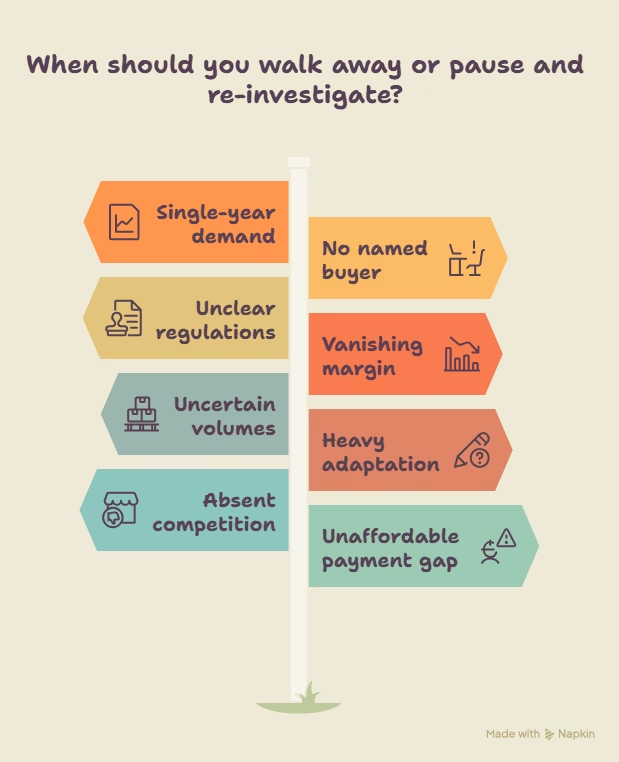
Knowing when to quit saves more money than any clever sourcing trick. Walk away, or pause and re-investigate, when you see any of these:
- Demand appears in only one year. A single spike is not a trend.
- You cannot name a buyer. If you cannot say who would purchase and why, you have an idea, not a market.
- Regulations are unclear. If you cannot confirm export and import eligibility, assume the answer is no until proven otherwise.
- The margin vanishes after landed cost. If the sheet only works when you leave costs out, it does not work.
- The supplier cannot commit to volumes. Uncertain supply makes every promise to a buyer a risk.
- Heavy adaptation with uncertain return. If changes are expensive and demand is unproven, the bet is too large.
- Competition is oddly absent. Find out why before assuming it is an opening.
- You would need to fund a long payment gap you cannot afford.
Two or more red flags on the same candidate is a strong signal to move on to the next one on your list.
Example: Comparing Three Candidates
Suppose an Indian exporter is weighing fresh produce, packaged food, and textile products. These are illustrative candidates only. They are not recommendations, and nothing here describes their current profitability.
The exporter takes each product, picks one specific destination, and runs it through the 5 part filter.
| Filter check | Fresh produce | Packaged food | Textile products |
| Product | Supply seasonal and variable, quality depends on harvest and handling | Specifications can be fixed, consistency easier to hold | Depends on mill and factory capacity, defined specs possible |
| Market | Demand may be strong but subject to strict import checks | Demand varies by product type, labelling rules important | Wide demand, but intense competition |
| Buyer | Often large importers or wholesalers with demanding standards | Importers, distributors, private label buyers | Retailers, brands, wholesalers with set specifications |
| Price | Spoilage and cold chain costs squeeze margin | Packaging and labelling add cost but margin is more predictable | Margin thin if competing on price alone |
| Delivery | Perishability demands speed and specialised handling | More forgiving shelf life, documentation still demanding | Straightforward to ship compliance and labelling vary |
Here is the point. One product may have stronger demand but need handling or compliance capabilities the exporter lacks. Another may present a smaller opportunity yet fit the exporter’s supply network and budget far better. Product adaptation and market requirements can change the outcome substantially.
The right choice is the one that passes every check, not necessarily the one with the largest headline market.
Your 30-Day Product Validation Plan
Research only helps if it ends in a decision. This four week plan converts everything above into action.
Week 1: Define and shortlist
- Complete the supply self audit from Step 1.
- Write a one line product definition for each of two or three candidates.
- Shortlist three to five potential markets per candidate.
- Find the likely ITC(HS) code for each product.
Week 2: Data and eligibility
- Pull multi year import data for each product market pair, and log classification, destination, period, and source.
- Compare value and quantity, and note who the main suppliers are.
- Check DGFT policy (and APEDA notices for food and agricultural products).
- Check destination import rules, standards, and labelling.
- Drop any pair that fails a legal check.
Week 3: Quotes and costing
- Request quotes from at least two or three suppliers and fill in the comparison table.
- Get freight and insurance estimates.
- Build a landed cost sheet for each remaining pair, including the buyer’s likely landed cost.
- Check tariff and preference information on the Market Access Map.
Week 4: Buyers and decision
- Contact prospective buyers and ask the Step 10 questions.
- Update your costs and specifications based on what you learn.
- Fill in the scorecard for each surviving candidate.
- Apply the disqualifier rule, choose one product and one market, and plan a limited test order.
A downloadable version of this plan makes a natural lead magnet, a one page checklist readers can print and tick off.
Common Mistakes to Avoid
| Mistake | The fix |
| Choosing a product because it is trending | Verify multi year import data before anything else |
| Picking the product first and the market later | Evaluate product market pairs together |
| Researching compliance after buying stock | Check export and import eligibility in Week 2, before spending |
| Judging margin at the factory gate | Build a full landed cost sheet and view the buyer’s delivered price |
| Going for the cheapest supplier | Test capacity, lead times, quality checks, and defect handling |
| Targeting many countries at once | Test one market, then expand |
| Treating contribution as profit | Subtract overheads and funding costs before celebrating |
| Assuming a trade agreement means zero duty | Check your exact product and route |
Conclusion and Key Takeaway
Choosing what to export is not about finding the product with the biggest headline market. It is about finding the one that survives scrutiny. Run every candidate through the 5 part filter, can you supply the product, is there verified demand in the market, does a real buyer want it from you, does the price hold after all costs, and can you manage delivery, legally and physically?
If you remember one line, make it this:
Choose an export product where verified demand overlaps with reliable supply, achievable compliance, competitive delivered pricing, and your business’s capabilities.
That is how to choose the right product to export without learning the lesson the expensive way. Take the scorecard, work through the 30 day plan, and let the evidence make the decision. If this guide helped, check out the remaining practical export guides, or leave a comment with the product you are evaluating.
FAQs
How do I find out which products are in demand abroad?
Use trade statistics rather than social media. Tools such as ITC Trade Map show what countries import, in what values and quantities, and who supplies them. Look across several years and compare value with quantity. Then confirm with buyer conversations.
Can I export any product from India?
Not necessarily. Many products can be exported freely, but some are restricted or need authorization, including SCOMET items. Find your ITC(HS) code and check the DGFT export policy for your specific product. Then check the destination country’s import rules separately.
How many markets should I target first?
Shortlist three to five markets for comparison, then test one before expanding. This keeps compliance, pricing, and logistics manageable while you learn.
How much money do I need to start exporting?
There is no single figure, because it depends on the product, order size, delivery terms, and payment terms. Build a landed-cost sheet and work out how much cash you commit before the buyer pays. That amount, plus a cushion for delays, is your realistic starting requirement.
Do I need an HS code before I choose a product?
You can brainstorm without one, but you need it to research trade data and confirm eligibility. Define your product precisely, find its ITC(HS) classification early, and verify it, because a wrong code leads to wrong data and wrong policy checks.
How do I find international buyers?
Start from your trade-data research: identify the importers, distributors, and retailers in your target market, and look at who already supplies them. Then approach them directly with a specific offer and use buyer conversations to refine your product. Always verify any buyer before shipping.
About the Author
Hi, I’m SriHarsha, founder of shxhub.in.
I focus on explaining import export business topics in a practical, beginner friendly way, based on how exports actually work on the real ground especially documentation, quality control, and buyer expectations.