
The United States is a massive engine of global trade. Every single day, billions of dollars worth of goods cross its borders. Some shipments are importing goods into the United States Others are leaving the country as exports.
For a small business owner or an aspiring entrepreneur, this flow of goods represents a huge opportunity.
But let’s be honest looking at the US import export system from the outside can feel like staring at a giant, complicated machine with a thousand moving parts.
You might be asking yourself, “Where do I even start?” or “Who is actually in charge of all this?”
If you get it right, importing goods into the United States can stock your shelves with unique products, and exporting can open your business to millions of new customers. If you get it wrong, your goods can get stuck at the border, costing you time, money, and sleep.
This guide breaks down import export systems of USA in plain terms. We are going to break down exactly how the system works, how importing and exporting actually work, who is watching your shipments, and how to stay on the right side of the rules so customs compliance protects you from expensive mistakes. Whether you are bringing products in or sending them out.
Table of Contents
What is Importing?
At its simplest level, importing is the act of bringing goods from a foreign country into the United States for trade or sale. But in the eyes of the US government, it is a lot more than just buying something online and waiting for a package.
When you act as an importer, you are the one responsible for everything that happens to that box. You are telling the US government, “I vouch for what is inside this container, I know where it came from, and I am paying the taxes on it.”
This responsibility applies even if you hire a freight forwarder or customs broker.
The Process of Importing Goods into the United States
The import process doesn’t start when the ship arrives at the port. It starts way before that.
- Classification: Before you import any product, you need to know the Harmonized System (HS) code for your product. This code tells US Customs exactly what the item is (e.g., “cotton t-shirt” or “electric toaster”).
- Valuation: You must declare the correct value of the goods. This isn’t just what you paid it includes assists, royalties, and packing costs.
- Filing Entry with CBP: When goods arrive, you (or your customs broker) file entry documents with U.S. Customs and Border Protection (CBP).
- Examination and Release: CBP decides if they want to inspect your cargo. If everything looks good and you pay your duties, they release the goods.
- Liquidation: This is the final step, often happening months later, where CBP effectively says, “Okay, we agree with your paperwork, case closed.”
The Benefits and Challenges of Importing
Why do people do it? The benefits are clear. Sourcing globally allows you to find lower manufacturing costs, access raw materials that don’t exist in the US, or sell high quality niche products that American consumers crave.
But the challenges are real. Customs compliance is strict. If you mess up your paperwork, your goods don’t just sit there you get fined. You also have to deal with long shipping times, currency exchange rates, and the risk that your supplier might send you a container of bad product.
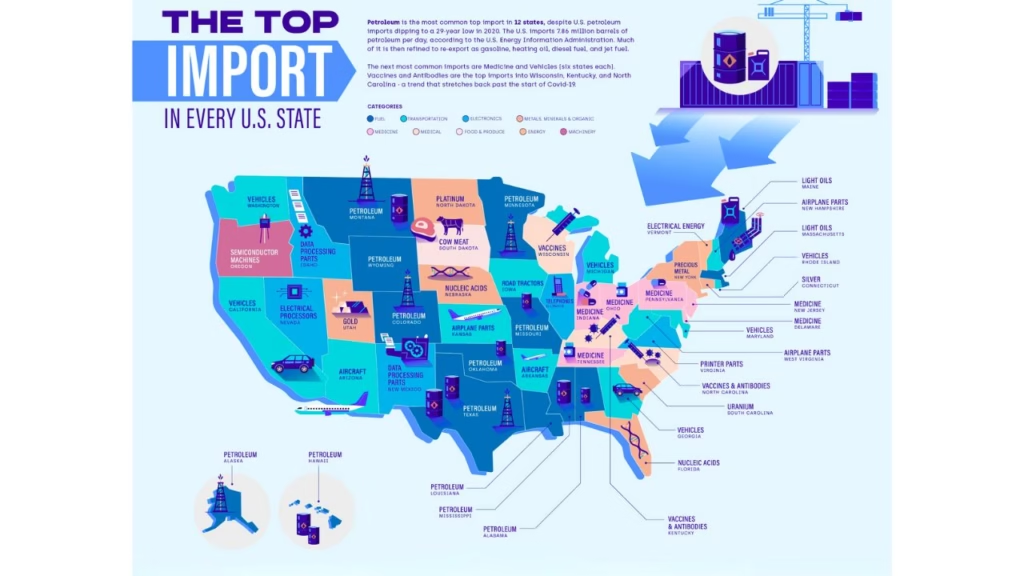
Key Import Commodities
What is coming into America? The United States largest exports might grab headlines, but imports fuel the economy.
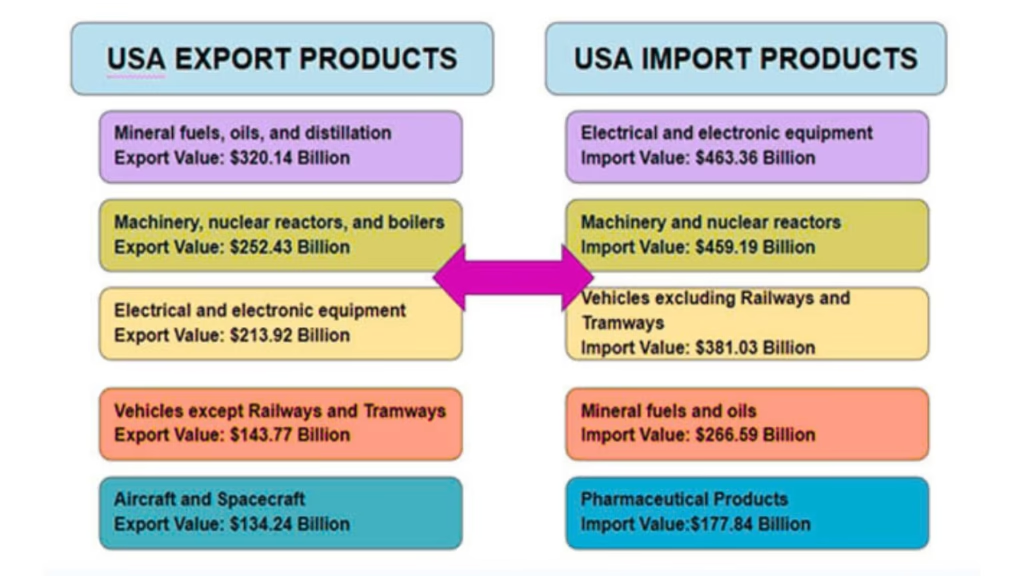
- Machinery and Electronics: Computers, broadcasting equipment, and office machine parts.
- Vehicles: Cars and auto parts are massive import categories.
- Pharmaceuticals: A significant portion of medicine is manufactured abroad.
- Oil and Mineral Fuels: Despite domestic production, the US still imports crude oil.
What is Exporting From the United States?
On the flip side, exporting is sending goods produced in the US to a foreign destination. If you make custom guitars in Nashville and sell one to a musician in Tokyo, you are an exporter.
While the US government is generally happier about exports (because it helps the economy), don’t assume they aren’t watching. US import export control regulations 2025 are stricter than ever regarding who you can sell to and what you can sell.
The Export Customs Clearance Process
Exporting feels different because the “heavy lifting” usually happens before the box leaves the warehouse.
- Screening: You must check “Denied Party Lists.” basically, a list of people and companies the US government says you cannot do business with.
- Classification (Again): You need to classify your goods, but this time for export control purposes (using a Schedule B number or ECCN).
- Licensing: Most goods don’t need a license (this is called “No License Required” or NLR), but sensitive technology or military items definitely do.
- Filing EEI: For shipments over $2,500, you usually have to file Electronic Export Information via a system called AESDirect. This tells the Census Bureau what is leaving the country.
The Benefits and Challenges of Exporting
The biggest benefit? You stop relying on just one market. If the US economy slows down, your customers in Europe or Asia might still be buying. It spreads your risk. Plus, “Made in USA” is still a powerful brand signal in many parts of the world.
The challenge is often regulatory. You have to navigate the laws of the US and the laws of the country you are shipping to. You also have to figure out how to get paid safely so you don’t ship a product and never see the cash.
Key Export Commodities
So, what is the main export of America? It’s not just one thing.
- Aerospace: Airplanes and spacecraft parts are huge top US exports.
- Refined Petroleum: The US is a major energy supplier.
- Pharmaceuticals: Just as we import them, we export high value medicines.
- Agricultural Products: Soybeans, corn, and meat are staple US top exports.
Importing vs Exporting Key Differences
Understanding the difference between importing and exporting goes deeper than just “in” and “out.” It comes down to responsibility.

The Responsibility Shift
When you import, the US government is obsessed with revenue and safety. They want to know:
- Did you pay the tax (duty)?
- Is this product safe for American consumers?
- Is it fake?
CBP acts like a bouncer at a club. They check everyone’s ID and cover charge. If you are the importer, the pressure is on you to prove everything is correct.
When you export, the government is obsessed with security and foreign policy. They want to know:
- Are you selling sensitive technology to a prohibited country?
- Is this product going to be used for something bad (like weapons proliferation)?
In exporting, the US Customs and Border Protection takes a back seat to other agencies, but the penalties for getting it wrong can be even more severe, including jail time for serious violations.
Economic Impact
Both drive the economy. Imports give consumers choices and lower prices (think of affordable electronics). Exports create jobs. It is estimated that every $1 billion in exports supports thousands of American jobs.
That is why the government tries to make it easier for small businesses to export, offering grants and assistance, whereas importing is mostly regulated without much financial help.
Who Regulates Trade in the U.S.?
This is where beginners get confused. There isn’t just “one” trade office. It is a web of agencies. Knowing who regulates what saves you from getting your shipment seized.
1. U.S. Customs and Border Protection (CBP)
This is the big boss of imports. Part of the Department of Homeland Security, CBP is the agency that physically stops your goods at the border. They collect duties, enforce laws for other agencies, and protect the borders. If you are importing goods into the United States, CBP is your main point of contact.
2. Department of Commerce / Bureau of Industry and Security (BIS)
These are the export regulators. They manage the Export Administration Regulations (EAR). If you are selling dual use goods (items that can be used for both civilian and military purposes, like high end computer chips), you answer to them. They decide if you need an import and export permit or license for specific technologies.
3. Partner Government Agencies (PGAs)
CBP enforces the rules, but often, other agencies write them.
- FDA (Food and Drug Administration): Regulates food, meds, and cosmetics.
- USDA (Dept. of Agriculture): Regulates plants and animals.
- EPA (Environmental Protection Agency): Regulates chemicals and vehicles.
If you import sunglasses, the FDA cares (they are medical devices). If you import a wooden table, the USDA cares (about bugs in the wood).
Role of U.S. Customs and Border Protection (CBP)

Let’s zoom in on CBP, because they are the gatekeepers. Many new business owners think CBP is there to help them fill out forms. They are not.
CBP is an enforcement agency. Their job is to find people breaking the rules.
The Enforcer
When you file your entry documents, you are making a legal declaration. CBP expects you to exercise “reasonable care.” This means you cannot just guess your HS code or guess the country of origin. If you guess wrong, CBP calls it negligence.
For example, if you say your shoes are made of plastic because the duty rate is lower, but they are actually leather, CBP sees that as potential fraud. They can issue a “Request for Information” (CF 28) or a “Notice of Action” (CF 29), which are fancy ways of saying, “We think you are wrong, prove us otherwise.”
Risk Management
CBP cannot inspect every single container trade would grind to a halt. Instead, they use risk management. They look at data.
- Is this a first time importer?
- Is the shipment coming from a high risk country?
- Does the paperwork look sloppy?
If you flag their system, you get inspected. An inspection can take weeks and cost you thousands of dollars in storage fees at the port. This is why export customs clearance and import compliance are so vital. You want to be invisible to CBP boring, compliant, and accurate.
Enforcing Trade Laws
CBP doesn’t just collect money. They enforce intellectual property rights. If you try to import fake Nike sneakers, CBP seizes them and destroys them. They also enforce forced labor laws.
If they suspect your goods were made with forced labor, they will detain the shipment until you can prove (with a mountain of paperwork) that your supply chain is clean.
Importer of Record vs. Exporter of Record
In the world of logistics, titles matter. You need to know what is exporter and importer of record.
Importer of Record (IOR)
The IOR is the person or entity legally responsible for the goods entering the US. This is the person on the hook for duties, taxes, and compliance.
- Crucial Tip: Even if you hire a customs broker or a freight forwarder to do the paperwork, you are likely the Importer of Record. If the broker makes a mistake, CBP fines you, not the broker. You cannot outsource liability.
United States Principal Party in Interest (USPPI)
In exporting, we often use the term USPPI. This is the person in the US who receives the primary benefit of the transaction. They are responsible for determining if a license is needed.
- Crucial Tip: Be careful with “Ex Works” (EXW) transactions where a foreign buyer hires a truck to pick up goods from your dock. If they handle the shipping, you might think you are off the hook. But the US government still looks at you to ensure the goods aren’t going to a prohibited destination.
What Happens When You Get It Wrong?
It is important to understand the consequences so you can avoid them.
- Cargo Holds: The most immediate pain. Your goods sit at the dock. You pay “demurrage” (storage fees) every day.
- Seizure: If the violation is bad enough, the government takes the goods and you never get them back.
- Monetary Penalties: CBP can issue penalties equal to the value of the goods. Imagine losing the product and having to pay its full value in cash to the government.
- Audits: If you make chronic mistakes, CBP can audit your business. They will go through your records for the last five years. It is intrusive, expensive, and stressful.
Should Beginners Worry About Compliance?
Yes. Immediately(But not very much).
There is a myth that “small shipments don’t matter.” People think if they just ship a few boxes via DHL or FedEx, the rules don’t apply.
While it is true that shipments under $800 (Section 321) enter duty free and with less paperwork, you are still the importer. If you use that exemption to smuggle in banned goods or violate FDA rules, you are still liable.
Furthermore, if you plan to grow, you need to build good habits now. Fixing a bad compliance process when you are shipping 50 containers a year is a nightmare. Building it right when you are shipping one pallet is easy.
Conclusion
The world of import export in the USA is exciting. It connects you to the global economy and offers limitless potential for growth. Whether you are looking at the United States largest exports for inspiration or trying to source the next big thing, the opportunity is there.
But opportunity comes with responsibility.
The US regulatory system led by U.S. Customs and Border Protection is designed to be strict. They expect you to know the rules. Whether it’s finding the right duty on export (trick question the US rarely taxes exports!) or ensuring customs compliance on imports, knowledge is your best defense.
Don’t let the paperwork scare you away. Just respect it. Do your research, classify your goods correctly, and perhaps most importantly, find good partners (like licensed customs brokers) to help you navigate the waters.
The future of trade is bright for those who play by the rules. Are you ready to get started?
FAQ’s
Explore the questions below to discover key details about US imports, top-tier exports, and broader trade-related insights. Whether you are researching market trends or just want to understand the economy better, these answers will help you see the bigger picture of international commerce.
Q1. What is the USA’s biggest import?
The USA’s biggest import is machinery, including computers, followed closely by electrical machinery, vehicles, and mineral fuels (like oil). Crude oil and refined petroleum products are particularly significant, as the US relies heavily on imports to meet its energy needs. Consumer goods like pharmaceuticals, clothing, and electronics also make up a large portion of imports.
Q2. What is the US No. 1 export?
The USA’s No. 1 export is refined petroleum products, such as gasoline, diesel, and jet fuel. Other top exports include aircraft and spacecraft, machinery, and medical equipment. The US is also a major exporter of agricultural products like soybeans, corn, and meat, which are highly sought after globally.
Q3. What goods does the US import from China?
The US imports a wide range of goods from China, with the most significant categories being:
Electronics: Smartphones, laptops, and other consumer electronics.
Machinery: Industrial and electrical machinery.
Textiles and Apparel: Clothing, footwear, and accessories.
Toys and Games: A large portion of toys sold in the US are manufactured in China.
Furniture: Home and office furniture is another major import category.
China is a critical trade partner, supplying many of the consumer goods used daily in the US.
Q4. What are the top 5 major US exports?
The top 5 major exports of the United States are:
1. Refined Petroleum: Gasoline, diesel, and other fuels.
2. Aircraft and Spacecraft: Commercial airplanes and related parts.
3. Machinery: Industrial and electrical machinery.
4. Medical Equipment: Instruments and devices used in healthcare.
5. Agricultural Products: Soybeans, corn, wheat, and meat.
These exports reflect the US’s strength in technology, energy, and agriculture.
Q5. Are US exports declining?
US exports have experienced fluctuations in recent years due to global economic conditions, trade policies, and supply chain disruptions. While exports have grown in some sectors like technology and energy, challenges such as tariffs, geopolitical tensions, and the COVID-19 pandemic have caused temporary declines in others. However, the overall trend shows resilience, with recovery in key industries like aerospace and agriculture.
About the Author
Hi, I’m Sriharsha, founder of shxhub.in.
I focus on explaining import export business topics in a practical, beginner friendly way, based on how exports actually work on the real ground especially documentation, quality control, and buyer expectations.