

Exporting isn’t just about shipping products overseas it’s about navigating a maze of demand, competition, regulations, and logistics. It’s not a game of guessing or gut feelings it’s a strategic process rooted in evidence and preparation. Think of it as your business passport to global markets, ensuring you don’t just enter but thrive.
An Indian spice exporter discovers Saudi Arabia’s massive demand but also its strict halal compliance rules. Or a textile manufacturer realizes their packaging doesn’t meet EU labeling laws, saving them from a costly mistake.
These aren’t just stories they’re proof that export market research is the difference between bold success and expensive failure.
In this guide, we’ll break down the essentials of export market research, showing you how to avoid pitfalls, seize opportunities, and make informed decisions that set your business up for international success. Ready to take the guesswork out of going global? Let’s dive in.
Table of Contents
What Market Research for Export Actually Means
What is export market research
Market research for export is the process of figuring out where your product can realistically sell outside your home country, at what price, under what rules, and against whom. Not vibes. Not assumptions. Evidence.
Export market research looks at demand, competition, regulations, logistics, and buyer behavior in foreign markets before you commit money, inventory, or reputation.
Two concrete examples:
- An Indian spice exporter checks HS code import data and finds Saudi Arabia imports large volumes but demands strict halal compliance. That’s market research for export.
- A textile manufacturer studies EU labeling laws and realizes their current packaging blocks entry. That’s export market research saving them a failed shipment.
If you’re skipping this step, you’re not “being bold.” You’re being careless.
Why market research is critical before exporting
Here’s the thing. Exporting multiplies mistakes. Domestic errors hurt. International errors bleed cash.
Export market research is critical because it reduces three risks at once demand risk, compliance risk, and pricing risk.
Two examples:
- Without research, you ship to a country with low demand and sit on dead inventory abroad. With research, you focus on markets already importing your product category.
- Without research, you price competitively in India but lose money overseas once duties, freight, and certifications kick in. With research, you calculate landed cost upfront.
Export success is rarely about luck. It’s about avoiding obvious, expensive mistakes early.
Difference between domestic vs International market research
Domestic and international market research are not cousins. They’re different games.
Domestic research focuses on customers, pricing, and competition within a familiar legal and cultural setup. International market research adds regulations, trade barriers, currency risk, logistics complexity, and cultural behavior on top.
Two examples:
- In domestic research, you worry about GST and local competitors. In international market research, you worry about import duties, non tariff barriers, certifications, and customs clearance.
- In domestic markets, a product adjustment is optional. In export markets, product adaptation like labeling language or ingredient disclosure can be mandatory.
Treating export market research like domestic research is how exporters get stuck at customs or rejected by buyers.
Step 1: Define Clear Export Market Research Objectives
Why unclear goals kill export decisions
Most exporters say they want to “start exporting” or “find buyers abroad.” That’s not a goal. That’s noise.
Unclear objectives lead to scattered research, wasted time, and false conclusions. Clear objectives turn research into decisions.
Two examples:
- “We want to export somewhere in Europe” leads to endless country comparisons and no action.
- “We want to find one profitable EU market for our processed foods within 12 months” gives you a filter for every data point you analyze.
If your export research objectives aren’t specific, your research output will be useless.
Common export objectives: growth, diversification, risk hedging
Most export research objectives fall into three buckets. Knowing which one you’re in, changes how you research markets.
- Growth: entering high volume import markets
- Diversification: reducing dependence on one country or buyer
- Risk hedging: balancing currency, political, or demand risk
Two examples:
- Manufacturers chasing growth often chase the largest importers, even though those markets are the most competitive.
- To limit risk, a trader spreads business across smaller but stable markets instead of relying on one volatile region.
Your export market selection depends entirely on which objective you prioritize. Mixing them up leads to bad choices.
Using SWOT analysis for export market selection
SWOT analysis for export is not a classroom exercise. It’s a reality check.
You assess your strengths and weaknesses internally, then map them against external opportunities and threats in target markets.
Two examples:
- Strength: low cost manufacturing. Opportunity: price sensitive African markets. That’s alignment.
- Weakness: lack of certifications. Threat: EU compliance rules. That’s a warning sign.
If your weaknesses collide with a market’s entry barriers, no amount of demand will save you.
Framing the right export research questions
Good export research starts with sharp questions, not broad curiosity. Your questions should force clarity on feasibility, not just attractiveness.
Two examples of strong export research questions:
- What adaptations are legally required to sell this product in Country X, and what do they cost?
- Who are the top three importing countries for this HS code, and how fast is demand growing there?
Bad questions ask “Is this market big?”
Good questions ask “Can we win here, and why?”
Step 2: Identify and Shortlist Target Export Markets
How to screen countries for export potential
Screening target export markets is about elimination, not attraction. Your goal is to kill bad options fast, not glamorize countries you like.
The export market selection process starts with filtering countries using hard constraints before emotional ones.
Two examples:
- If a country has high demand but bans your product category or requires certifications you don’t have, it’s out. No debate.
- If logistics costs exceed your margin even before duties, the market is dead on arrival.
Good exporters remove 80 percent of options early and go deep on the remaining few.
Criteria: tariffs, regulations, logistics cost, demand, cultural fit
Every serious export market selection process rests on five non-negotiables.
- Tariffs and duties: Directly impact landed cost and pricing.
- Regulations and compliance: Decide whether you can enter at all.
- Logistics cost and time: Kill cash flow if ignored.
- Demand and import volume: Prevent exporting into a vacuum.
- Cultural fit and usage behavior: Decide repeat purchases.
Two examples:
- Indian auto components may face low tariffs in Africa but long transit times. That affects working capital, not just profit.
- Spices may have strong demand in the Middle East, but cultural preferences around flavor and packaging shape acceptance.
If even one of these five fails, the market becomes fragile.
How many countries to analyze (and why more is a mistake)
Analyzing too many countries is not complete. It’s avoidance masked as research. The right number is three to five countries in the initial.
Anything beyond that reduces depth and clarity.
Two examples:
- An exporter studying 15 countries ends up with Incomplete data and no decision.
- An exporter studying four countries deeply can rank them and act.
Export success comes from focus. Spreading attention across too many markets delays revenue and increases confusion.
Grouping markets by size vs growth potential
Not all target export markets should be judged by current size. Some deserve attention because of future momentum.
You should group markets into two buckets:
- Large, established importers: stable demand, intense competition
- High growth or emerging markets: lower volumes, faster expansion
Two examples:
- The US or EU offers scale but demands compliance and pricing discipline.
- Parts of Africa or Southeast Asia offer growth with fewer rooted competitors.
Knowing which group you’re targeting keeps expectations realistic and strategy aligned.
Step 3: Analyze Trade Data and Market Size Using Secondary Research
Using HS code data for export market research
HS code market research is the backbone of export market analysis. HS codes allow you to track actual import and export flows by product category, not opinions or surveys.
Two examples:
- A tea exporter uses HS code data to compare import volumes across the US, Russia, and the UK.
- A machinery exporter identifies which countries are increasing imports year over year, not just importing in absolute terms.
If you’re not using HS codes, you’re not doing export research. Period.
Import volume, growth trends, and demand indicators
Market size alone is meaningless without context. You need to read three signals together.
- Import volume: shows current demand
- Growth trends: shows future potential
- Demand indicators: confirm sustainability
Two examples:
- A market with moderate imports but double digit growth is often more attractive than a saturated large market.
- A market with high imports but flat growth signals intense competition and price pressure.
Export trade data tells you where demand is moving, not just where it exists.
Identifying top importing countries for your product
Your product already has buyers somewhere. Your job is to find them.
Export market analysis should start by listing the top importing countries for your HS code, then ranking them by feasibility.
Two examples:
- If Germany imports heavily but requires certifications you lack, it drops in ranking.
- If a mid sized importer has manageable regulations and rising demand, it moves up.
Volume matters, but accessibility matters more.
Spotting low competition or underserved markets
This is where smart exporters separate themselves.
Underserved markets often hide in plain sight moderate import volumes, steady growth, and limited supplier diversity.
Two examples:
- A country importing mainly from one or two source nations may be open to alternatives.
- A market importing small volumes across many suppliers may lack a dominant player.
Low competition doesn’t mean low standards. It means fewer deep rivals and easier entry.
Step 4: Use Government and Institutional Export Research Sources
Export promotion portals and why they matter
Export promotion portals exists to reduce information imbalance. Ignoring them doesn’t make you independent. It makes you uninformed.
These platforms consolidate market access rules, sector insights, and country specific trade guidance that would take weeks to piece together manually.
Two examples:

- An exporter checks an official portal and discovers a product is restricted unless registered with a local authority. Shipment saved.
- Another ignores it, ships blind, and gets stuck at customs. Money gone.
Government backed data isn’t perfect, but it’s structured, credible, and designed for exporters. Use it.
Country commercial guides and market access databases
Country commercial guides explain how business is actually done in a market, not just what the law says.
Market access databases go further. They spell out entry conditions, tariffs, documentation, and procedural steps.
Two examples:
- A guide reveals that buyers in a market prefer distributors over direct imports. That changes your entry strategy.
- A database flags a licensing requirement that makes casual exporting impossible.
If you don’t understand the entry rules, you don’t have a market. You have a theory.
Identifying tariffs, duties, and non tariff barriers
Export regulations by country are never just about customs duty. That’s the trap.
You need to account for:
- Basic customs duty
- Additional surcharges
- Anti dumping measures
- Technical standards and inspections
Two examples:
- A low tariff market still becomes expensive due to mandatory testing and certification.
- A duty free market under an FTA(Free Trade Agreement) still blocks entry through documentation and origin rules.
Export barriers are often procedural, not financial. Miss them and your pricing model collapses.
Regulatory red flags most exporters miss
Most exporters look at tariffs and stop. That’s lazy.
Common regulatory red flags include:
- Product registrations that take months
- Mandatory local representation
- Language specific labeling laws
- Pre shipment inspections
Two examples:
- A food exporter ignores labeling language rules and faces re-labeling costs at port.
- A machinery exporter misses safety certification and loses the buyer.
International trade regulations don’t forgive ignorance. They punish it quietly and expensively.

Step 5: Conduct Primary Market Research for Export Validation
Why data alone lies without field validation
Secondary data tells you what should work. Primary market research for export tells you what actually works.
Numbers don’t explain buyer psychology, trust barriers, or negotiation norms. People do.
Two examples:
- Trade data shows strong imports, but local buyers reveal preference for long credit periods you can’t offer.
- Demand looks solid on paper, but cultural resistance kills repeat orders.
Data without validation creates false confidence.
Interviewing local buyers, agents, and industry insiders
Export buyer research should focus on people who touch the transaction, not commentators. Talk to importers, distributors, freight forwarders, and trade consultants in the target market.
Two examples:
- A distributor explains why certain price points never move, regardless of quality.
- An agent flags documentation delays that aren’t mentioned in official guides.
One honest insider conversation can invalidate months of desk research.
Surveys, focus groups, and cultural preference checks
Not every product needs a survey, but many need cultural checks. Surveys and focus groups help validate usage patterns, packaging expectations, and price sensitivity.
Two examples:
- A product size popular in India turns out impractical in overseas.
- A color or ingredient triggers cultural resistance you didn’t anticipate.
International customer research is about adaptation, not convincing.
Trade fairs and on ground market visits
Trade fairs compress market learning into days instead of months. They allow you to observe competitors, pricing, buyer behavior, and negotiation styles in real time.
Two examples:
- A fair reveals your pricing is out of range before you waste money on shipments.
- A market visit exposes logistical bottlenecks no report mentioned.
If the market matters, you show up. Remote research has limits.
Step 6: Analyze Competition in the Target Export Market
Mapping competitors by country, pricing, and positioning
Export competition analysis starts with mapping who is already selling, where they come from, and how they win.
You’re not just listing competitors. You’re understanding country advantage, price bands, and value positioning.
Two examples:
- Chinese suppliers dominate on price, EU suppliers dominate on certifications, and regional suppliers dominate on delivery speed.
- A market with many low priced suppliers leaves little room for mid priced entrants without differentiation.
If you don’t know where you fit on this map, you don’t belong in the market.
Understanding why buyers choose existing suppliers
Buyers don’t choose suppliers randomly. They choose for reasons that are usually boring and predictable. Common reasons include price stability, consistent quality, reliable logistics, and compliance history.
Two examples:
- A buyer sticks with a higher priced supplier because late shipments cost them more than the price difference.
- Another buyer avoids new exporters due to documentation errors that delay clearance.
International competitor research is about uncovering switching barriers, not just pricing.
Identifying gaps competitors are ignoring
Gaps are rarely obvious. If they were, everyone would rush in. Look for unmet needs caused by inflexible systems, not by a lack of options.
Two examples:
- Competitors offer bulk quantities only, leaving room for flexible MOQs(Minimum Order Quantity).
- Competitors meet standards but ignore customization or faster response times.
Export market competition is less about undercutting and more about defeating.
Comparing Indian products vs other exporting countries
Indian exporters often underestimate their strengths and overestimate others. You need an honest comparison across price, quality, compliance, and adaptability.
Two examples:
- Indian suppliers may lose on branding but win on customization and cost efficiency.
- Competing countries may offer scale but lack flexibility or relationship depth.
Your job is to compete where Indian products actually have leverage, not where they don’t.
Step 7: Calculate Export Costs and Pricing Feasibility
Landed cost calculation explained
Landed cost for export is the true cost of getting your product into the buyer’s hands, not just FOB pricing. It includes manufacturing cost, packaging, inland transport, freight, insurance, duties, taxes, and compliance expenses.
Two examples:
- A product priced competitively at factory level becomes overpriced after freight and duties.
- Another product looks expensive initially but becomes competitive due to lower compliance costs.
If you don’t calculate landed cost, your export pricing strategy is fiction.
Impact of duties, freight, compliance, and adaptations
Every cost layer compounds the next. Ignoring one distorts the entire picture.
Key cost drivers include:
- Import duties and additional charges
- Freight volatility and port congestion
- Certifications, testing, and inspections
- Product or packaging adaptations
Two examples:
- A low duty market still turns unviable due to mandatory certifications.
- A compliant product loses margin when freight rates spike.
Export cost calculation must be conservative, not optimistic.
Free Trade Agreements and pricing advantages
FTAs can turn an average product into a competitive one. Or do nothing if misused. You need to verify rules of origin, documentation requirements, and product coverage.
Two examples:
- An FTA reduces duty but requires origin proof the exporter can’t provide. Advantage lost.
- Another exporter qualifies fully and undercuts competitors legally.
FTAs reward preparation, not assumptions.
When a “good market” becomes unprofitable
A market can look perfect on paper and still fail financially. Warning signs include thin margins, long payment cycles, high compliance cost, or currency risk.
Two examples:
- Strong demand but 120 days payment terms strain cash flow.
- Healthy margins vanish once mandatory adaptations are added.
Walking away from an unprofitable market is a strategic decision, not a failure.
Step 8: Validate Compliance, Certifications, and Product Adaptations
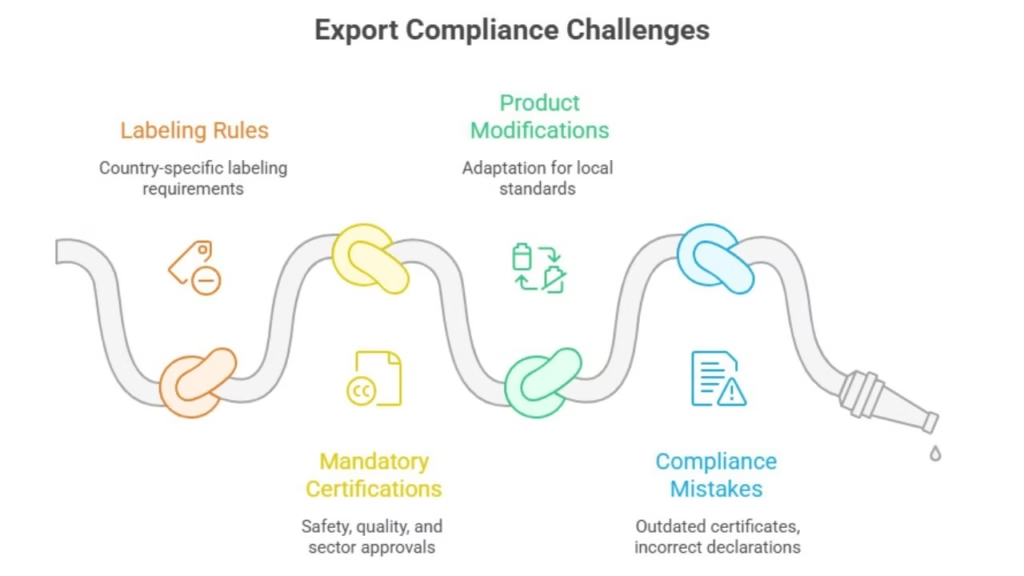
Country specific labeling and packaging rules
Export compliance requirements start with labeling, not customs.
Every country has its own rules around language, measurements, ingredient disclosure, warnings, and importer details. Miss one line and the shipment stalls.
Two examples:
- A food product clears quality checks but gets blocked because labels aren’t in the local language.
- A consumer product fails because packaging lacks mandatory importer contact information.
Labeling is not decorative. It is legal infrastructure.
Mandatory certifications and standards
Export certifications decide who can sell, not just how. These may include safety, quality, environmental, or sector specific approvals, often issued or recognized by authorities in the importing country.
Two examples:
- A product accepted in India requires additional certification abroad before customs clearance.
- A buyer refuses to even sample without proof of compliance certificates.
If certification timelines don’t align with your cash flow, the market is not viable.
Product modifications required for entry
Product adaptation for export is often unavoidable. Modifications may involve formulation changes, size adjustments, voltage standards, or packaging materials.
Two examples:
- An electrical product needs voltage and plug changes to meet local standards.
- A packaged good requires reformulation due to ingredient restrictions.
If adaptation costs exceed margin potential, the market should be dropped.
Compliance mistakes that block shipments
Most compliance failures are predictable and avoidable. Common mistakes include outdated certificates, mismatched HS codes, incorrect declarations, and missing documents.
Two examples:
- A shipment held because documents list different product descriptions.
- Goods rejected due to expired certification.
Customs doesn’t care about intent. It cares about paperwork.
Step 9: Consolidate Findings into an Export Market Entry Plan
Ranking markets based on feasibility and ROI
At this stage, you stop researching and start deciding. Rank markets using clear criteria entry cost, compliance burden, margin potential, demand stability, and payment terms.
Two examples:
- A smaller market with fast payments ranks higher than a larger market with long credit cycles.
- A moderate demand market with low compliance hurdles beats a high demand but high risk market.
Export market entry strategy is about return on effort, not just revenue size.
Why starting with 1–2 countries wins
Trying to enter multiple markets at once is how exporters lose focus and capital. Starting with one or two countries allows controlled learning, faster feedback, and operational stability.
Two examples:
- A focused exporter refines documentation and logistics before expanding.
- A scattered exporter repeats the same mistakes across markets.
Scale comes after stability, not before.
Deciding between direct export vs Intermediaries
Your entry mode should match your capability, not your ambition. Direct export offers control but demands compliance strength and buyer access. Intermediaries reduce complexity but cut margins.
Two examples:
- A new exporter uses agents to test demand without operational overload.
- An experienced exporter goes direct to protect margins and relationships.
There’s no superior model. There’s only fit.
When to outsource export market research
Outsourcing makes sense when time, expertise, or access is the limiting factor. Agencies can accelerate validation, but they don’t replace decision making.
Two examples:
- A firm outsources research to validate a high stakes market quickly.
- Another outsources blindly and follows bad advice without examining.
Outsource execution support, not strategic responsibility.
11. Key Export Market Research Tools and Resources
Below are export market research tools that actually matter. Not everything shiny. Only what helps decision making.
| Category | Tools / Resources | What They’re Useful For |
| Trade data platforms | UN Comtrade, TradeStats Express, Export Genius | HS code based import and export volumes, growth trends, supplier country analysis |
| Country information databases | World Bank, CIA Factbook, RVO Country Info | GDP, population, income levels, business climate, macro risk indicators |
| Government export portals | Trade.gov, Access2Markets, business.gov.uk | Export regulations by country, tariffs, documentation, market access rules |
| Trend analysis & Industry reports | Google Trends, Statista, Euromonitor | Demand trends, category growth, consumption behavior |
| India specific export research resources | APEDA, EPCH guidelines, Indian export promotion councils | Sector-specific reports, compliance guidance, market insights for Indian exporters |
Two blunt observations:
- Free export data sources are enough to shortlist markets. Paid tools are for depth, not direction.
- If you don’t understand HS code data, no tool will save you.
Export market research tools don’t replace thinking. They support it.

Common Export Market Research Mistakes to Avoid
Chasing “big markets” blindly
Big markets attract everyone. That’s the problem. Large import volumes usually come with intense competition, strict compliance, and thin margins.
Two examples:
- An exporter targets the US because it’s large, then drowns in certifications and legal costs.
- Another targets a mid sized market with less competition and builds traction faster.
Market size without accessibility is a trap.
Ignoring non tariff barriers
Export mistakes rarely come from duties alone. Non tariff barriers include inspections, certifications, labeling rules, quotas, and procedural delays.
Two examples:
- Zero duty market still blocks entry due to mandatory testing.
- A product clears customs but fails post clearance inspections.
International trade risks are procedural, not obvious.
Over relying on desk research
Desk research tells you what should happen. Reality decides what does happen. Reports don’t reveal buyer trust issues, payment behavior, or negotiation culture.
Two examples:
- Strong trade data hides the fact that buyers prefer long term suppliers only.
- Market looks open until agents reveal informal entry barriers.
If you don’t talk to people in the market, you don’t know the market.
Misreading demand signals
Import volume does not equal opportunity. High imports may signal value, not demand gaps.
Two examples:
- Rising imports hide price wars among suppliers.
- Flat imports hide stable, profitable niches.
Export research errors happen when data is read without context.
Final Thoughts: How Often Export Market Research Should Be Updated
Why export markets are not static
Export markets move whether you pay attention or not. Regulations change. Freight rates swing. Demand shifts. Political risk shows up uninvited.
The mistake exporters make is treating market research as a one time task instead of an ongoing discipline.
Two examples:
- A market that was profitable last year turns economically unworkable after new certification rules or duty changes.
- A slow market suddenly opens up because competitors exit or supply chains shift.
Export strategy planning only works if you accept that today’s assumptions expire.
Reassessment timelines
You don’t need constant research. You need scheduled reality checks.
A practical rule:
- Light review every 6–12 months for active markets
- Full reassessment before entering any new country or launching a new product
Two examples:
- An exporter reviews pricing and compliance annually to avoid margin erosion.
- Another skips reviews and gets blindsided by regulatory changes.
Long term export growth comes from discipline, not vigilance theater.
Scaling research as exports grow
As exports scale, research must scale too. What worked for one market won’t work for five.
Early stage exporters focus on feasibility and compliance. Mature exporters focus on optimization and risk management.
Two examples:
- A small exporter tracks demand and costs manually in one market.
- A growing exporter monitors currency risk, supplier concentration, and policy shifts across regions.
Export market research doesn’t end. It evolves.
Frequently Asked Questions (FAQ)
Q1. How long does export market research usually take?
Serious export market research takes weeks, not days. Initial screening can be done in 2–3 weeks. Proper validation, including compliance checks and buyer conversations, often takes 2–3 months.
Two realities:
Rushed research leads to wrong market entry.
Slow, unfocused research leads to no entry at all.
Speed matters, but accuracy matters more.
Q2. Can small exporters afford proper market research?
Yes, if they stay disciplined.
You don’t need expensive reports to start. Most early-stage exporters can rely on free trade data, government portals, and direct buyer conversations.
Two mistakes to avoid:
Spending nothing and guessing.
Spending too much before proving demand.
Good research is about focus, not budget.
Q3. Is it possible to export successfully without visiting the market?
Possible, yes. Advisable, no.
You can validate demand remotely, but on-ground insights expose risks desk research hides.
Two examples:
Remote research confirms demand, but market visits reveal payment and logistics issues.
Trade fairs expose real pricing and competition instantly.
If the market is strategic, visiting it pays for itself.
Q4. How many export markets should a beginner target at once?
One. Maybe two.
Targeting more markets doesn’t increase success. It increases errors.
Two outcomes:
One focused market builds systems and confidence.
Multiple markets drain cash and attention.
Exporting rewards concentration before expansion.
Q5. When should an exporter stop researching and start exporting?
When three things are clear:
Demand exists and is accessible
Compliance requirements are manageable
Pricing leaves real margin after all costs
Two red flags to pause:
Unclear regulations
Margins that only work “if everything goes right”
Export research ends when uncertainty drops to acceptable levels, not zero.
About the Author
Hi, I’m SriHarsha, founder of shxhub.in.
I focus on explaining import export business topics in a practical, beginner friendly way, based on how exports actually work on the real ground especially documentation, quality control, and buyer expectations.