
Navigating international trade payments can feel like a high stakes balancing act. How can an exporter ship goods across the globe without risking non-payment? On the other hand, how can a buyer be sure they will receive what they paid for?
This is where Cash Against Documents (CAD) comes in. It offers a secure middle ground that protects both parties involved in a transaction. For exporters, particularly those in markets like India building relationships with new overseas buyers, understanding this method is crucial.
This article will provide a detailed guide to the CAD payment method. We will break down exactly what it is, how the process works step by step, and explore its key benefits and drawbacks, so you can decide if it’s the right choice for your business.
Table of Contents
What is CAD (Cash Against Documents)?
At its core, Cash Against Documents (CAD) is a trade finance arrangement where a seller ensures they receive payment before a buyer can take delivery of the shipped goods. In this setup, critical shipping documents are held by a trusted intermediary, usually a bank, and are only released to the buyer once full payment has been made.
This direct link between payment and document release is what makes the system secure.
This method is also widely known as Documents Against Payment (D/P) at sight. By creating a clear, enforceable process, CAD plays a vital role in fostering trust and security in international trade, allowing businesses to expand into new markets with reduced financial risk.
How Does the CAD Payment Method Work?
Understanding the mechanics of Cash Against Documents (CAD) is essential for leveraging its benefits. The process follows a logical sequence designed to protect both parties, ensuring goods and payment are exchanged securely. Here is a breakdown of how a typical CAD transaction unfolds:
Agreement on Terms
The process begins long before goods are shipped. The buyer and seller must agree on the terms of the sale, specifically opting for Cash Against Documents as the payment method. This agreement should clearly outline which documents are required for the release of the goods, such as the bill of lading, commercial invoice, and insurance certificate.
Shipment and Document Submission
Once the agreement is in place, the seller ships the goods to the buyer. After the goods are in transit, the seller gathers all the required shipping documents. Instead of sending these directly to the buyer, the seller submits them to their own bank, known as the “remitting bank.“
Forwarding to the Collecting Bank
The remitting bank then forwards these critical documents to a bank in the buyer’s country, known as the “collecting bank.” The collecting bank’s role is to act as a neutral intermediary that holds the documents until the conditions of the sale are met.
Payment and Release
The collecting bank notifies the buyer that the documents have arrived. To take possession of the goods, the buyer must first pay the full amount due. Once the collecting bank receives the payment, they release the documents to the buyer. With these documents in hand, the buyer can now claim their goods from the carrier.
The Role of Banks: Intermediaries, Not Guarantors
It is important to understand the specific role banks play in a CAD transaction. While they act as trusted intermediaries that facilitate the exchange of documents for cash, they do not guarantee payment. Unlike a Letter of Credit, where the bank is obligated to pay if the buyer defaults, in a CAD arrangement, the banks simply act as agents.
Their responsibility is limited to handling the documents and collecting payment they do not assume financial risk if the buyer refuses to pay or accept the goods.
Key Documents Involved in CAD
The success of a Cash Against Documents (CAD) transaction relies almost entirely on the paperwork. Since the buyer cannot inspect the physical goods before paying, the documents act as the primary representation of the shipment.
If these papers are missing, incorrect, or mismatched, the entire process can grind to a halt, leading to expensive delays at customs or even payment refusal.
To ensure a smooth transaction, exporters must carefully prepare a specific set of documents. While requirements can vary based on the agreement, the following four documents are standard pillars of the CAD process:
1. Commercial Invoice
Think of the commercial invoice as the bill of sale for the transaction. It is more than just a request for payment it serves as the definitive statement of value for customs officials and the buyer.
This document must clearly detail the description of the goods, the quantity being shipped, the price per unit, and the total value. It should also explicitly state the agreed upon payment terms (in this case, CAD) and incoterms to avoid any confusion regarding liability.

2. Bill of Lading (B/L) or Transport Documents
The Bill of Lading is arguably the most critical document in international shipping. It serves a dual purpose it acts as a receipt from the carrier confirming they have received the cargo, and more importantly, it functions as a document of title.
Having the original Bill of Lading is often legally required to claim the goods at the destination port. In a CAD transaction, the bank holds this document securely until payment is made, effectively keeping control of the cargo out of the buyer’s hands until funds are transferred.
3. Packing List
While the commercial invoice focuses on financial details, the packing list focuses on logistics. It provides an itemized breakdown of exactly what is in each package, box, or pallet. This list is essential for customs officers who may need to inspect a specific part of the shipment without unpacking the entire container.
It also allows the buyer to verify that the physical inventory matches what they ordered before they release the payment to the bank.
4. Insurance Certificate
International shipping carries unavoidable risks, from rough seas to theft. The insurance certificate proves that the goods are covered against loss or damage during transit. In a CAD arrangement, this document assures the buyer that if the goods arrive damaged or don’t arrive at all there is financial recourse available. It essentially safeguards the value of the goods while they are in the phase of transit.
The Critical Importance of Accuracy
In the world of documentary collections, precision is not just a virtue it is a necessity. Banks dealing with CAD transactions operate under a principle of strict compliance. They examine documents on their face value and do not verify the actual condition of the goods.
If there is a discrepancy for example, a typo on the invoice that doesn’t match the Letter of Credit or the Bill of Lading the bank may refuse to process the documents. This can leave goods landed at the port, racking up demurrage charges while the seller works urgently to correct the paperwork.
Therefore, careful to detail when preparing these documents is the best insurance policy an exporter can have.
Pros and Cons of CAD
Every payment method in international trade comes with its own set of advantages and risks. Cash Against Documents (CAD) is often seen as a “middle ground” solution, but it’s essential to weigh the benefits against the potential downsides before committing to a contract. Here is a closer look at why businesses choose CAD and what challenges they might face.
The Advantages of Using CAD
For many exporters and importers, Cash Against Documents strikes the right balance between security and cost.
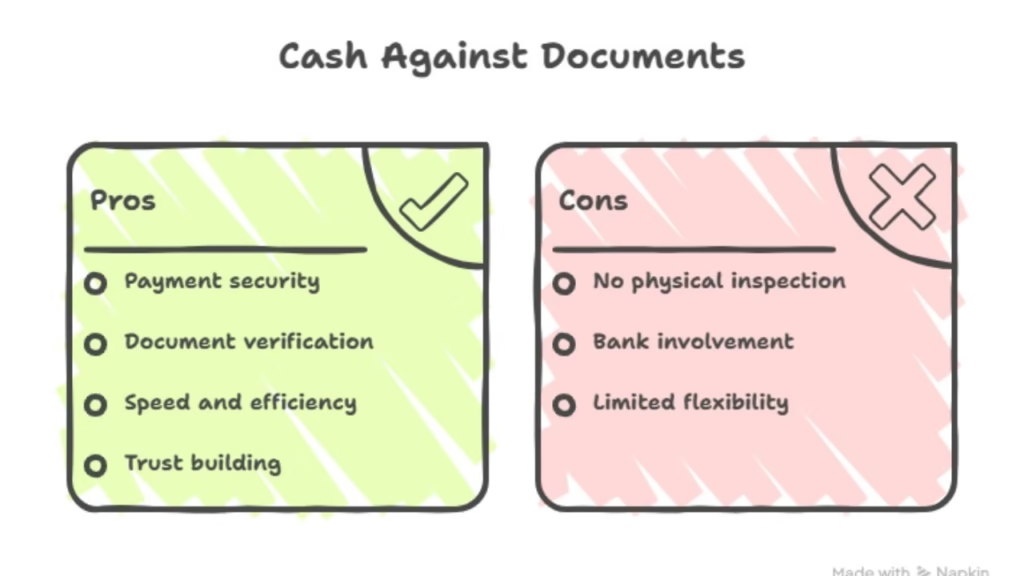
- Payment Security for Sellers: The most significant benefit for exporters is that the buyer cannot take delivery of the goods until they have paid. This mechanism significantly reduces the risk of non-payment compared to open account terms, where the buyer gets the goods first and pays later.
- Verification for Buyers: While buyers cannot physically inspect the goods before paying, they do get to examine the shipping documents. This ensures that the shipment details such as quantity and description match the order before any funds leave their account.
- Speed and Efficiency: CAD transactions are generally faster and less administrative than Letters of Credit (LC). Since there is no need for the buyer’s bank to issue a complex credit guarantee, the process moves more quickly, allowing for faster shipment and payment cycles.
- Building Commercial Trust: For new trading relationships where trust is still developing, Cash Against Documents is an excellent tool. It shows the buyer that the seller is willing to ship without upfront cash, while still protecting the seller’s interests. It avoids the high costs of an LC while offering more security than an open account.
The Disadvantages of Using CAD
Despite its benefits, CAD is not without its flaws. Understanding these limitations is crucial for managing expectations and risk.
- Refusal Risk: The biggest risk for sellers is that the buyer may simply refuse to pay and collect the documents. If this happens, the seller retains ownership of the goods but is left with the cargo stranded at a foreign port. The seller must then pay for return shipping or find a new buyer locally, often at a distressed price.
- Strict Documentation Requirements: As noted earlier, the process relies entirely on accurate paperwork. A single error even a minor typo on a Bill of Lading can cause the bank to withhold payment or the buyer to reject the documents, halting the entire transaction.
- Banking Fees: While cheaper than a Letter of Credit, CAD still involves bank fees for handling the documentary collection. These costs can add up and are often split between the buyer and seller, slightly reducing the profit margin on the deal.
- Limited Financial Flexibility: Unlike open account terms that might offer 30, 60, or 90 days to pay, Cash Against Documents is typically a “sight” payment method. This means the buyer must have the cash ready immediately upon the arrival of documents. There is little room for negotiating early payment discounts or credit extensions, which can strain the buyer’s cash flow.
Comparison of CAD with Other Payment Methods
Choosing the right payment method is about balancing risk and trust. While Cash Against Documents (CAD) is a popular choice, how does it compare with other common international trade finance options? Understanding the differences can help you select the best strategy for your specific business relationships.
CAD vs. Open Account
In an Open Account transaction, the seller ships the goods and sends the documents directly to the buyer, agreeing to receive payment at a later date (e.g., 30, 60, or 90 days).
- The Difference: This is the most favorable option for buyers but the riskiest for sellers. With Open Account, the seller loses control of the goods before receiving a penny.
- Why Choose CAD? CAD offers significantly more security for the exporter because the buyer cannot access the goods without paying first.
CAD vs. Cash in Advance
Cash in Advance is the exact opposite of an Open Account. Here, the buyer pays the seller before the goods are even shipped.
- The Difference: This provides maximum security for the seller but places all the risk on the buyer. Many buyers are hesitant to agree to these terms, fearing non shipment.
- Why Choose CAD? CAD is a compromise that shares the risk. It shows the buyer you are willing to ship the goods, making your offer more competitive than sellers demanding 100% upfront payment.
CAD vs. Documents Against Acceptance (DA)
Both Cash Against Documents and Documents Against Acceptance (DA) are forms of documentary collections, but the timing of the payment differs.
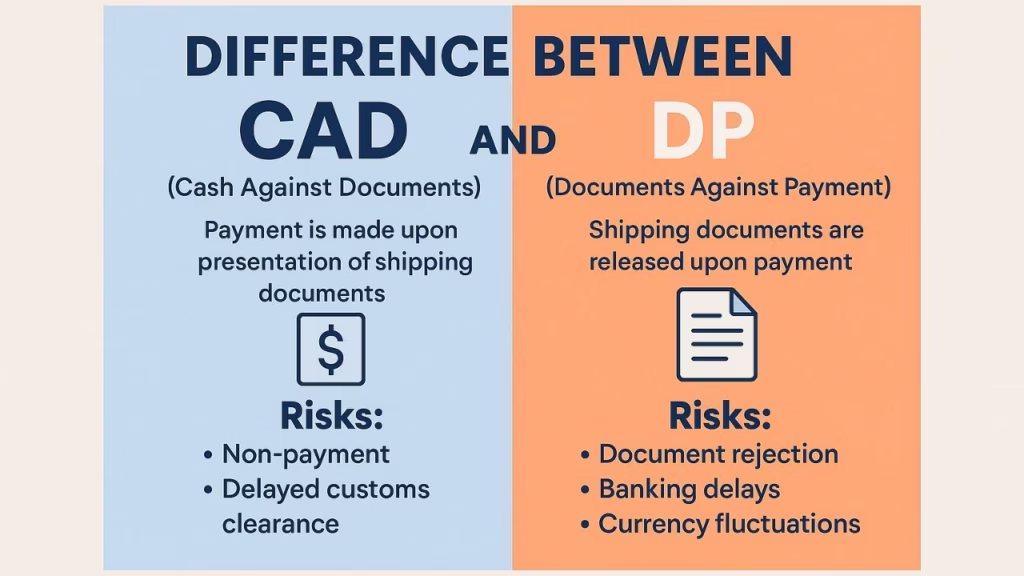
- The Difference: With CAD (also called Documents Against Payment or D/P), the buyer must pay immediately at sight to get the documents. With DA, the buyer accepts a time draft promising to pay at a future date (e.g., 60 days later) to receive the documents.
- Why Choose CAD? CAD ensures immediate cash flow. With DA, the seller effectively extends credit to the buyer, which carries the risk that the buyer might default after already taking delivery of the cargo.
CAD vs. Letters of Credit (LC)
A Letter of Credit (LC) is a formal guarantee from the buyer’s bank that they will pay the seller if all conditions are met.
- The Difference: An LC offers the highest level of security because the bank’s credit replaces the buyer’s credit. However, LCs are expensive, paper heavy, and complex to set up.
- Why Choose CAD? CAD is faster, cheaper, and administratively simpler than an LC. It is the preferred option when there is a moderate level of trust between parties, but not enough to justify the high fees of a Letter of Credit.
The Bottom Line: CAD sits comfortably in the middle of the trade finance spectrum. It avoids the extreme risks of Open Accounts and the high costs of Letters of Credit, making it an ideal “balanced” option for established partners or low risk transactions.
When to Use CAD
Determining the right payment method often depends on the relationship between the buyer and seller, as well as the nature of the goods being traded. While Cash Against Documents isn’t a one size fits all solution, it is particularly effective in specific trade scenarios where a balance of security and cost efficiency is required.

1. Initial Trade Deals and Moderate Trust
CAD is an excellent choice for exporters engaging with new foreign buyers for the first time. In these initial stages, trust hasn’t yet been fully established. The seller may not be comfortable shipping goods on an open account basis without a payment guarantee, and the buyer may be hesitant to pay cash in advance without proof of shipment.
CAD bridges this gap effectively, providing a secure mechanism that protects both parties without the high fees associated with a Letter of Credit.
2. Industries Relying on Document Control
Certain industries naturally align with the CAD process due to the critical nature of their shipping documentation.
- Commodities: In the trade of raw materials like grains, oil, or metals, the Bill of Lading represents ownership of large, valuable shipments. CAD ensures that this title of ownership is only transferred upon payment.
- Manufacturing and Retail: For manufacturers shipping finished goods, retaining control until payment is secured prevents potential losses from inventory that could otherwise be tied up in foreign markets without payment.
3. Relevance for Emerging Markets
For exporters in growing economies like India, CAD is a vital tool for expanding into international markets. It allows businesses to offer competitive terms to overseas buyers avoiding the friction of demanding 100% advance payment while still safeguarding their revenue.
By using CAD, exporters can mitigate the risk of non payment, which is crucial when dealing with cross-border transactions where legal recourse can be difficult and expensive.
Conclusion
Navigating the complexities of international trade requires tools that balance security with efficiency, and Cash Against Documents (CAD) serves as a powerful bridge in this landscape. By linking payment directly to the release of shipping documents, CAD offers a practical compromise that protects the interests of both exporters and importers.
It shields sellers from the risks of non payment while assuring buyers that their goods are en-route before funds are released. While it lacks the powerful guarantee of a Letter of Credit and the flexibility of an Open Account, its lower costs and streamlined process make it an ideal choice for many businesses.
For partners in moderate trust relationships or those looking to expand into new global markets without excessive financial exposure, CAD provides a solid foundation for growth. As you structure your next international deal, consider whether this balanced approach could be the key to unlocking smoother, more secure trade relationships.
Frequently Asked Questions (FAQ)
1. What is the main advantage of using CAD in international trade?
The primary advantage of Cash Against Documents (CAD) is that it provides a secure middle ground for both the buyer and the seller. The seller is assured of payment before the buyer can take possession of the goods, while the buyer is assured that the goods have been shipped before making a payment.
2. How does CAD differ from a Letter of Credit (LC)?
The main difference lies in the bank’s role. In a CAD transaction, banks act as intermediaries handling documents and payments but do not guarantee payment. With a Letter of Credit (LC), the buyer’s bank provides a formal guarantee of payment, making it more secure for the seller but also more expensive and complex than CAD.
3. What happens if the buyer refuses to pay?
This is the main risk for the seller in a CAD transaction. If the buyer refuses to pay and collect the documents, the seller retains ownership of the goods but is left with cargo stranded in a foreign port. The seller must then cover the costs to ship the goods back or find a new buyer.
4. Can CAD be used for all types of goods?
Yes, CAD can be used for nearly any type of physical good. It is particularly common in industries where clear title and control over the shipment are critical, such as commodities, manufacturing, and retail. The key is that the transaction involves physical shipping documents.
5. Is CAD the same as Documents Against Payment (D/P)?
Yes, Cash Against Documents (CAD) and Documents Against Payment (D/P) are terms that are often used interchangeably. Both refer to a transaction where the buyer must pay for the goods at “sight” (immediately upon presentation of the shipping documents) to gain control of them.
About the Author
Hi, I’m SriHarsha, founder of shxhub.in.
I focus on explaining import export business topics in a practical, beginner friendly way, based on how exports actually work on the real ground especially documentation, quality control, and buyer expectations.