
Imagine this You’ve poured your savings into an export business, followed every checklist, and shipped your first order. But instead of success, you’re met with silence no repeat orders, no serious buyers, just a slow bleed of resources. What went wrong? The answer often lies in the very first step Product Selection.
Knowing how to choose the right product for export isn’t just a decision it’s the foundation of your entire business. It’s not about what’s easy to source or what’s trending locally. It’s about understanding global demand, profitability, compliance, and scalability.
Get this step wrong, and no amount of effort can save you from the pitfalls of price wars, rejected shipments, or dead end inquiries.
This guide isn’t here to give you a recycled list of “top export products.” It’s here to help you think strategically, avoid common traps, and build a business that succeeds in competitive global markets. Ready to make your export journey a success? Let’s dive in.
Table of Contents
Why Product Selection Makes or Breaks an Export Business
Here’s the thing most people don’t want to admit export success isn’t decided by documentation, logistics, or even finding buyers. It’s decided much earlier. At the product selection stage. Get that wrong and everything else is just damage control.
Exporting is unforgiving. The market doesn’t care that you invested money, took a loan, or followed a YouTube checklist. If the product is wrong for the market, you bleed slowly through rejected samples, price negotiations, compliance failures, and dead inquiries.
Why most export failures start with the wrong product choice
Most export failures don’t look dramatic. They look like silence. Margins shrinking until the business quietly dies.
Two common examples:
- An exporter picks a product because it’s easy to source locally. Example generic cotton T shirts. The problem? The global market is flooded by Bangladesh and Vietnam at prices you can’t touch. Result endless inquiries, zero profitable orders.
- Someone exports spices because India is famous for them. But they choose bulk, low grade spices with no certifications. The US buyer asks for lab reports and traceability. They don’t have it. Deal dead.
The mistake isn’t execution. It’s choosing a product without checking if it deserves to be exported in the first place.
Difference between exporting what you have vs exporting what the market wants
This is where most beginners mess up, and I’ll be blunt exporting what you have is lazy thinking.
Exporting what you have looks like this:
- You already manufacture something, so you assume someone abroad will buy it.
- You look for buyers after deciding the product.
Exporting what the market wants looks like this:
- You study demand, pricing, and regulations first.
- You adjust the product, packaging, or even sourcing to fit that market.
Two clear contrasts:
- A rice mill exports generic non basmati rice because that’s what they produce. Competes on price, razor thin margins.
- Another exporter targets basmati rice for the Middle East, adjusts grain length and packaging, and sells at a premium.
Same country. Same industry. Completely different outcomes.
Indian exporters targeting global markets
This guide is not for people looking for “top 10 products to export” lists. Those lists are recycled nonsense.
This is for:
- First time exporters in India who don’t want to burn money on the wrong product.
- Existing traders who exported once or twice but never scaled.
- Manufacturers who think export is just domestic sales with shipping added.
If you’re serious about selling to markets like the US, Europe, UAE, or Southeast Asia, you need to think globally, not locally with a passport.
What “Right Export Product” Actually Means (Before You Start Research)
Let’s kill a myth early. The “right export product” is not the most exported product. It’s the product that survives demand checks, margin math, and regulatory inspection at the same time.
If even one of these collapses, the product is wrong. Period.
Demand, profitability, compliance, and scalability explained plainly
Four pillars.
- Demand: Are buyers actively importing this product, not just searching it on Google?
- Example 1: Organic spices with consistent US import data.
- Example 2: Pharmaceutical intermediates with repeat bulk orders in Europe.
- Profitability: Can you make money after freight, duties, certifications, and delays?
- Example 1: Leather accessories with high value to weight ratio.
- Example 2: Engineering components where customization allows better margins.
- Compliance: Can you legally sell it in the target country?
- Example 1: Food products without FSSAI or FDA compliance are dead on arrival.
- Example 2: Cosmetics without ingredient disclosures won’t clear EU customs.
- Scalability: Can you repeat and grow orders without collapsing?
- Example 1: A spice exporter who depends on one seasonal supplier.
- Example 2: A garment exporter who can’t maintain consistent sizing or fabric quality.
A product that looks good on paper but fails one of these is not export ready.
Why high demand alone is a trap
High demand attracts beginners. It also attracts heavy competition.
Two classic traps:
- Mobile accessories. Massive global demand, but China owns the supply chain and pricing. You compete on scraps.
- Basic garments. Always in demand, but margins are crushed unless you specialize or brand.
High demand without differentiation means:
- Price wars
- Zero buyer loyalty
- Constant pressure to cut costs
Demand is necessary. It’s not sufficient.
Export mindset shift product market country fit
This is the mental upgrade most exporters never make.
You’re not exporting a product.
You’re exporting a product to a specific market in a specific country under specific rules.
Two examples:
- Spices work in the Middle East with bulk packaging and strong aroma profiles. The same product fails in the EU without residue testing and labeling.
- Millet snacks sell in the US as health foods with clean branding. Sell them as cheap namkeen and you’re ignored.
What this really means is simple:
The same product can be a winner in one country and a disaster in another. Once you understand this, your product selection stops being random and starts being strategic.

Step 1: Identify Global Demand Using Export Data (Not Gut Feeling)
If you’re choosing an export product based on instinct, local success, or “this should sell abroad,” stop. That’s not strategy. That’s gambling with better vocabulary.
Export demand is already visible. You don’t need predictions. You need to read what countries are already buying and paying for.
Where to Find Reliable Export Demand Data
You don’t need ten tools. You need three, and you need to use them correctly.
UN Comtrade
This shows what countries import, from whom, in what quantity, and over time. It’s raw and boring. That’s why it’s reliable.
Example 1: If the US has imported increasing volumes of Indian spices for five straight years, that’s demand.
Example 2: If exports spike one year and crash the next, that’s not demand. That’s noise.
ITC Trade Map
This is UN Comtrade with a brain. Cleaner visuals, easier comparisons, and growth rates built in.
Example 1: You can see which countries are increasing imports faster than others.
Example 2: You can compare India’s position against competitors like Vietnam or China.
Niryat Portal (India specific)
This tells you what India is actually exporting successfully.
Example 1: Identifying products where India already has supply strength.
Example 2: Spotting sectors where exports are growing, not stagnating.
If a product doesn’t show up meaningfully on at least one of these, it’s not “undiscovered.” It’s probably unwanted.
How to Read Export Data Without Overcomplicating It
Most people either drown in data or misuse it. Both are self created wounds.
What numbers actually matter
- Export volume: Are buyers ordering repeatedly or just testing?
- Growth trend: Is demand stable or shrinking?
- Destination countries: Who is actually buying and paying?
Two examples:
- A product with moderate volume but steady 5–8% annual growth is safer than a product with huge volume and random swings.
- A product exporting mostly to one country is risky compared to one spread across multiple markets.
Ignore your own metrics. Focus on consistency.
Spotting stable vs hype driven demand
Stable demand looks boring.
- Flat or gently rising import graphs
- Same buyer countries year after year
Hype driven demand looks exciting and then collapses.
- Sudden spikes with no history and reasons
- Driven by trends, shortages, or temporary regulations
Example 1: Pharmaceuticals with long term contracts show stability.
Example 2: Trend based food products explode on paper and vanish in two years.
If the graph makes you excited, be suspicious.
Step 2: Shortlist Target Markets Before Finalizing the Product
Choosing a product without choosing a market is like building a house without knowing the land. Same product behaves differently in different countries.
High Potential Export Markets for Indian Exporters
These markets aren’t “best.” They’re demanding, which is why they’re profitable.
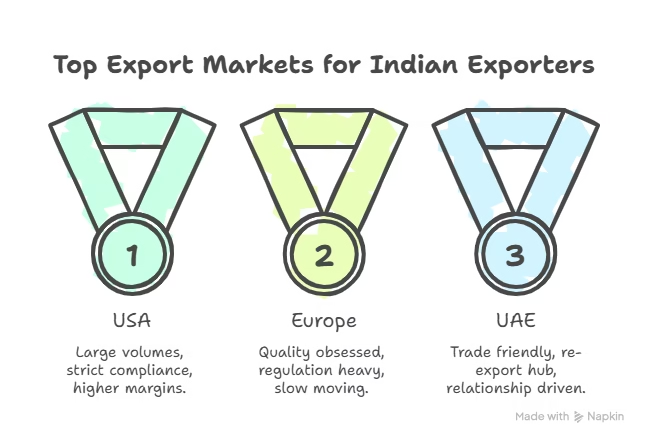
USA
Large volumes, strict compliance, higher margins if you get it right.
Example 1: Processed foods with proper certifications sell at premium prices.
Example 2: Non compliant shipments get rejected without mercy.
Europe
Quality obsessed, regulation heavy, and slow moving.
Example 1: Organic and sustainable products perform well.
Example 2: Poor labeling or documentation kills deals early.
UAE
Trade friendly, re-export hub, relationship driven.
Example 1: Food, textiles, and construction materials move fast.
Example 2: Price sensitivity is lower than India, higher than Europe.
Southeast Asia
Growing consumption, easier entry, but competitive.
Example 1: Engineering goods and pharma do well.
Example 2: Margins depend heavily on logistics efficiency.
Each market rewards different strengths. Pick the market first. Then finalize the product.
Matching Products to Market Specific Needs
This is where exporters either adapt or disappear.
Region based demand patterns
- Middle East favors bulk food items and strong flavors.
- US and EU prefer packaged, branded, compliant products.
Cultural, legal, and consumption differences
- Ingredients acceptable in India may be restricted in Europe.
- Packaging sizes that sell in India may be rejected abroad.
Examples:
- Spices exported loose to Gulf countries but packaged and tested for the EU.
- Snacks positioned as health foods in the US instead of cheap FMCG.
Same product. Different execution. Massive difference in results.
Risk Factors That Kill Export Products Quietly
Export businesses don’t usually fail loudly. They bleed out.
Political and regulatory risks
- Sudden import bans
- Policy changes
- Sanctions or trade restrictions
Example 1: A product heavily dependent on one country collapses when rules change.
Legal barriers and local standards
- Certifications
- Labeling laws
- Testing requirements
Example 1: Food shipments stuck at ports due to missing documentation.
Example 2: Products recalled due to non compliant materials.
Cultural mismatches
- Wrong branding
- Poor messaging
- Ignoring consumer behavior
Example 1: Selling price focused products in quality driven markets.
Example 2: Using Indian consumption logic in Western retail environments.
These risks don’t show up in Google searches. They show up in your losses.
Step 3: Check If You Can Supply Consistently at Scale
This is where most “export ready” products get exposed. A buyer doesn’t care if you can ship once. They care if you can ship again. And again. And again, without excuses.
If your supply collapses after the first order, you don’t have an export business. You have a lucky transaction.
Production Capacity Reality Check
Why one time orders don’t matter
One time orders are buyer tests, not success stories.
Two common scenarios:
- A US buyer places a small trial order. You stretch resources, borrow stock, somehow deliver. Next month they ask for double the quantity. You can’t. Relationship over.
- A UAE trader orders once for market testing. You celebrate. There’s no follow up because you can’t guarantee timelines or volumes.
Export buyers think in systems, not emotions. If you can’t scale, they move on fast.
Consistency as a competitive advantage
Consistency beats talent in exports.
Examples:
- A spice exporter with average quality but reliable monthly shipments wins over a better quality supplier who misses deadlines.
- A garment exporter who delivers the same fabric, color, and sizing every time gets repeat orders even at slightly higher prices.
In exports, reliability is a product feature.
Supply Chain Stability and Lead Times
Your product is only as strong as the weakest supplier behind it.
Raw material availability
One brutal question: can you source this raw material year round at predictable prices?

Examples:
- Agro products tied to harvest cycles create supply gaps if not planned.
- Imported raw materials expose you to currency swings and shipping delays.
If supply is seasonal, your export planning must be seasonal too. Pretending otherwise is how exporters fail.
Vendor dependence risks
Relying on one supplier is not efficiency. It’s fragility.
Examples:
- One dye supplier raises prices suddenly. Your margins vanish.
- One job worker shuts down during peak season. Your shipment misses the deadline.
Exporters who scale always have backup vendors. No exceptions.
Seasonal supply issues
Seasonality isn’t a problem if you price and plan for it. It’s deadly if you ignore it.
Examples:
- Food exporters without cold storage lose consistency.
- Textile exporters dependent on seasonal workforce during festival periods often miss lead times.
Buyers hate surprises. Seasonal excuses don’t travel well across borders.
Step 4: Evaluate Export Profitability (Not Just Margins on Paper)
This is where hopefulness kills exporters. If your profit exists only in Excel, it’s not profit.
High Value, Low Volume vs Low Value, High Volume Products
This choice defines your entire export model.
High value, low volume
- Spices with certifications
- Leather accessories
- Organic chemicals
Examples:
- Shipping 1 ton of high grade spice makes more sense than 10 tons of commodity grain.
- Leather wallets generate better margins than bulk leather sheets.
Lower freight stress. Better margins. Higher buyer expectations.
Low value, high volume
- Basic Agro commodities
- Undifferentiated textiles
Examples:
- Small price changes wipe out profits.
- Freight increases turn profits into losses overnight.
These products require scale, efficiency, and deep pockets. Most beginners underestimate that.
Real Cost Components Exporters Ignore
This is where “profitable” products quietly turn negative.
Logistics and freight
Freight is not fixed. It fluctuates violently.
Examples:
- Ocean freight doubles. Your margin disappears.
- Port delays increase storage costs you didn’t budget.
If freight scares you, your product choice is wrong.
Certifications and compliance costs
Compliance isn’t optional. It’s a gatekeeper.
Examples:
- FSSAI, lab testing, and shelf life studies for food products.
- Product testing and documentation for regulated markets.
Skipping compliance doesn’t save money. It delays losses.
Packaging and labeling
Global buyers don’t accept jugaad.
Examples:
- Incorrect labels lead to customs issues.
- Poor packaging increases damage and returns.
Packaging is part of the product. Treat it that way.
Role of Government Export Incentives
Incentives are support systems, not business models.
Duty drawback and DGFT schemes
These improve cash flow. They don’t rescue bad products.
Examples:
- A decent margin product becomes more attractive with duty drawback.
- A low margin product remains weak even after incentives.
Exim Bank support
Useful for credit, market studies, and expansion. Not a substitute for demand.
Examples:
- Financing helps scale a proven product.
- Loans don’t fix weak pricing or poor demand.
Why incentives should support, not justify, a weak product
If your product works only because of incentives, it doesn’t work.
Two truths:
- Policies change.
- Incentives disappear.
Build an export product that survives without subsidies. Then use incentives to grow faster, not to stay alive.
Step 5: Analyze Competition and Define Your USP
If you can’t explain why a buyer should choose you over 20 other exporters, you don’t have a business. You have a listing.
Competition analysis isn’t about fear. It’s about realism.
How Crowded Is the Export Market for Your Product?
Every product has competition. The question is whether you’re entering a fight you can actually win.
Competing countries and pricing pressure
Look at who already dominates the market.
Examples:
- In garments, Bangladesh and Vietnam win on cost and scale. Competing purely on price is suicide.
- In electronics accessories, China controls manufacturing, logistics, and speed. You’re not undercutting them.
If the top exporters have structural advantages you can’t match, price competition will crush you.
Commodity vs differentiated products
Commodity products live and die by price.
Differentiated products live by perception and value.
Examples:
- Bulk spices without branding or certification are commodities. Buyers switch suppliers instantly.
- Certified organic spices with traceability create switching costs.
If your product description sounds like everyone else’s, you’re a commodity. Accept that or change the product.
Building a Defensible USP
USP(Unique Selling Point) is not a slogan. It’s the reason buyers stay. You don’t need all of these. You need at least one that’s real.
Quality
Quality only works if it’s measurable.
Examples:
- Consistent mesh size and moisture levels in spices.
- Uniform stitching and fabric GSM in garments.
“Good quality” means nothing without proof.
Pricing
Cheap is not a USP unless you own the cost structure.
Examples:
- Long term supplier contracts that lock raw material costs.
- Process efficiencies that competitors can’t replicate easily.
If your pricing advantage disappears after one freight hike, it’s not a USP.
Certifications
Certifications create barriers.
Examples:
- Organic, FDA, or EU compliant food certifications.
- Pharma or engineering standards that limit who can supply.
These reduce competition more effectively than marketing ever will.
Niche positioning
Niches protect margins.
Examples:
- Technical textiles instead of generic fabrics.
- Millet based health foods instead of mass market snacks.
Smaller market. Better buyers. Higher control.
Step 6: Check Compliance, Restrictions, and Trade Barriers
This step is boring. It’s also where careless exporters lose money. Compliance doesn’t care about intent. It only cares about rules.
Product Specific Export Restrictions and Bans
Every country protects its consumers and industries. Your product must fit inside those boundaries.
Country level import rules
Rules change by country, not product alone.
Examples:
- Certain food additives allowed in India are banned in Europe.
- Packaging materials accepted in Asia may be restricted in the US.
Assuming “it worked elsewhere” is how shipments get stuck.
Product adaptability across borders
- Ask whether your product can be modified easily.
Examples:
- Changing labels, ingredients, or packaging size for different markets.
- Adjusting formulations to meet local standards.
Products that require zero adaptation rarely scale globally.
Mandatory Certifications and Standards
Certifications are not paperwork. They are filters.
Food, pharma, engineering goods examples
Examples:
- Food exports require FSSAI, lab testing, shelf life studies, and often FDA or EU approvals.
- Pharma and chemical products face strict documentation, testing, and traceability.
- Engineering goods may need product specific standards or compliance certificates.
Each category has its own gatekeepers. Ignore them and you don’t enter the market.
Cost and timeline implications
Compliance costs money and time. Plan for both.
Examples:
- Certification timelines can delay market entry by months.
- Testing and audits increase upfront costs before the first sale.
If your product can’t absorb these costs, it’s not export-ready.
At this stage, weak products usually reveal themselves. That’s good. Killing bad ideas early saves capital.
Step 7: Validate Your Choice Against Proven Export Categories
This step exists to answer one blunt question:
Is your product aligned with what India already exports successfully, or are you trying to swim against the current?

Before locking anything, compare your idea with the major export products of India. This doesn’t mean copying blindly. It means understanding where India already has global credibility.
Popular Export Products from India (2026 Outlook)
When people search for what India exports the most or export items from India, these categories dominate the data year after year.
Textiles
Textiles remain one of the major export products of India, but competition is intense.
Examples:
- Generic fabrics struggle on price against Bangladesh and Vietnam.
- Home textiles, technical fabrics, and value added products perform far better.
Basmati rice
A flagship product in agricultural exports from India.
Examples:
- Premium basmati rice commands strong demand in the Middle East and Europe.
- Non branded or low grade rice competes purely on price.
Spices
A core answer to what India exports the most in agriculture.
Examples:
- Whole spices and certified blends attract repeat buyers.
- Bulk, uncertified spices fall into commodity traps.
Pharmaceuticals
High compliance, high trust.
Examples:
- Finished formulations and intermediates with long term contracts.
- Zero tolerance for documentation or quality gaps.
Leather
Value added leather goods outperform raw materials.
Examples:
- Footwear, bags, and accessories sell better than hides.
- Design consistency matters more than volume.
Engineering goods
Often overlooked, but extremely strong.
Examples:
- Auto components and industrial parts with repeat demand.
- Customization creates buyer lock in.
These categories collectively form most list of products exported from India articles for a reason. If your product doesn’t fit into at least one of these or a sub niche within them, you need a very strong justification.
High Margin Niches Most Exporters Miss
This is where smart exporters separate themselves from people chasing the top 10 products export from India lists blindly.
Technical textiles
A high margin extension of the textile sector.
Examples:
- Medical, industrial, and protective textiles.
- Less competition, higher compliance barriers.
Processed foods
A fast growing segment within agricultural exports from India.
Examples:
- Pickles, ready to eat foods, sauces.
- Better margins than raw agricultural items.
Organic and millet based products
A premium slice of the top 10 agricultural products exported from India trend.
Examples:
- Millet snacks positioned as health foods in the US.
- Organic grains and flours for EU markets.
These niches don’t always show up in generic export items from India articles, but here, margins survive.
Step 8: Use the Right Tools Before Locking the Product
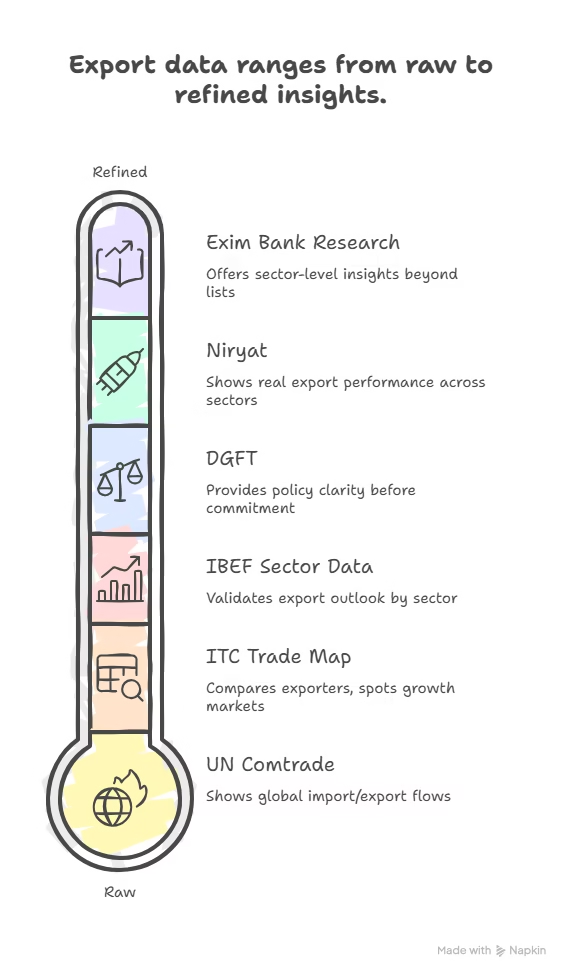
At this stage, you’re not exploring ideas. You’re validating decisions. These tools help confirm whether your product truly belongs among the major export products of India or is just a hopeful assumption.
Government and Institutional Resources
These platforms show what’s actually happening.
Niryat
Shows real export performance across sectors.
Examples:
- Identifying fast growing export items from India.
- Tracking trends in agricultural exports from India.
DGFT
Policy clarity before commitment.
Examples:
- Checking restrictions on agricultural items list categories.
- Confirming eligibility for incentives.
Exim Bank research papers
Depth over hype.
Examples:
- Sector level insights beyond “top 10 products export from India” lists.
- Market risk analysis by country.
IBEF sector data
Macro validation.
Examples:
- Understanding which products dominate what India exports the most.
- Long term export outlook by sector.
Global Trade Intelligence Platforms
These tell you whether global buyers agree with Indian export data.
UN Comtrade
Raw global import and export flows.
Examples:
- Verifying demand for major export products of India.
- Identifying top importing countries.
ITC Trade Map
Cleaner, comparative insights.
Examples:
- Comparing India with competing exporters.
- Spotting growth markets beyond obvious choices.
How to cross verify demand signals
Never trust one source.
Two checks that matter:
- If a product appears in the top 10 agricultural products exported from India, confirm sustained imports on UN Comtrade.
- If Niryat shows growth, confirm buyer side demand on ITC.
When Indian data and global import data agree, you’re not guessing anymore.
Common Mistakes Exporters Make While Choosing Products
One of the biggest mistakes is chasing keywords instead of logic.
Copying “top export products” lists blindly
Lists like top 10 products export from India attract beginners and destroy margins.
Examples:
- Everyone rushes into the same agricultural items list categories.
- Late entrants compete on price and lose.
These lists explain what India exports the most, not what you should export.
Ignoring compliance until the order arrives
This is how first shipments die.
Examples:
- A buyer places an order, then asks for certifications you never checked. Shipment delayed. Trust lost.
- Goods reach the port and get held because labeling doesn’t meet local laws.
Compliance checked late is compliance ignored.
Overestimating margins and underestimating logistics
Paper profits are comforting. Real costs are cruel.
Examples:
- Freight rates jump and wipe out expected margins.
- Port delays add storage and demurrage costs you never budgeted.
If your product can’t survive bad logistics weeks, it’s not export worthy.
Final Product Selection Checklist (Before You Export Anything)
This is not motivational. It’s a filter. If you can’t say yes to all of these, stop.
Demand validated
- Export data confirms real, repeat demand.
- Buyers exist beyond one country.
Market selected
- Target country chosen first, not last.
- Product adjusted for that market’s rules and preferences.
Supply confirmed
- Capacity exists beyond trial orders.
- Backup vendors identified.
Profitability calculated
- All costs included freight, compliance, packaging, delays.
- Margins survive worst case scenarios.
Compliance checked
- Certifications identified and achievable.
- Timelines and costs accounted for.
USP defined
- Clear reason buyers choose you over others.
- USP survives price pressure and competition.
If any box stays unchecked, you don’t need more motivation. You need a different product.
That’s how you choose an export product without guessing, hoping, or copying.
FAQs
1. Can I export a product that sells well in India?
Yes, but that alone means almost nothing.
Example one: a snack that flies off shelves in India fails in the US because of different taste preferences and labeling laws.
Example two: a construction material popular locally gets rejected abroad due to missing standards.
Local success is a starting signal, not validation. Export demand must be proven separately.
2. How do I know if there is real demand for my export product?
Real demand shows up in trade data, not opinions.
Example one: consistent import volumes across multiple years on UN Comtrade.
Example two: the same product appearing across several destination countries on ITC Trade Map.
If demand spikes once and disappears, it’s noise, not opportunity.
3. Is it better to export high demand or high-margin products?
High margin beats high demand for most exporters.
Example one: certified spices with lower volumes but strong margins.
Example two: leather accessories that cost little to ship but sell at premium prices.
High-demand products without differentiation usually turn into price wars.
4. When should I check compliance and certifications?
Before you talk to buyers, not after.
Example one: food exports that fail because FSSAI or FDA requirements were ignored.
Example two: engineering goods stuck at ports due to missing documentation.
Compliance checked late is money lost early.
5. Are government export incentives enough to make a product profitable?
No. Incentives support good products; they don’t rescue bad ones.
Example one: a solid-margin product becomes more competitive with duty drawback.
Example two: a weak product stays weak even with subsidies.
If your product works only because of incentives, it doesn’t work.
About the Author
Hi, I’m Sriharsha, founder of shxhub.in.
I focus on explaining import export business topics in a practical, beginner friendly way, based on how exports actually work on the real ground especially documentation, quality control, and buyer expectations.